Don't worry! The contents here will appear on the published page.
Accounting Software Implementation: The CFO’s Cutover Playbook

Woosung Chun
CFO
Woosung Chun
CFO
Woosung Chun is the CFO of DualEntry with experience in corporate finance, accounting, strategy, and acquisitions. He previously grew from scratch and led the M&A and Finance teams at Benitago, where he completed more than 12 acquisitions in 2 years. He graduated with a BS from NYU Stern. At DualEntry, Woosung writes about AI in accounting, revenue recognition, foreign currency accounting, hedge accounting, and ERP modernization for finance teams navigating complex, multi-entity environments.
Learn about our editorial policies.
Last updated
October 16, 2026
Reviewed by
Do San (Justin) Myung

Do San (Justin) Myung
Expert Accountant & Former Consulting CFO
Justin (Do San Myung) is Expert Accountant at DualEntry with 20+ years of hands-on experience managing general ledgers, financial close processes, and ERP implementations for mid-market and enterprise companies. As a former Consulting CFO and Controller, he has personally overseen month-end closes, SOX compliance programs, and multi-entity consolidations across technology, manufacturing, and services industries. Justin specializes in transforming manual accounting workflows into automated, AI-driven processes.
Learn about our editorial policies.
Summarize this article

TL;DR
Implementations fail on unowned decisions, not software: Migration depth, data-cleanup ownership, parallel-run exit criteria, and cutover timing all need a named owner before configuration starts.
Complexity sets the timeline, not company size: Plan for 4–8 weeks for a single entity on a standard chart of accounts, 3–5 months once integrations and ASC 606 configuration are involved, and 6–9 months for multi-entity consolidation and FX.
Budget 1–2x first-year license cost all-in: That covers partner fees, internal finance hours, and integrations. Under ASU 2018-15, application-development-stage costs can be capitalized, but training and most data conversion stay in the P&L – and ASU 2025-06 replaces the stage test for annual periods beginning after 15 December 2027.
Fix the chart of accounts, then migrate only the history you need: Dimensionalize before you move anything. The default is the opening trial balance plus two years of monthly trial balances, with open AR/AP at transaction level – and AR, AP, and fixed assets must tie to their control accounts to the cent on day one.
Give the parallel run an exit rule: Cut over at a month boundary after UAT passes on your own transactions, and end the parallel run once two consecutive closes reconcile within a pre-agreed variance threshold. A conversion is an ICFR event, so keep tie-out workpapers, an access and segregation-of-duties matrix, and ITGC evidence ready for auditors.
AI-native systems turn history into an asset: Migrated GL data trains transaction coding from day one, which makes full-history migration worth it. DualEntry migrates data in 24 hours, charges $0 in implementation fees, and averages a 4–6 week go-live across its customer base.
Nobody loses an implementation on the demo. They lose it in week six, when the controller asks who signed off on how much history is coming across, and nobody in the room knows.
That's what usually sits behind a failed accounting software implementation. Not bad software. Decisions nobody owned: migration depth, data cleanup, parallel-run exit criteria, cutover timing. Each one gets deferred until it turns into a delay.
So this is the playbook version. How long it takes, what it costs, how much history to bring across, when to cut over, and what your auditors will want to see.
[tldr]
What is accounting software implementation?
.avif)
Accounting software implementation is everything that happens between signing the contract and trusting the new system's first close. It covers chart-of-accounts design, configuration, data migration, testing, training, and cutover. It's different to setup, which is just installing the software and connecting bank feeds – the easy 10% of the job. Choosing the ERP system comes first.
So, why does this deserve a playbook? Because large IT projects run 45% over budget and deliver 56% less value than predicted (McKinsey/Oxford, 2012). [1] That study covered projects budgeted above $15 million, so read it as a direction of travel rather than a benchmark for your own: in Panorama’s 2026 ERP data, closer to a quarter of projects run over budget at all. [2] Behind those numbers you'll usually find decisions nobody owned, rather than bad software.
Every section below resolves one decision with a table: how long, how much, how much history, when to cut over, and what your auditors will ask.
How long it takes: timeline by complexity
Accounting software implementation takes 4-8 weeks (single-entity SMB) to 6-9 months (multi-entity mid-market). Plan for 4-8 weeks if you're a single entity leaving QuickBooks, 3-5 months once integrations and ASC 606 revenue recognition configuration enter the picture, and 6-9 months if multi-entity consolidation and FX are involved.
Implementation timeline by complexity tier
A common misconception is that company size gates each tier, but in reality it comes down to entity count, the amount of system integration work, revenue recognition complexity, and the state of your data. A 20-person company with messy customer records can take longer than a 200-person company with clean ones.
The phases also overlap more than you’d expect. For example: data cleanup should start in week one, alongside configuration. If you wait for a configured system before looking at your data, you've already pushed the go-live date.
And when timelines slip, it's rarely the vendor’s fault. Panorama's 2026 ERP report names organizational issues – governance, resistance to change, process redesign – as the most common reason projects run over schedule, with approvals and cross-functional sign-off trailing behind technical execution. [2] Data cleanup that nobody owns belongs on that list too, in our experience. Setting clear accountability from the start can save you a lot of time and pain later. For scale, the same report puts the median ERP project at nine months among organizations with median revenue around $200 million – so the 6-9 months in Tier 3 above is not a pessimistic number.
What implementation really costs
A good rule of thumb: budget 1-2x your first-year license cost, all-in, for a Tier 1-2 accounting software implementation. That covers implementation partner fees, internal finance hours, and integration work. A $30,000 annual license means a realistic all-in budget of $30,000 to $60,000.
Implementation cost matrix by company stage*
* Ranges are based on implementations we run and current partner rate cards.
Of the four cost lines above, internal hours are the one most teams forget to factor in. But they’re critical: at the low end, 300 hours at a Tier 2 company means a controller working half-time on the project for four months. At 600, it is closer to full-time.
Then there are the hidden costs, like historical data transformation, parallel-run double effort, and backfilled reporting.
One piece of good news for the budget conversation: ASU 2018-15 (ASC 350-40) lets you capitalize implementation costs in a cloud hosting arrangement – but only those incurred in the application development stage. Preliminary-stage work, training, and most data conversion stay in the P&L, and whatever you do capitalize is amortized over the hosting term, in the same income statement line as the subscription fee. [3][4] See the FASB update and KPMG's guidance for the details. One forward look: ASU 2025-06 replaces that stage test for annual periods beginning after 15 December 2027, with early adoption permitted – capitalization will then start when management commits funding and completion is probable. [5] Training and most data conversion stay in the P&L either way.
McKinsey put the average overrun for large IT projects at 45%, [1] and Panorama's 2026 report finds more than a quarter of ERP projects still running over budget – most often because of technology nobody had budgeted for. [2] So it’s worth taking the ranges outlined in the table above seriously. Our ERP implementation cost calculator prices your own scope.
Fixing the chart of accounts before you migrate
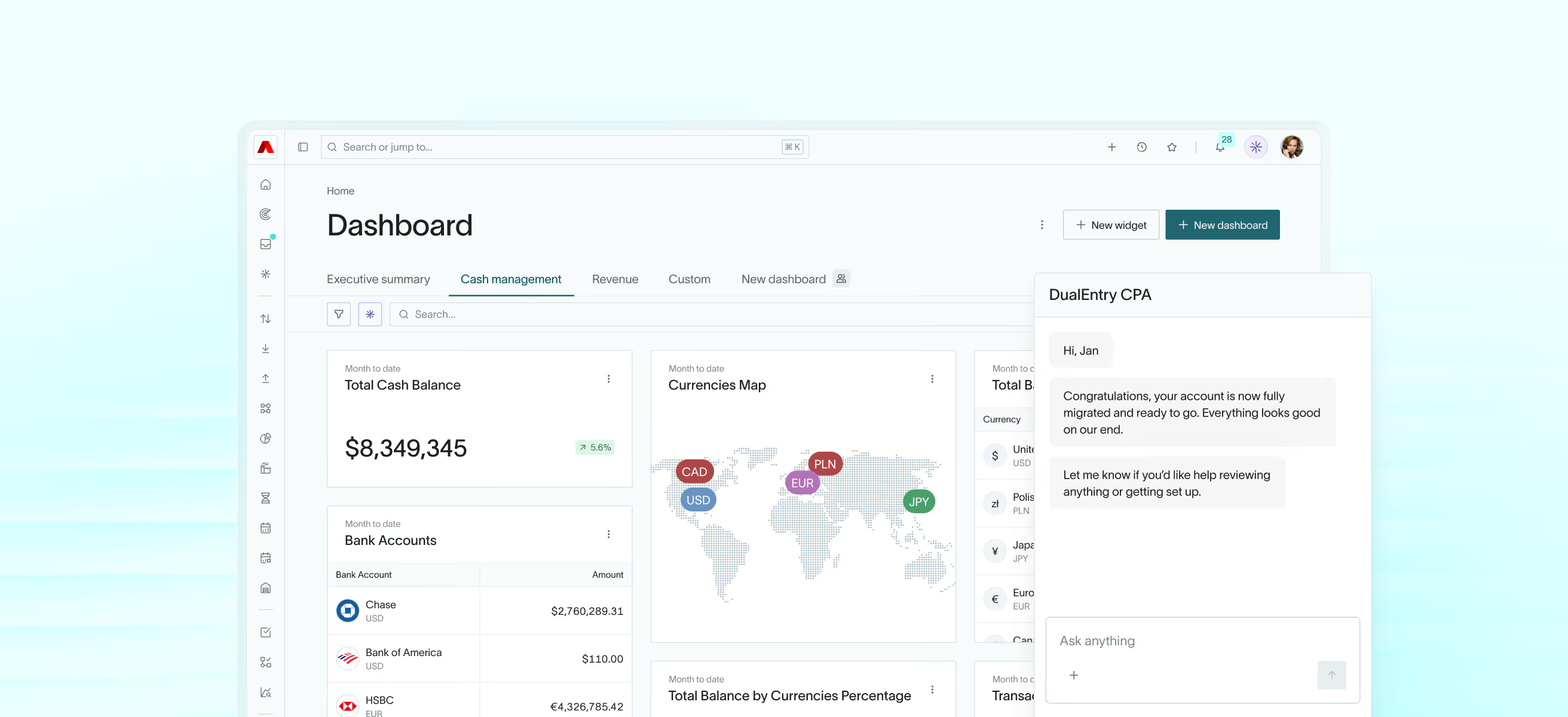
Chart of accounts design determines post-implementation reporting quality, which makes it one of the highest-leverage decisions in the entire project. Migrate a broken COA into new software and you'll get your old reporting back in a prettier UI.
The fix is dimensional: fewer natural accounts, more dimensions (entity, department, product, customer…) and letting the software do the slicing. In the migrations we run, a flat 300-account COA built for QuickBooks typically collapses into around 80 accounts with 4 dimensions. Every report that once needed a new account now just needs a filter.
Getting there requires a rationalization pass. Go account by account and make one of three calls: merge it, kill it, or turn it into a dimension. Be ruthless with accounts that only exist because a report once needed them.
Then, map every old account to its new home before migration starts. Keep hold of the mapping document, because your auditors will ask for it later.
You’ll see the chart of accounts and its financial dimensions described as "90% of implementation success". Which is a strong claim – but nobody who repeats it shows the method behind it. It’s simply the three steps above: dimensionalize, rationalize, and map.
Data migration: how much history should you bring over?
Default to migrating the opening trial balance plus two years of monthly trial balances. Bring transaction-level detail only for open AR and AP items. Migrating your full ledger history is worth it in just two cases: if it’s an audit or diligence requirement, or if you’re using an AI-native system that can train on it.
GL history migration: decision table
The mechanics run through the opening balance journal – the single entry that loads your opening balances into the new general ledger from the cutover-date trial balance. Open AR and AP items post as subledger detail beneath it, the fixed asset register loads with accumulated depreciation, and any accruals due to reverse get scheduled.
The acceptance test is the subledger tie-out. On day one, your AR aging, AP aging, and fixed asset register must equal their control accounts down to the last cent. If they don't, you need to stop and fix it.
Timing is a trade-off. A fiscal-year-start cutover gives you clean comparatives, while a mid-year cutover means footnoting part of the year. It's rarely worth waiting the better part of a year for a clean start – so pick a date, and move on.
Finally, keep the legacy system read-only for your retention window. Never pay to migrate what you only need for lookup.
Go-live and the parallel run
Should you run old and new accounting systems in parallel? Yes – but agree the end point before you start. A parallel run ends when two consecutive closes reconcile within a defined variance threshold. Without that rule, it becomes permanent double work. Go live at a month boundary, once user acceptance testing has passed on your own transactions.
There are three ways to switch:
- Big-bang: This cuts everything over on one date, which is fine for Tier 1, where the ledger is simple enough to roll back.
- Phased: These go-lives move one entity or module at a time, which suits Tier 3 groups that can't absorb one giant change.
- Parallel run: This involves posting the same period in both systems and comparing the results. It’s the default for Tier 2-3, because it tests the new system against reality without betting the close on it.
Whichever you choose, run user acceptance testing (UAT) in a sandbox environment on your own transactions: full order-to-cash and procure-to-pay cycles, with real customers and vendors. Vendor demo data proves nothing about your edge cases.
Go/no-go criteria at cutover
Cutover week follows a fixed sequence: freeze entry in the legacy system, export the final trial balance, post the opening journal, switch the bank feeds, and send the first invoice from the new system.
Set the variance threshold before the parallel run starts – under 0.5% of revenue is a workable starting point, at or tighter than the 0.5%–2% of revenue that Big 4 methodologies use as a benchmark for overall audit materiality, [6] though the threshold is management’s call, not the auditor’s – and confirm every recurring journal has been reproduced. Then, give training and adoption the same level of attention. Prosci’s Best Practices in Change Management research, drawn from more than 2,600 change practitioners, finds that excellent change management makes projects ~7x more likely to meet objectives than poor change management. [7]
Audit readiness: how to be prepared for every difficult question
A system conversion is an ICFR event – a change to your internal controls over financial reporting – and your auditors will test the conversion itself. Build the workpapers during migration, while the evidence is fresh.
Expect these 4 asks:
- Conversion tie-out workpapers: Old trial balance → account mapping → new trial balance, with support for every difference and a clean audit trail across the cutover period.
- Access and segregation-of-duties matrix: Who can post, approve, and administer in the new system.
- ITGC evidence: Proof that your IT general controls held up through the transition – change management logs, backup and restore tests, environment access. System-generated data and reports are a recurring theme in PCAOB inspection findings, so expect scrutiny here. [8]
- Cutover-period journal review: Every manual journal in the transition months, documented and approved.
Public companies face these under AS 2201's integrated audit and the SEC's ICFR guidance. [9][10] Private companies get the same questions the moment diligence starts.
There's an upside, though. Deloitte's advice is to rationalize controls during the conversion – automate in the new system what you used to perform manually, rather than recreating the old manual set. [11] In its 2023 survey of 564 audit and finance leaders, Protiviti found 58% of companies reporting a year-over-year rise in SOX compliance hours. [12] A system conversion is exactly the kind of event that adds to that number, and a well-documented conversion with automated controls is how you keep your team out of it.
How AI-native systems change the playbook
In a legacy implementation, historical data is a cost to minimize. In an AI-native implementation, it's an asset. AI-native ERP systems learn transaction coding from migrated historical general ledger data. Every year of history you migrate teaches the system how your team actually codes.
Once historical data becomes training data, three parts of the playbook shift with it. Full-history migration now has a return, since coding automation works from day one instead of a blank system learning slowly. Training moves from data-entry mechanics to review-and-exception work, because the system drafts entries and your team approves them. And timelines compress – configuration that used to be consultant labor becomes system inference from your own data.
What doesn’t change? Chart of accounts design, subledger tie-outs, and go/no-go discipline. While AI can do a great job of reading your history – and even flagging the variances worth a look – it can't fix an ill-advised COA setup, and it won't make the judgment calls for you. Treat any vendor who claims otherwise with suspicion.
In DualEntry, migration brings across every journal entry, invoice, and payment automatically. And before you commit, your real data runs live in a free sandbox: UAT on your own transactions before signature, rather than after. The result is an average go-live of 4-6 weeks across our customer base – an average, so weigh it against your own tier.
Accounting software implementation checklist
Here’s the whole playbook we’ve walked through above, compressed into a single screen. If every line in here can be assigned an owner and a date, your team’s ready.
Implementation to-dos, phase by phase
Conclusion
When an implementation fails, it’s less about software and more about unowned decisions. Nobody picked the migration depth, handled the data cleanup, or decided when the parallel run would end. Assign the owners and you've done the hard part – but the right system is still needed to take care of the slow part.
If your next implementation is Tier 2 or 3, see how DualEntry’s AI-native system makes it easier with a 24-hour data migration, a CPA-led onboarding, and $0 implementation fees. Schedule a demo now.
Accounting Software Implementation FAQs
What is accounting software implementation?
It's the process of configuring, migrating data into, testing, and cutting over to a new accounting system — essentially, everything between contract signature and the first month-end close that you trust. It's distinct from setup, which just covers installation and bank-feed connection.
How long does accounting software implementation take?
An implementation takes 4 to 8 weeks for a single-entity company with a standard COA, 3–5 months if you need to factor in integrations and revenue-recognition configuration, and 6–9 months if multi-entity consolidation is needed. Keep in mind also that the gating factor is data readiness and decision speed, not vendor speed.
How much does accounting software implementation cost?
As a rule of thumb, budget roughly 1–2x first-year license cost all-in for a Tier 1–2 implementation: covering partner fees, internal finance hours, and integrations. Under ASU 2018-15, application-development-stage implementation costs in a cloud arrangement can be capitalized; training and most data conversion cannot. ASU 2025-06 replaces that stage test with a management-commitment and probable-to-complete threshold for annual periods beginning after 15 December 2027.
What are the steps of accounting software implementation?
Requirements and COA redesign, system configuration, data migration, integration build, user acceptance testing, training, cutover at a month boundary, and a parallel run with defined exit criteria — followed by 30/60/90-day reviews.
Should you run old and new accounting systems in parallel?
Yes for multi-entity or integration-heavy implementations, but only with exit criteria: end the parallel run after two consecutive closes reconcile within a pre-agreed variance threshold. Open-ended parallel runs institutionalize double work.
How much historical data should you migrate?
Default to the opening trial balance plus 2 years of monthly trial balances, with open AR/AP items at transaction level. Migrate full transaction history only when audit or diligence demands it — or when an AI-native system will train on it.
References
-
 Bloch, Michael, Sven Blumberg, and Jürgen Laartz. "Delivering Large-Scale IT Projects on Time, on Budget, and on Value." McKinsey & Company, in conjunction with the University of Oxford, 1 October 2012.
-
Panorama Consulting Group. "2026 ERP Report" (2026) — survey of 170 organizations, fieldwork January 2025–January 2026.
-
Financial Accounting Standards Board. (2018). Accounting Standards Update No. 2018-15, "Intangibles—Goodwill and Other—Internal-Use Software (Subtopic 350-40): Customer's Accounting for Implementation Costs Incurred in a Cloud Computing Arrangement That Is a Service Contract" (August 2018) — see ASC 350-40-25-18, 350-40-35-13 and 350-40-45-1.
-
KPMG LLP. "Handbook: Software and Website Costs," February 2026 edition.
-
Financial Accounting Standards Board. (2025). Accounting Standards Update No. 2025-06, "Intangibles—Goodwill and Other—Internal-Use Software (Subtopic 350-40): Targeted Improvements to the Accounting for Internal-Use Software."
-
Committee of European Auditing Oversight Bodies. "Report on the CEAOB Survey: Materiality in the Context of an Audit." European Commission, July 2022 — based on 495 public-interest-entity audits across 21 EEA countries and the materiality methodologies of the four largest audit networks.
-
Anderson, Scott. "The Correlation Between Change Management and Project Success." Prosci, Best Practices in Change Management research — based on more than 2,600 change practitioners.
-
Public Company Accounting Oversight Board. "Staff Update on 2024 Inspection Activities." PCAOB Spotlight, March 2025 — see "IT Considerations, Including System-Generated Data and Reports."
-
Public Company Accounting Oversight Board. AS 2201, "An Audit of Internal Control Over Financial Reporting That Is Integrated with An Audit of Financial Statements."
-
U.S. Securities and Exchange Commission. "Commission Guidance Regarding Management's Report on Internal Control Over Financial Reporting Under Section 13(a) or 15(d) of the Securities Exchange Act of 1934." Release Nos. 33-8810; 34-55929; FR-77 (27 June 2007).
-
Deloitte. "ERP Implementation: ICFR and SOX Considerations."
-
Protiviti. "The Evolution of SOX: Tech Adoption and Cost Focus Amid Business Changes, Cyber and ESG Mandates." 2023 Sarbanes-Oxley Compliance Survey — 564 respondents, fielded Q2 2023.
See the full power of DualEntry in 30 minutes
Woosung Chun is the CFO of DualEntry with experience in corporate finance, accounting, strategy, and acquisitions. He previously grew from scratch and led the M&A and Finance teams at Benitago, where he completed more than 12 acquisitions in 2 years. He graduated with a BS from NYU Stern. At DualEntry, Woosung writes about AI in accounting, revenue recognition, foreign currency accounting, hedge accounting, and ERP modernization for finance teams navigating complex, multi-entity environments.