Don't worry! The contents here will appear on the published page.
General Ledger vs Trial Balance: Key Differences

Do San (Justin) Myung
Expert Accountant & Former Consulting CFO | DualEntry
Do San (Justin) Myung
Expert Accountant & Former Consulting CFO | DualEntry
Justin (Do San Myung) is Expert Accountant at DualEntry with 20+ years of hands-on experience managing general ledgers, financial close processes, and ERP implementations for mid-market and enterprise companies. As a former Consulting CFO and Controller, he has personally overseen month-end closes, SOX compliance programs, and multi-entity consolidations across technology, manufacturing, and services industries. Justin specializes in transforming manual accounting workflows into automated, AI-driven processes.
Learn about our editorial policies.
Last updated
August 27, 2026
Reviewed by
Woosung Chun

Woosung Chun
CFO, DualEntry
Woosung Chun is the CFO of DualEntry with experience in corporate finance, accounting, strategy, and acquisitions. He previously grew from scratch and led the M&A and Finance teams at Benitago, where he completed more than 12 acquisitions in 2 years. He graduated with a BS from NYU Stern. At DualEntry, Woosung writes about AI in accounting, revenue recognition, foreign currency accounting, hedge accounting, and ERP modernization for finance teams navigating complex, multi-entity environments.
Learn about our editorial policies.

Summarize this article
General ledger and trial balance: two terms that sit front-and-center in any Accounting 101 course – and two terms that, nevertheless, are still often unclear.
The general ledger (GL) is like the master record of a business’ financial activity. It captures and organizes every transaction across assets, liabilities, equity, revenue, and expenses.¹ The trial balance is like a checkpoint. It summarizes the ending balances of each account from the GL, making sure the ledger is mathematically balanced before a business prepares its financial statements.²
Together, they’re powerful and essential. Accountants use them in sequence to keep reporting accurate. Ledger first, then trial balance.
In this article we’ll dig into these topics deeper. Whether you’re a student or a small-business owner handling accounting tasks for the first time, you’ll get all you need to know: the definition and differences of these terms, where they fit into the accounting workflow, and how to avoid making mistakes with them.
What is a general ledger?
.jpg)
All financial transactions live in the general ledger. The GL is the main accounting record; the basis for every financial statement.¹
In double-entry accounting, every transaction has two sides.³ The general ledger captures both, showing where money comes from and where it goes. This keeps the books balanced – essential for catching any errors early and giving you (and any auditors, investors, lenders, or regulators) complete trust in your numbers.
Within the GL, transactions are organized by account. Each ledger account tracks key details, like the transaction date and description, debit or credit entry, and the running balance.
How the general ledger works in practice
To recap on the above in the simplest terms:
- Transactions are recorded in the general journal, then are posted into the GL by account type
- Transactions are posted in balanced form (i.e. with equal debits and credits) to align with the core accounting equation:
𝐴𝑠𝑠𝑒𝑡𝑠=𝐿𝑖𝑎𝑏𝑖𝑙𝑖𝑡𝑖𝑒𝑠+𝐸𝑞𝑢𝑖𝑡𝑦 ⁴ - The GL helps you trace and verify all financial activity (helpful for both audit and compliance purposes)
If you’d like a clearer breakdown of how those two differ, read our guide on general ledger vs general journal.
An example of a general ledger account
Rent Expense
--------------------------------
Debit
April        $1,000
May          $1,000
June         $1,000
--------------------------------
Balance      $3,000
See more detailed general ledger examples here.
What is a trial balance?
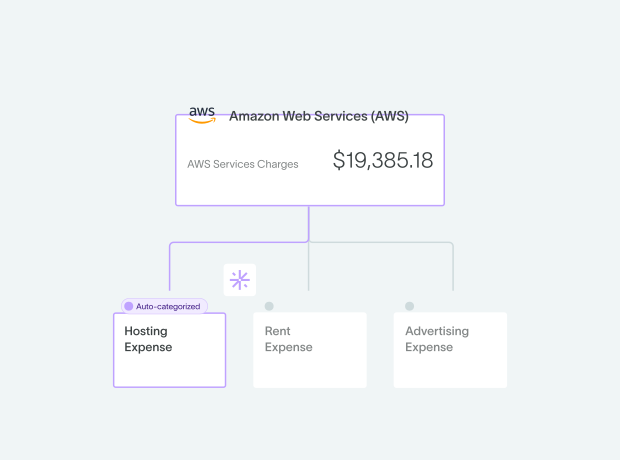
The trial balance summarizes all account balances from the GL. It’s split into debit and credit columns for easy comparison, so you can validate that the total debits equal the total credits.² If they don’t, it’s a red flag: a ledger posting was either missed or recorded incorrectly.
Having a balanced trial balance means your foundational books are mathematically correct before any adjustments or financial-statement prep takes place.⁵
The different types of trial balance
- Unadjusted trial balance: extracted before adjustments
- Adjusted trial balance: prepared after adjustments or corrections
- Post-closing trial balance: prepared after closing temporary accounts ⁵
How a trial balance is prepared from the general ledger
Here’s how double-entry accounting is checked in practice:
- Pull ending balances from the general ledger
- List each account in the trial balance
- Record each balance as a debit or a credit
- Total each column and check they’re equal
The key differences between a general ledger and a trial balance
A side-by-side comparison
What comes first: general ledger or trial balance?
Always the general ledger. The trial balance follows it, pulling directly from the GL’s ending balances.⁵
Why might a trial balance not match the general ledger?
A trial balance may not match the GL if some transactions were omitted, posted to only one side, or recorded with transposition errors (inaccuracies caused by digits being reversed, like recording 54 instead of 45).⁵ Differences can also come up when ledger updates are incomplete or not fully posted. In these cases, the mismatch signals that one or more entries need to be reviewed and corrected before moving forward.
Example: general ledger vs trial balance
- If a company records Rent Expense ($1,000 debit) and Bank ($1,000 credit) each month, the general ledger shows each rent transaction by date.
- In contrast, the trial balance at period-end lists “Rent Expense $3,000 debit” and “Bank $3,000 credit” – a summarized snapshot.
The workflow: journal entries → general ledger → trial balance
Step by step
- Record journal entries by capturing each transaction with matching debits and credits.
- Post those entries to the general ledger, grouping transactions by account codes to keep everything easy to track.
- Calculate the ending balances for each ledger account.
- Put together the trial balance with debit/credit columns.
- Check that the totals match. If they don’t, investigate and correct any errors.
A simple numerical example
Transactions:
Example journal entry (Owner investment of $10,000):

Debit    Cash                     $10,000
Credit   Capital                  $10,000
Example journal entry (Rent payment of $1,000):

Debit    Rent Expense             $1,000
Credit   Cash                     $1,000
Example journal entry (Revenue earned of $3,000):

Debit    Cash                     $3,000
Credit   Revenue                  $3,000
The trial balance shows:
Summary of account balances:

Debit    Cash                     $12,000
Debit    Rent Expense             $1,000

Credit   Revenue                  $3,000
Credit   Capital                  $10,000
✔ Totals match: $13,000 Debits = $13,000 Credits.
Best use cases – and some practical tips
When to use the general ledger…
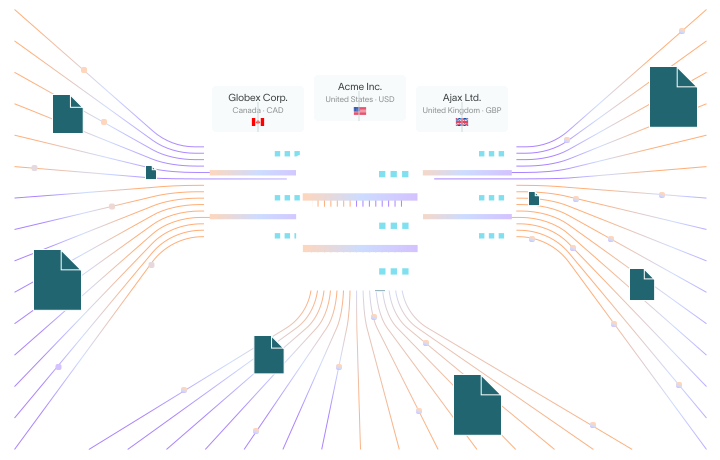
The general ledger is best used when you need to understand the story behind unusual balances or sudden transaction spikes. You’ll get the level of detail you need to trace individual entries and see what’s causing changes in an account.
The GL is also essential in supporting audits or compiling management reports, and when you need to reconcile discrepancies between subledgers and control account balances. If you want a deeper breakdown of how those two layers interact, see our guide on general ledger vs subledger.
…and when to use the trial balance
The trial balance is most useful at the end of a reporting period, before adjustments or financial statements are put together. It helps you to spot unposted or unbalanced entries by showing whether total debits and credits match. The trial balance also allows for a quick mathematical check to confirm that account balances line up as expected.
Common mistakes to be wary of
Regularly occurring issues include running a trial balance before all ledger accounts have been fully updated, or misposting entries to the wrong accounts or wrong side of the entry. You can also run into problems when your bank and control accounts aren’t reconciled regularly. To avoid these errors, best practices include locking prior periods after the close, keeping clean and clear audit trails – or switching to a general ledger software that helps you put these processes on autopilot. Following a set of account reconciliation best practices can help prevent these issues from carrying over into your trial balance.
How DualEntry helps to automate general-ledger accounting
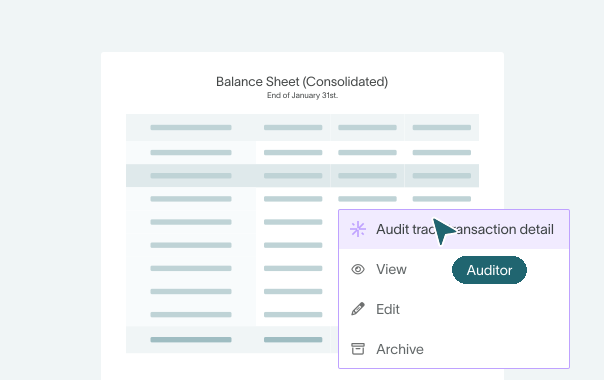
DualEntry automates the most time-consuming parts of general-ledger accounting, so you’re able to move faster with fewer manual touchpoints. Some of its top benefits include:
- Streamlined GL automation: Eliminate manual journal entries, spreadsheets, and complex GL coding. DualEntry automates accruals and prepaid accounting, amortization, depreciation, P&L allocations, and other recurring calculations, while keeping reporting accurate in real time.
- Auto distribution, categorization, and reconciliation: Transactions are intelligently distributed, categorized, and reconciled automatically, cutting review time and minimizing posting errors.
- AI anomaly detection: AI continuously audits your data and flags up any unusual transactions before they’re logged in your GL. This helps prevent oversights and catch issues before they become bigger problems.
- Bulk import with AI: Upload large volumes of transactions via Excel, CSV, or zip files, then let AI-assisted import read them and create the relevant entries.
- Built-in transparency and audit trails: Feel more peace of mind with features like an append-only ledger with automated audit trails.
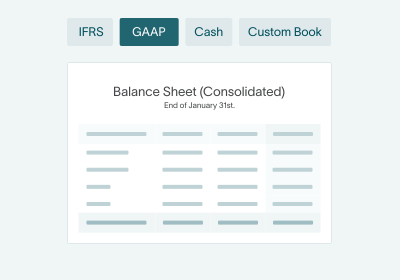
- Multi-book accounting: Manage and report across multiple books and languages at the same time. View transactions side-by-side under IFRS, GAAP, tax, cash basis, or reporting frameworks, all traced directly back to the general ledger.
General Ledger vs Trial Balance FAQs
Conclusion
- The general ledger provides detailed records of every transaction, while the trial balance confirms numerical accuracy before reporting.
- Following a structured workflow — from journals to ledgers to the trial balance — minimizes errors and smooths financial statement preparation.
- Automating these steps with DualEntry strengthens accuracy and efficiency.
The general ledger and trial balance serve different, but equally important, roles in accounting. The GL provides detailed records of every transaction, and the trial balance confirms that the numbers add up before it’s reporting time.
When you follow a structured workflow – from journal entries to the general ledger to the trial balance – errors are easier to catch and reporting is smoother. Each step builds on the last, and you end up with a clear path from daily bookkeeping to reliable financial statements.
And when you automate these steps, the process becomes even smoother, faster, and more accurate. With an AI-native ERP like DualEntry handling postings, reconciliations, anomaly detection, and reporting in real time for you, you’ll spend less time correcting errors and more on insights that keep your business ahead.
See the full power of DualEntry in 30 minutes
Do San (Justin) Myung
Expert Accountant & Former Consulting CFO | DualEntry
Justin (Do San Myung) is Expert Accountant at DualEntry with 20+ years of hands-on experience managing general ledgers, financial close processes, and ERP implementations for mid-market and enterprise companies. As a former Consulting CFO and Controller, he has personally overseen month-end closes, SOX compliance programs, and multi-entity consolidations across technology, manufacturing, and services industries. Justin specializes in transforming manual accounting workflows into automated, AI-driven processes.