Don't worry! The contents here will appear on the published page.
General Ledger vs. General Journal: A Comprehensive Comparison

Do San (Justin) Myung
Expert Accountant & Former Consulting CFO | DualEntry
Do San (Justin) Myung
Expert Accountant & Former Consulting CFO | DualEntry
Justin (Do San Myung) is Expert Accountant at DualEntry with 20+ years of hands-on experience managing general ledgers, financial close processes, and ERP implementations for mid-market and enterprise companies. As a former Consulting CFO and Controller, he has personally overseen month-end closes, SOX compliance programs, and multi-entity consolidations across technology, manufacturing, and services industries. Justin specializes in transforming manual accounting workflows into automated, AI-driven processes.
Learn about our editorial policies.
Last updated
September 25, 2026
Reviewed by
Woosung Chun

Woosung Chun
CFO, DualEntry
Woosung Chun is the CFO of DualEntry with experience in corporate finance, accounting, strategy, and acquisitions. He previously grew from scratch and led the M&A and Finance teams at Benitago, where he completed more than 12 acquisitions in 2 years. He graduated with a BS from NYU Stern. At DualEntry, Woosung writes about AI in accounting, revenue recognition, foreign currency accounting, hedge accounting, and ERP modernization for finance teams navigating complex, multi-entity environments.
Learn about our editorial policies.

Summarize this article
General ledger. General journal. What’s the difference?
First, back to the basics: in double-entry accounting, every transaction is recorded with equal debits and credits. This balance is what makes modern financial reporting reliable – and it starts with how transactions move through journals and ledgers. Transactions are first recorded in journals, then posted to ledgers. From there, they go into the trial balance and, ultimately, the financial statements.1
The general journal is known as the “book of original entry” because it’s where transactions are first captured in chronological order. The general ledger, meanwhile, is the “book of final entry.” In the GL, all that activity is grouped by account for reporting purposes.2
Read on to learn more about the differences between journals and ledgers. You’ll also see how automation can make bookkeeping easier and more accurate.
What is a general journal?
What it’s for
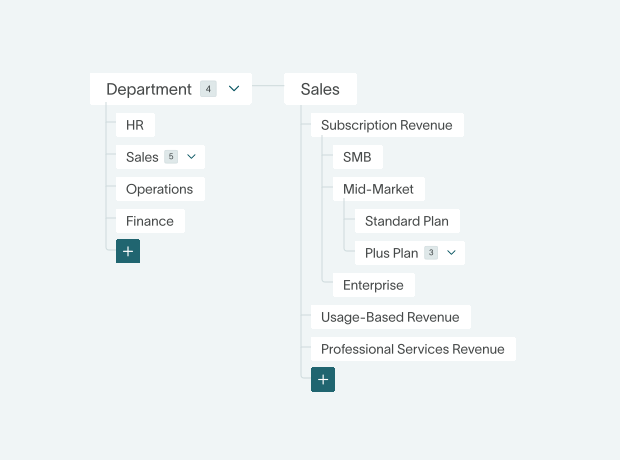
You can think of the general journal as a chronological log – one that’s especially useful for recording non-routine items like accruals, adjustments, and corrections.3 Each entry affects at least two accounts (one debited and one credited) so the books stay balanced.4 It also connects the transaction to supporting documents like invoices or receipts, creating a clear record of what happened.
Parts of a journal entry
- The date
- The accounts debited and credited
- The amounts
- A short description that explains the transaction
- Optionally: Account numbers tied to the chart of accounts
- Also optionally: Document reference(s)
A clearly structured journal, with defined debit and credit columns, ensures accurate posting to the ledger.5
Example of a general journal entry
If a business purchases 800 monetary units of IT supplies on credit, the journal entry debits IT Supplies and credits Accounts Payable for 800.
The description might read “Purchased IT supplies on account from Vendor X” and include the vendor-invoice number. Once it’s approved, this entry is the basis for updates to both the IT Supplies and Accounts Payable accounts in the GL.
Transactions in the general journal
A general journal is regularly used for transactions that don’t fit into day-to-day sales or purchase processes, especially at period end. Common examples include:
- Adjusting entries (accruals, deferrals, depreciation, amortization)6
- Corrections and reversals when previously recorded transactions need to be fixed or reclassified
- Non-routine transactions (write-offs, complex allocations, intercompany entries)
- Closing entries that transfer income and expense balances to retained earnings at the end of a reporting period7
What is a general ledger?
.jpg)
At a glance…
The general ledger (GL) is the central hub of a company’s financial records. Here you’ll find all transactions organized by account, covering assets, liabilities, equity, revenue, and expenses. Often called the “book of final entry,”8 it accumulates postings from journals and subledgers to form the foundation of financial statements.
Though it’s traditionally been maintained manually, in modern ERPs with built in general ledger like DualEntry the GL is maintained in real time, automatically recording transactions as they are entered.
General-ledger account structure
Each GL account tracks activity over time, showing a beginning balance, all debit and credit movements, and an ending balance. While accountants often visualize accounts as T-accounts (debits on the left, credits on the right), most modern systems display them as running transaction ledgers with a rolling balance. Subledgers feed summarized totals into control accounts within this structure (learn more about general ledger vs subledger here).
An example GL posting
If IT supplies are purchased on credit for 800, the Office Supplies account is debited and Accounts Payable is credited. Once the invoice is paid, Accounts Payable is debited and Cash is credited.
Each posting links back to the original journal entry – leaving a clear audit trail and cumulative spending history.
You can see more detailed general ledger examples here.
The relationship between the general journal and general ledger

Even if you’re running a modern finance function and letting automation do the heavy lifting, understanding how entries move from journal to ledger makes it easier to trace balances and spot where something may have gone wrong.
In the accounting cycle, transactions start with source documents, are recorded in the general journal, and are then posted to the general ledger. The journal captures each transaction in detail and in date order. The ledger reorganizes that information by account, showing how each balance changes over time.
Incorrect journal entry? That error will make its way into the ledger and affect reporting. Accuracy at the entry stage, therefore, really matters. Together, the journal and ledger create a structured audit trail that supports the trial balance and financial statements.9
Key differences between a general journal and a general ledger
Comparison
The general journal and general ledger play different roles. The journal records transactions in the order they happen. The ledger groups those transactions by account so balances can be tracked and analyzed.
Journal entries have a structured, narrative format: date, accounts affected, debit and credit amounts, and a short explanation. Ledger accounts look different, displaying activity in account-based views, often as running balances that show how totals change over time.10
Journals hold detailed, transaction-level info – which ledgers then condense into summarized balances used for reporting. In sequence, the journal is the book of original entry, while the ledger is the book of final entry that receives and organizes posted data.
How they fit together
- The journal captures the “story” of each transaction in time order, while the ledger organizes that activity by account.
- A typical flow looks like this: record the transaction in the journal, post the debits and credits to ledger accounts, prepare a trial balance, then produce the financial statements.11
- Going back to the IT supplies example we referenced earlier: the journal first records the debit and credit. The ledger then needs updates to its IT Supplies and Accounts Payable balances separately.
- In practice, people review the ledger more often than the journal, because it shows account totals and trends.
The role of both in double-entry accounting
Double-entry accounting means that every transaction needs to affect at least two accounts. Total debits must equal total credits.
This dual impact is first recorded in the journal. Then, those debits and credits are then posted to the GL. As postings build up, the ledger keeps running balances for assets, liabilities, equity, revenues, and expenses. It’s highly structured – and easy for accountants to see how accounts change over time.
After posting, a trial balance summarizes all the ledger balances to confirm that debits and credits are equal before adjustments are made and financial statements are prepared.
For example: a credit sale recorded in the journal as a debit to Accounts Receivable and a credit to Sales Revenue will update both ledger accounts. Those updated balances then go into the income statement and balance sheet.
Together, journals and ledgers create a clear trail from source document to reported figure, strengthening accuracy, internal controls, and audit readiness.12
Modern accounting: automating the journal and ledger
Software and ERP integration
Cloud-based general ledger software and ERPs automatically generate journal entries when invoices, bills, or receipts hit the system.
Those entries are immediately posted to the GL, and balances are updated without a separate, manual step. With unified platforms like DualEntry, different business units – like sales, purchasing, and inventory – are connected, so journal and ledger data is always centralized and consistent.
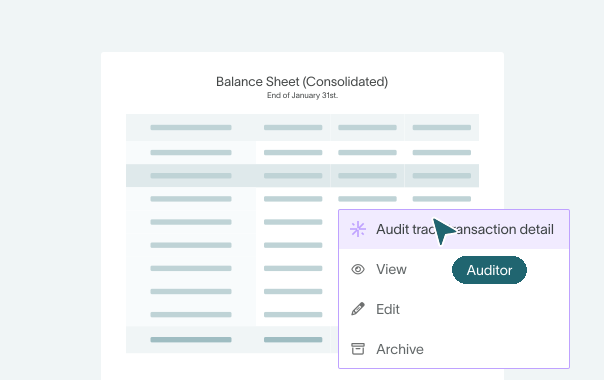
Because balances update continuously, users can run real-time trial balances and reports at any point of the month. Built-in audit trails, including granular details like timestamps and user details, make it easier to trace how each entry was created and posted.
The advantages of automation
Automation cuts out manual data-entry errors like transposed numbers or incorrect debit/credit placement.13 Recurring transactions and allocations can be templated or scheduled, and real-time updates give you instant visibility into cash, margins, and expenses.
If you choose an AI accounting software, you’ll also benefit from time-saving features like automatic matching, OCR reading and uploads (no more manually typing in invoice details), and auto-flagging of any discrepancies.
Automation also supports growth: you can handle higher transaction volumes without adding to your finance team’s headcount. For growing teams still on entry-level systems, this is often the tipping point that leads them to move from QuickBooks to an ERP.
Common mistakes to avoid
Automation is a game-changer – but it’s not something you can just turn on and forget about. Here are some common mistakes for teams new to automated accounting systems:
- Overrelying on automation without reviewing posting rules or account mappings first
- Failing to perform regular general ledger reconciliation with bank statements and subledgers
- Not doing a human sense-check of system-generated entries like depreciation or currency revaluations
- Setting up weak access controls that enable unauthorized posting
- Not documenting workflows, integrations, or approval processes
How DualEntry automates journals and ledgers
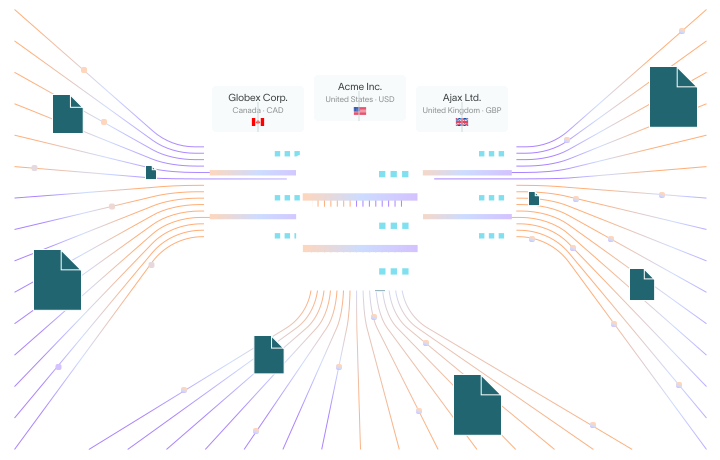
Modern accounting doesn’t have to mean manual posting and endless period-end adjustments. DualEntry automates journal creation and ledger updates so your books stay accurate in real time.
- Real-time GL updates: Every approved transaction, from journal entries and allocations to AR/AP activity, automatically posts to the correct GL accounts
- Automated recurring entries: Accruals, prepaids, amortization, and depreciation are generated automatically, cutting down on the manual month-end close process workload
- AI-driven categorization: Transactions are coded to the correct accounts and dimensions before posting – meaning less miscoding and more clean, consistent reporting
- Document-to-journal automation: Upload a vendor invoice, and DualEntry’s AI reads it, creates a draft journal entry, and posts it to the GL after approval
- Built-in reconciliation software: Automated bank syncing and transaction matching keep ledger balances aligned with bank feeds and subledgers
- Strong controls by design: Approval workflows, segregation-of-duties settings, and detailed audit trails make sure entries stay secure, compliant, and audit-ready
Overall, finance teams can focus less on data entry and more on insight and oversight.
General Ledger vs. General Journal FAQs
Conclusion: why both are essential to accurate accounting
The general journal and general ledger aren’t competing tools. They’re partners. Together, they create a straight line from source documents to financial statements. When entries are recorded properly and posted correctly, you can feel confident that your trial balance and reports reflect what’s really going on in your business.
AI-native platforms like DualEntry take most of the manual work out of this process, all while keeping strong audit trails and giving you real-time visibility at all times – at whatever level of granularity you (or your auditors) need.14
See the full power of DualEntry in 30 minutes
Do San (Justin) Myung
Expert Accountant & Former Consulting CFO | DualEntry
Justin (Do San Myung) is Expert Accountant at DualEntry with 20+ years of hands-on experience managing general ledgers, financial close processes, and ERP implementations for mid-market and enterprise companies. As a former Consulting CFO and Controller, he has personally overseen month-end closes, SOX compliance programs, and multi-entity consolidations across technology, manufacturing, and services industries. Justin specializes in transforming manual accounting workflows into automated, AI-driven processes.