Don't worry! The contents here will appear on the published page.
General Ledger vs Subledger: Key Differences & Reconciliation Guide

Do San (Justin) Myung
Expert Accountant & Former Consulting CFO
Do San (Justin) Myung
Expert Accountant & Former Consulting CFO
Justin (Do San Myung) is Expert Accountant at DualEntry with 20+ years of hands-on experience managing general ledgers, financial close processes, and ERP implementations for mid-market and enterprise companies. As a former Consulting CFO and Controller, he has personally overseen month-end closes, SOX compliance programs, and multi-entity consolidations across technology, manufacturing, and services industries. Justin specializes in transforming manual accounting workflows into automated, AI-driven processes.
Learn about our editorial policies.
Last updated
September 25, 2026
Reviewed by
Woosung Chun

Woosung Chun
CFO
Woosung Chun is the CFO of DualEntry with experience in corporate finance, accounting, strategy, and acquisitions. He previously grew from scratch and led the M&A and Finance teams at Benitago, where he completed more than 12 acquisitions in 2 years. He graduated with a BS from NYU Stern. At DualEntry, Woosung writes about AI in accounting, revenue recognition, foreign currency accounting, hedge accounting, and ERP modernization for finance teams navigating complex, multi-entity environments.
Learn about our editorial policies.
Summarize this article
Not sure what belongs in a general ledger versus a subledger? You’re not alone. But getting it wrong can lead to messy books, reconciliation headaches, and balances that don’t tie out at month end.
The general ledger (GL) is the master record for financial reporting. A subledger is less broad-reaching, but not less important. It holds detailed transaction data for specific areas, like accounts receivable, accounts payable, inventory, and fixed assets.
Subledgers track the detail, then post summarized totals into related GL control accounts. If those balances don’t match, financial statements and audits can quickly go off track.
In this guide, you’ll learn the key differences between a GL and subledger, all about batch vs real-time posting and reconciliation – and what it all means for the monthly close.
What is a general ledger?
.jpg)
Definition
The general ledger is the backbone of a company’s finances, summarizing all financial transactions by account type to give you a high-level view of how business is doing. Each GL account (assets, liabilities, equity, revenue, expenses) aggregates totals from related subledgers.
Because it brings everything together in one place, the GL is the foundation for financial statements, performance analysis, and compliance audits.
How it works
Every transaction is first recorded as a journal entry. Then it’s posted to the general ledger, where transactions are grouped by account so balances can be tracked over time.
While subledgers hold the detailed activity (e.g. individual customer invoices in accounts receivable), the GL doesn’t list every one of those transactions. Instead, it shows a summarized total in a related control account, like ‘Accounts Receivable Control’.
The system follows the double-entry bookkeeping principle – meaning that total debits must always equal total credits.¹ This keeps the ledger balanced and ensures the summary in the GL matches the detailed records in the subledgers.
An example
AR Control Account → Jan total debits $25,000 from customer invoices, credits $22,000 from receipts; balance $3,000 receivable.
Click here if you want to see some real life general ledger examples.
What is a subledger (or subsidiary ledger)?
Definition and purpose
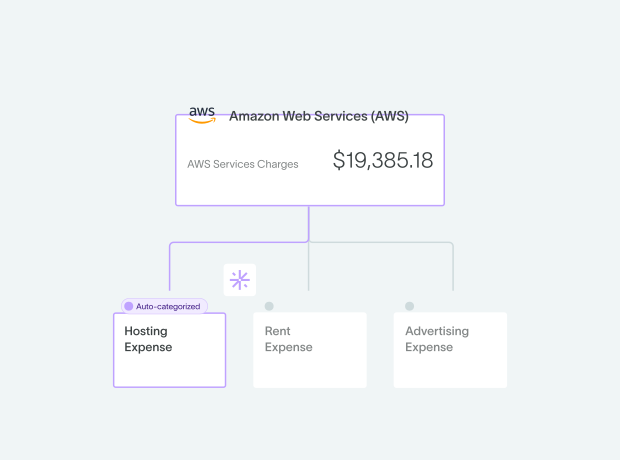
A subledger records detailed transactions for a specific area of the business and supports a related control account in the general ledger. Instead of summarizing totals, it captures individual entries – think each customer invoice, supplier bill, payroll run, or asset purchase.
Common subledgers include accounts payable, accounts receivable, inventory, payroll, and fixed assets. They give the detailed visibility that the GL alone can’t. This helps you see exactly what makes up each summarized balance.
How subledgers work
Subledgers are updated daily, or in real time, as transactions happen. Each new invoice, payment, or inventory movement is recorded at the transaction level.
At regular intervals, totals from the subledger are posted to the corresponding control account in the GL. By keeping detailed records separate but still connected, subledgers make account reconciliation easier and improve accuracy when reviewing balances.
Example
Customer invoice $5,000 → recorded in AR subledger under “Customer A,” summarized to AR Control in GL.
The differences between a general ledger and subledger
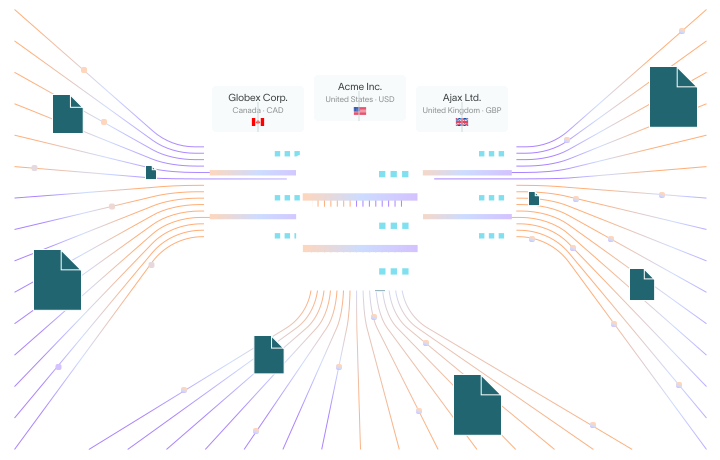
Comparison table
How subledgers and the GL work together
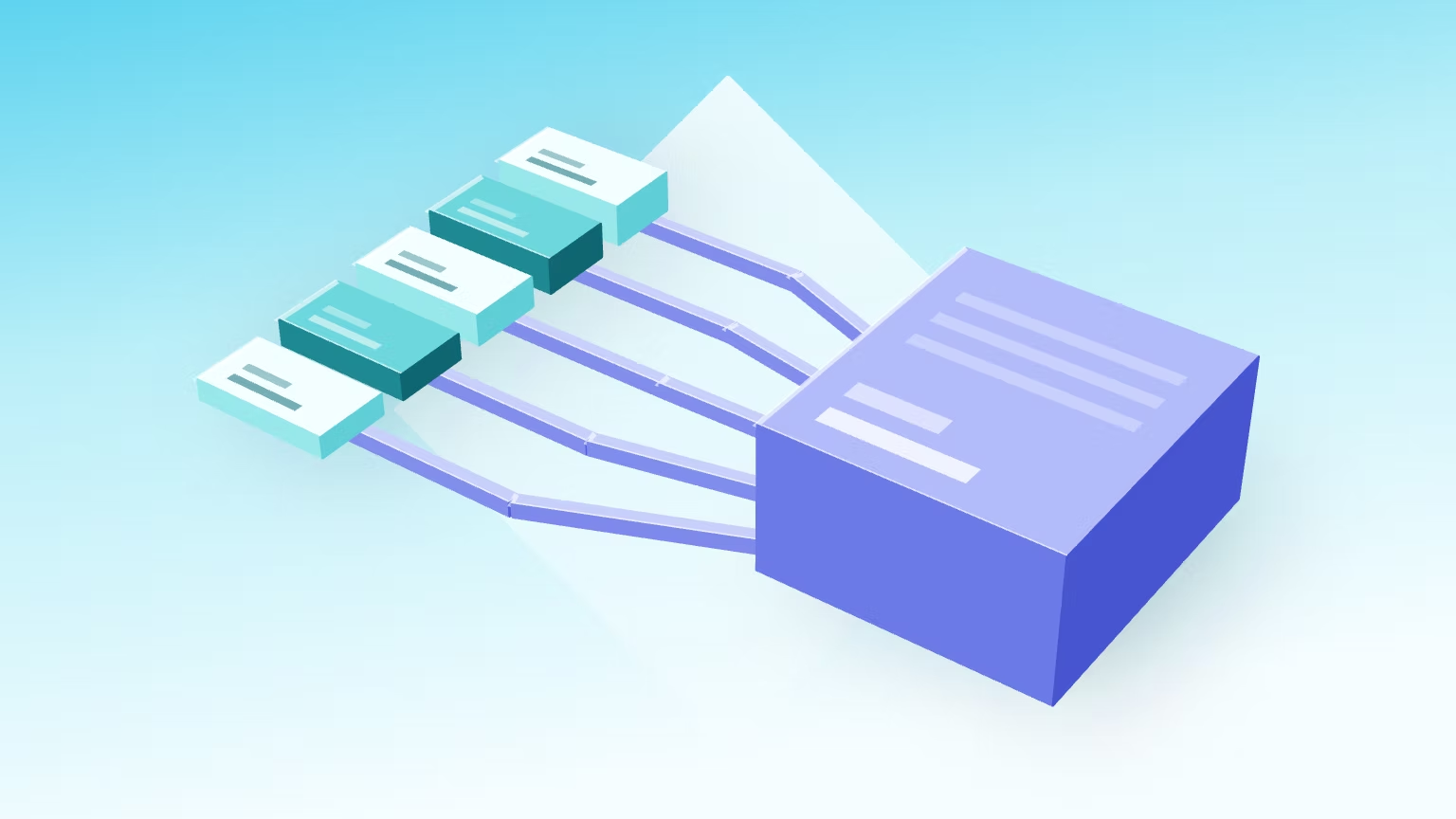
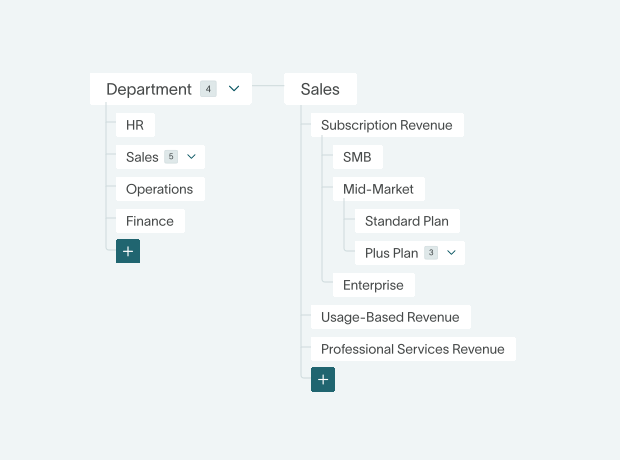
Subledgers feed into the general ledger through control accounts, which summarize detailed transaction data for reporting.
By separating detail from summary, the GL stays organized – even with high transaction volumes – while subledgers handle the day-to-day activity. It’s easier to track changes, spot issues, and keep your numbers accurate as your business scales.
A simple example in action
Vendor purchases → recorded in AP subledger → summed into “Accounts Payable Control” in GL → reflected as total liability on balance sheet.
Types of subledgers (with examples)
It varies in complexity, but most businesses use different subledgers to track specific areas of financial activity in more detail.
- Accounts receivable (AR): Tracks invoices issued to customers and the payments received. This helps you see who owes you money and how long invoices have been outstanding. Example: Customer A invoice, $2,000.
- Accounts payable (AP): Records supplier bills and outgoing payments. This makes it easier to monitor what you owe and when payments are due. Example: Supplier X invoice, $3,500.
- Inventory: Monitors quantities on hand, cost per unit, and valuation changes over time. It helps to keep stock levels and inventory values accurate. Example: 100 units purchased @ $20 each.
- Fixed assets: Logs asset purchases, depreciation, and disposals. This lets you track the long-term value of major business assets. Example: Equipment $10,000; annual depreciation $1,000.
- Payroll: Summarizes employee wages, deductions, and related taxes. It keeps a clear record of compensation and required withholdings.
Each subledger connects to its own GL control account, ensuring that detailed transaction records roll up into accurate summarized balances for reporting.
How data flows from subledger to general ledger
Step by step
- Transaction recorded: A transaction is first entered into the relevant subledger. For example: when you issue a customer invoice, it’s recorded in the accounts receivable (AR) subledger.
- Subledger balance updated: The subledger updates its running total, adjusting the balance of that account.
- Summary posted to the GL: At scheduled intervals (or automatically in real time), the summarized total from the subledger is posted to the relevant control account in the general ledger.
- Financial records updated: The general ledger reflects the updated balance in the broader accounting records, which ultimately flow into the financial statements.
A simple example of how the numbers look
Transaction: Customer purchase $5,000 (AR subledger).
Posting: Subledger → AR Control (GL debit) → Revenue (GL credit).
Balance reflected: AR Control $5,000 debit; Revenue $5,000 credit.
Batch vs real-time posting
Subledger data can move into the general ledger in two ways: through batch posting or real-time posting.
With batch posting, transactions are grouped together and transferred at scheduled intervals. This is common in legacy ERP systems because the older software was designed to process data in stages, reducing system load and improving performance. Real-time posting, meanwhile, syncs transactions instantly as they occur. You’ll find this type of posting in more modern, cloud-based systems. ²
For accuracy and more trust in your numbers (especially important for growing business in the mid-market and beyond), real-time posting wins.³ Batch processing can mean delayed updates, while real-time means the GL is always up to date.
Subledger and general ledger reconciliation
Why and when to reconcile
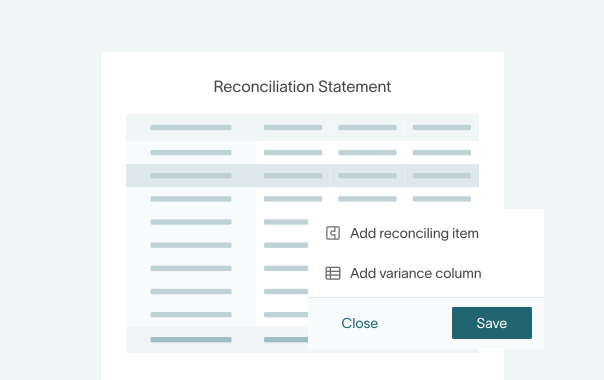
Reconciliation ensures that totals in each subledger match the related control accounts in the general ledger before a period is closed. If those balances don’t match up, financial statements may be inaccurate.
How often reconciliation happens depends on transaction volume. Some businesses reconcile daily, others weekly or monthly. The goal’s always the same: to confirm that the detail and the summary align.
A practical reconciliation process
- Extract the relevant control account balances from the general ledger at the end of the period.
- Compare those balances against the summarized totals from the corresponding subledger.
- Identify and analyze any discrepancies. They could be down to timing, unposted batches, or simply data-entry errors.
- Post any necessary corrections.
- Re-run your reconciliation reports to confirm that balances now match before finalizing the period. For a deeper dive into the policies, controls, and workflows that keep this process consistent as you scale, see our guide to account reconciliation best practices.
Common issues (and fixes)
Automation benefits
The new generation of modern, cloud-based ERPs makes reconciliation faster and more accurate.⁴ Automation handles all reconciliations – from bank accounts and credit cards to intercompany balances and revenue subledgers – in one place, with automated checks and real-time processing to maintain accuracy.
As an AI-native ERP, DualEntry can process high transaction volumes and handle reconciliations at scale. It also analyzes your reconciliation patterns to suggest custom matching rules, covering everything from straightforward bank matches to complex intercompany entries. Exceptions and unusual items are instantly flagged, keeping you continuously audit-ready and able to solve discrepancies as soon as they come up.
How subledgers and the GL fit into the month-end close
At month end, subledgers are finalized first. This step confirms that all pending transactions, like invoices, payments, payroll runs, or inventory updates, are fully recorded. Once complete, their totals are reconciled against the related control accounts in the general ledger.
Next, finance teams review GL control accounts for accuracy, post any necessary adjustments, and validate that balances are correct before they close the period.
After adjustments are posted, the trial balance is generated to confirm that total debits and credits still align before financial statements are finalized. If you want a clearer breakdown of how that differs from the general ledger itself, see our guide on general ledger vs trial balance.
These processes have traditionally been manual and time-consuming. Now, modern ERPs with built in close management software by automating approvals, and keeping clear audit trails. Automation makes the close more structured, controlled, and fast. It’s also less error-prone.
Why you need both ledgers
The general ledger gives you the summarized totals you need for precise financial reporting, while subledgers keep the detailed transaction history behind those numbers. Put simply, one delivers high-level visibility; the other delivers transparency at the transaction level.
Together, they create a system that is both accurate and auditable. Relying on only one would mean sacrificing either operational detail or financial clarity. The GL and subledgers form a complete, traceable accounting structure that supports strong internal controls and reliable reporting.
How can DualEntry help with the general ledger and subledger?
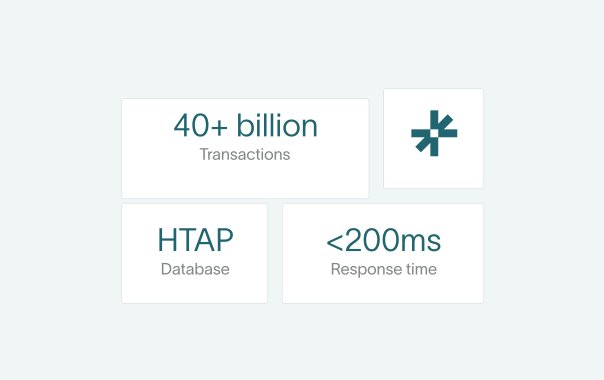
DualEntry’s AI-native general ledger supports mid-market companies handling multiple entities and books. It automates journal-entry posting and transaction processing across both the GL and subledgers, and uses machine learning to match transactions and flag variances automatically.
AI-assisted workflows detect duplicate vendor payments and unusual transaction patterns instantly, so they don’t have the chance to cause problems later down the line. Real-time audit trails and automated bank reconciliations also help keep control accounts aligned.
With 200+ integrations across finance teams’ most-used apps and software – like Salesforce, Stripe, ADP, and Bill.com – data flows directly into DualEntry, in real time, without the heavy manual work. Plus, as our general ledger software learns from past reconciliations, its matching accuracy improves over time, so you can close faster with fewer errors.
General ledger vs subledger FAQs
Conclusion
The general ledger and subledgers play distinct but closely connected roles in an AI accounting software. Subledgers are there to capture detailed, transaction-level activity, and general ledger consolidates that info into summarized balances – key for financial reporting and control.
Keeping the two aligned is essential. When subledgers and GL control accounts stay in sync, you get compliant reporting, smoother month-end closes, and audit-ready financial statements. When they don’t, discrepancies can quickly ripple through your books.
Modern ERP systems help bridge that gap. By automating journal postings, reconciliation, and exception checks, platforms like DualEntry cut down on manual tasks and improve overall accuracy.
Whether you’re an accountant or a business owner, understanding how these ledgers interact – and supporting that process with the right systems – gives you stronger financial oversight and clear, compliant reporting standards.
See the full power of DualEntry in 30 minutes
Justin (Do San Myung) is Expert Accountant at DualEntry with 20+ years of hands-on experience managing general ledgers, financial close processes, and ERP implementations for mid-market and enterprise companies. As a former Consulting CFO and Controller, he has personally overseen month-end closes, SOX compliance programs, and multi-entity consolidations across technology, manufacturing, and services industries. Justin specializes in transforming manual accounting workflows into automated, AI-driven processes.