Don't worry! The contents here will appear on the published page.
Meta Is Back in the AI Race. Muse Wonder Just Ranked #2 for Accounting

John Iwuozor
Content Lead, Finance and Research
John Iwuozor
Content Lead, Finance and Research
John Iwuozor leads content, finance, and research at DualEntry. He writes for the people who actually close the books: controllers running month-end, CFOs weighing an ERP migration, accountants buried in reconciliations. Before DualEntry he spent five years covering B2B SaaS and fintech for Forbes Advisor, Ramp, and Infosecurity Magazine. He builds every piece on primary data, including benchmarks, practitioner interviews, and product testing, rather than recycled advice. He is also an avid chess player.
Learn about our editorial policies.
Last updated
October 13, 2026
Reviewed by
Summarize this article
Meta has spent much of the past year trying to prove it can still compete at the frontier of AI. On October 12, it made its strongest case yet.
The company launched Muse Wonder and Muse Wonder Full, two new models it says are designed to compete with the best systems from OpenAI and Anthropic across coding, finance, legal work, memory, and long-running agentic tasks. Meta is calling them its most capable models to date and the next step in its push toward “personal superintelligence.”
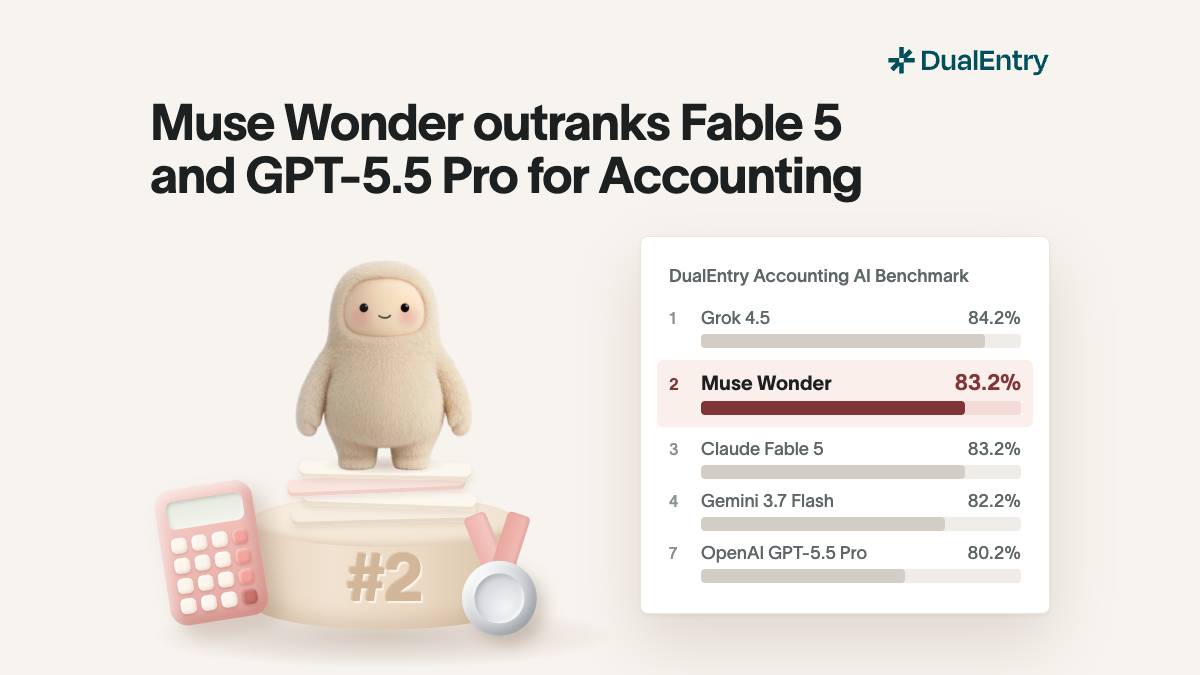
We ran Muse Wonder through the DualEntry Accounting AI Benchmark to see how that translates to accounting work. It scored 83.2%, putting it at #2 overall and ahead of every OpenAI, Anthropic, and Google model we’ve tested so far.
Its predecessor, Muse Spark 1.1 scored 61.4% on the same benchmark, meaning Wonder comes in 21.8 percentage points higher.
.jpg)
Key findings
- Muse Wonder scored 83.2%, ranking #2 overall on the DualEntry Accounting AI Benchmark.
- It finished ahead of every OpenAI, Anthropic, and Google model we’ve tested so far.
- It scored 21.8 percentage points higher than Muse Spark 1.1.
- Its strongest categories were reporting at 97% and reconciliation at 92%.
- It scored 77% on hard tasks, compared with 86% on easy and 87% on medium tasks.
Where Muse Wonder performed best
Wonder’s strongest result was in reporting, where it reached 97% accuracy, followed by reconciliation at 92%. Its broader accounting score was 80%.
The reporting results were particularly consistent. Wonder correctly handled almost every reporting question across repeated runs, including harder cash flow and financial statement calculations.
It also held up reasonably well as the questions got harder, scoring 77% on hard tasks compared with 86% on easy and 87% on medium.
Where it still struggled
The misses were more concentrated in a few operational accounting tasks. Wonder struggled with some accounts receivable payment scenarios and showed some inconsistency on close-related journal entries and transaction classification edge cases.
That matters because a high overall score can hide very different levels of reliability across workflows. A model can be excellent at reporting and reconciliation while still making mistakes in the transactional details finance teams rely on every day.
Meta has closed a lot of ground
Muse Wonder does not make Meta the best model on every accounting task, but it changes where Meta sits in the field.
A model family that scored 61.4% with Muse Spark 1.1 is now at 83.2% and #2 overall. For accounting work, that is a meaningful shift.
See the full DualEntry Accounting AI Benchmark to compare Muse Wonder with every model we’ve tested.
See the full power of DualEntry in 30 minutes
John Iwuozor leads content, finance, and research at DualEntry. He writes for the people who actually close the books: controllers running month-end, CFOs weighing an ERP migration, accountants buried in reconciliations. Before DualEntry he spent five years covering B2B SaaS and fintech for Forbes Advisor, Ramp, and Infosecurity Magazine. He builds every piece on primary data, including benchmarks, practitioner interviews, and product testing, rather than recycled advice. He is also an avid chess player.