Don't worry! The contents here will appear on the published page.
Intercompany reconciliation: finally smoother, thanks to AI

Do San (Justin) Myung
Expert Accountant & Former Consulting CFO | DualEntry
Do San (Justin) Myung
Expert Accountant & Former Consulting CFO | DualEntry
Justin (Do San Myung) is Expert Accountant at DualEntry with 20+ years of hands-on experience managing general ledgers, financial close processes, and ERP implementations for mid-market and enterprise companies. As a former Consulting CFO and Controller, he has personally overseen month-end closes, SOX compliance programs, and multi-entity consolidations across technology, manufacturing, and services industries. Justin specializes in transforming manual accounting workflows into automated, AI-driven processes.
Learn about our editorial policies.
Last updated
September 25, 2026
Reviewed by
Woosung Chun

Woosung Chun
CFO, DualEntry
Woosung Chun is the CFO of DualEntry with experience in corporate finance, accounting, strategy, and acquisitions. He previously grew from scratch and led the M&A and Finance teams at Benitago, where he completed more than 12 acquisitions in 2 years. He graduated with a BS from NYU Stern. At DualEntry, Woosung writes about AI in accounting, revenue recognition, foreign currency accounting, hedge accounting, and ERP modernization for finance teams navigating complex, multi-entity environments.
Learn about our editorial policies.

Summarize this article
Consolidated financials should only reflect what happens with third parties, not transactions between entities in the same group.1 But that’s easier said than done. Accurate reporting depends on getting intercompany balances to match perfectly before elimination. As groups grow, the process often becomes slow, spreadsheet-heavy, and error-prone.
This is where modern tools come in. In this article, we’ll explore how AI-powered accounting tools can help automate matching, flag discrepancies, and bring structure to intercompany workflows2 – making consolidation faster, cleaner, and less painful.
What is intercompany reconciliation, and why is it important?
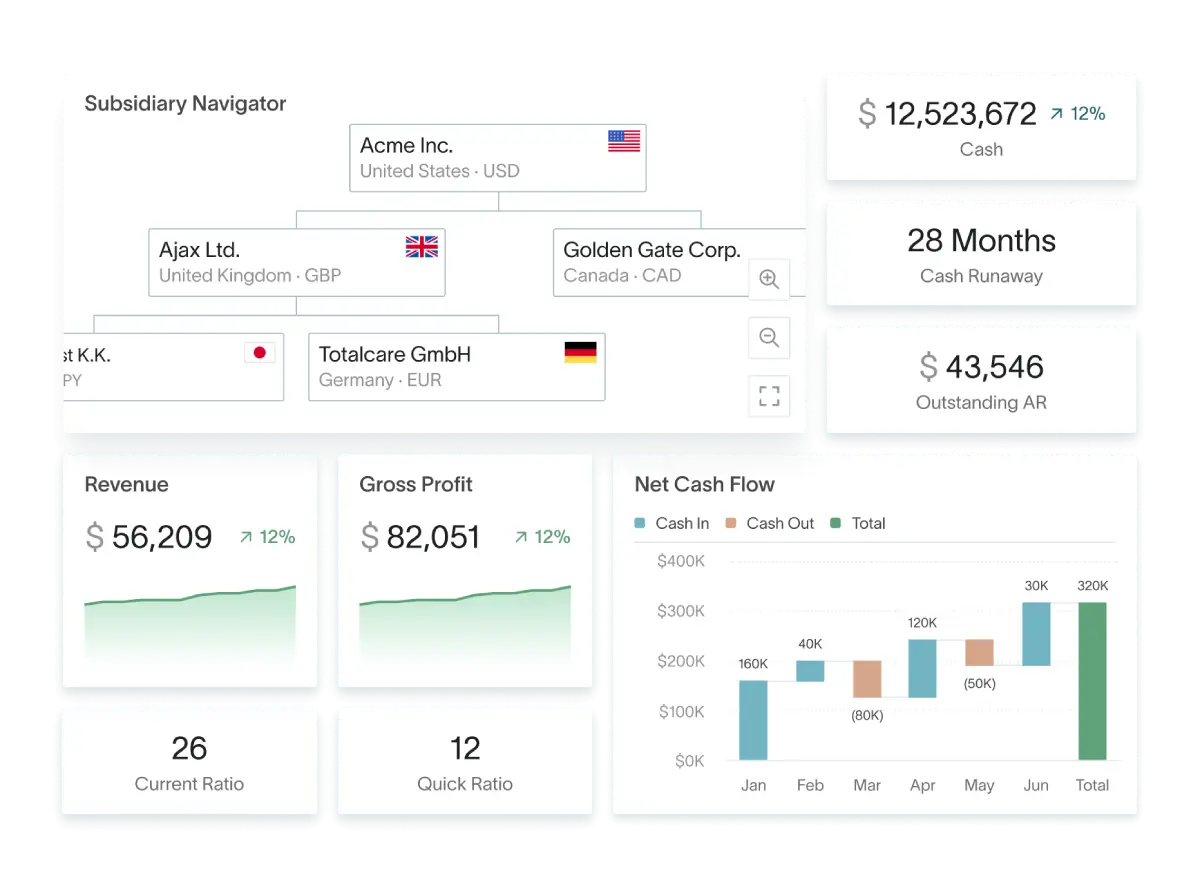
Intercompany reconciliation is the process of making sure transactions between entities in the same group match on both sides before consolidation.3
Under standards like IFRS 10, groups need to eliminate all intragroup balances and activity – so internal receivables, payables, revenue, and expenses shouldn’t appear in consolidated results. For that to work, each side of the transaction needs to agree in amount, timing, and classification.
These transactions come in many forms: internal sales of goods, service charges, loans, interest, management fees, cost allocations. Across all of them, consistency matters. If entities apply different accounting treatments to them, reconciliation is harder and eliminations are less reliable.
If balances don’t match, the consequences can be serious. Consolidated revenue, expenses, assets, and liabilities may be misstated, leading to an overstated view of the group’s performance and financial position.4
Example: Intercompany sale and elimination
- Parent sells goods to a subsidiary on credit.
- Parent records a receivable and revenue, while the subsidiary records inventory (or expense) and a payable.
- On consolidation, these entries are eliminated, so only external activity remains.5
Common intercompany reconciliation challenges
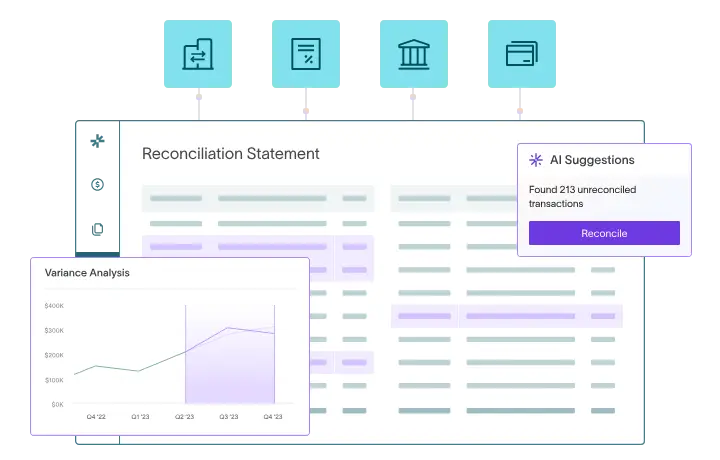
Mismatched or missing transactions
In an ideal world, intercompany balances should always cancel out perfectly. In reality, that rarely happens.
Timing differences are a common cause – say one entity records a transaction in one period, but then the counterparty records it later. Cut-off policies, different reporting timelines, or delays in communication can all contribute.
Other issues include misclassifications (e.g. transactions being recorded as third-party instead of intercompany) and variances caused by inconsistent foreign-currency treatments.
Manual work – and the delays that come with it
Deloitte describes intercompany accounting as a frequent pain point for controllership, with fragmented, manual processes creating a “mess under the bed” effect that obscures risk and slows the close.6 Many teams still rely on spreadsheets, emails, and disconnected systems to track and resolve differences – making it hard to see what’s outstanding and where issues are building up.
As transaction volumes and entity structures grow, the workload does too. Accountants end up spend more time chasing mismatches and reworking data, so there’s less time for strategic analysis.
3 tips for making intercompany reconciliation smoother
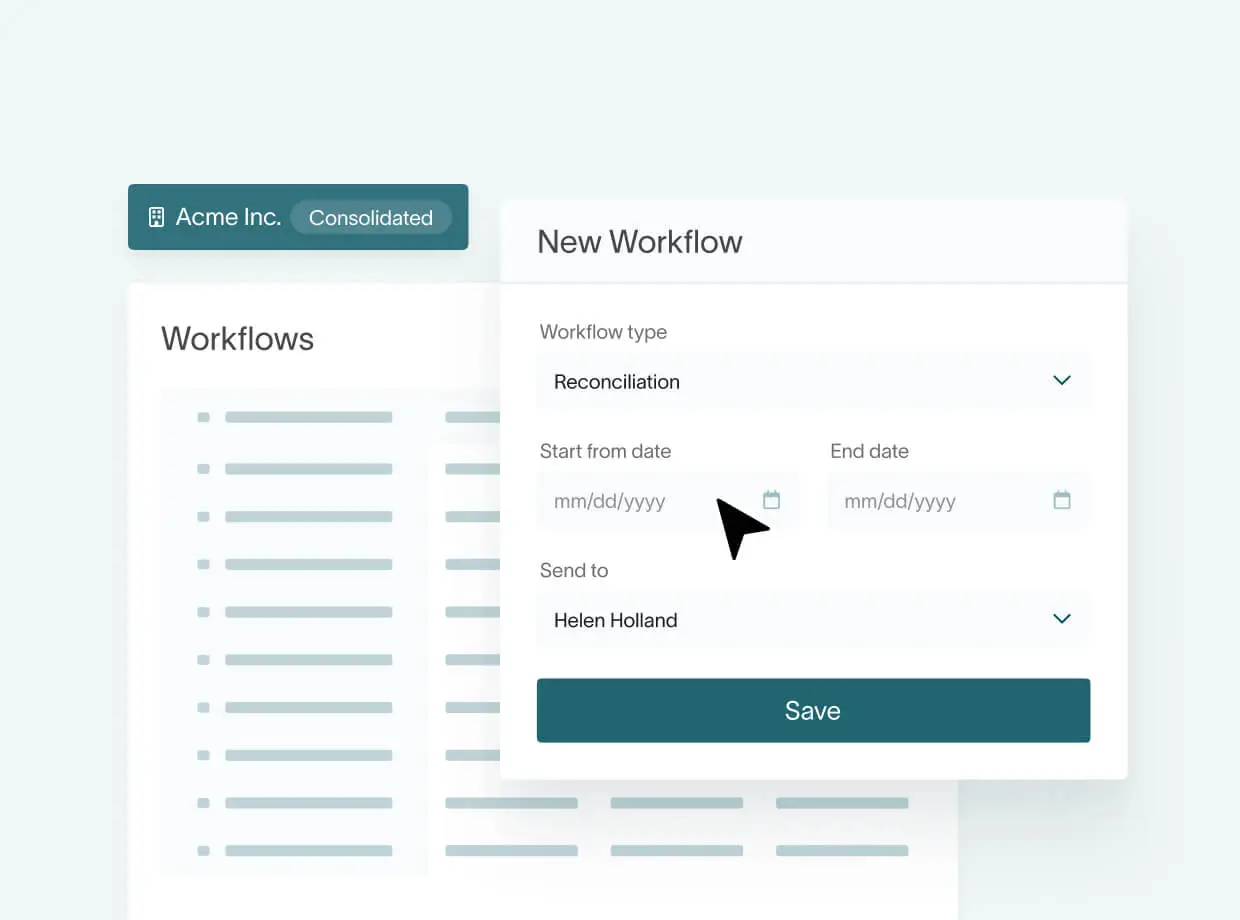
Get everyone working the same way
If each entity always follows its own rules, intercompany reconciliation will forever be a pain point. The more consistent your approach, the fewer mismatches you’ll need to chase later.
Start by aligning accounting policies across the group, especially for common intercompany transactions like recharges, loans, and internal sales. Setting up clear guidance on pricing, billing, and settlement processes will help to avoid disputes and recurring differences. Once everyone in the group starts recording transactions in the same way (and on the same timelines), reconciliation will be much more straightforward, and consolidation will run much more smoothly.
Bring your data into one place
Scattered data is another big source of friction when reconciliation’s concerned. Having intercompany balances sitting across multiple sources – like a mix of software and spreadsheets – reporting accurately is a struggle.
While it can feel like a leap, switching over to one centralized platform for all things finance is worth it. For accountants and auditors alike, it unlocks the ultimate win: a single source of truth. Think consistent mappings, aligned reporting dates, better visibility across entities, real-time progress insights, and clear audit trails.
In modern platforms like DualEntry, intercompany data flows into one place, so it’s easier to track balances, spot mismatches, and keep everything aligned in real time without constant file transfers.
Automate repetitive and lower-value tasks
A lot of intercompany work is repetitive: matching transactions, routing exceptions, posting recurring entries. These often-tedious, time-consuming tasks can now be taken over by automation.
Instead of lumbering finance teams with the manual box-ticking, AI-native software can match large volumes of transactions, only flagging up items that need attention. AI can also identify unusual data patterns or discrepancies that might otherwise be missed during the rush to close.
With automation’s help, a more streamlined intercompany reconciliation process can look like this:
- The software collects and standardizes data
- AI automatically matches transactions
- Human experts are notified to investigate and resolve any exceptions
- Adjustments and eliminations are generated and posted (with review/approval where needed)
- Consolidated results are prepared for review
Where does AI and automation fit in?
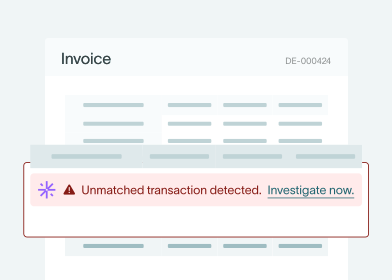
Finding anomalies
While humans find huge datasets tedious, AI never does. One of the technology’s biggest strengths is its ability to scan large volumes of data and pick out what doesn’t fit. AI models can identify unusual patterns, mismatches, or outliers across intercompany transactions. There’s no more need for hours of manual review.
This goes beyond simple rule-based matching. By learning from historical data, AI can flag inconsistencies that might otherwise go unnoticed, helping teams catch issues earlier and reduce risk across reconciliation and consolidation. This power of this technology has already convinced the Big 4 – take PwC, for example, which has championed anomaly detection since 2023(7) and is now pushing this on a larger scale with the launch of its AI environment PwC One, which includes anomaly detection for different use cases.7.
Working more efficiently
Per Deloitte, process automation is one of the key technology enablers in intercompany accounting8. Automated workflows can standardize how transactions are processed, matched, and reviewed across entities. This reduces reliance on spreadsheets, while also cutting down on manual effort and helping to enforce consistent policies. Built-in audit trails make it easier to track what was done, by who, and when. To see which platforms automate eliminations and consolidation across entities, compare the options in our multi-currency consolidation software breakdown.
Intercompany reconciliation is full of repetitive, rules-based tasks. This is what automation handles best – so why wouldn’t you hand the work over to AI?
How companies are using AI and automation now
The most efficient finance teams are using AI and automation to rethink the entire reconciliation workflow.
They’re using powerful platforms with OCR technology that extracts and categorizes transaction data and maps it to the correct GL accounts without human intervention.Transaction matching across entities is handled automatically, at high volumes, saving on hours (or days) of manual work. Accountants instead focus their effort on exceptions – not reviewing every single transaction, but only looking into the anomalies that are flagged up to them by AI.
Flux analysis – previously a tedious task – can now also be handled with AI, which tracks period-over-period variances automatically and pinpoints any unusual movements.
Bringing even more structure to the close, software with automated task-management capabilities helps to keep teams on track by assigning, scheduling, and tracking every reconciliation step through one dashboard. Email chains and spreadsheet tracking are things of the past.
As we mentioned above, PwC's Anomaly Detection Platform and Deloitte's intercompany transformation work both point in the same direction: integrated, AI-driven workflows are now the standard for high-performing finance functions.
Intercompany reconciliation FAQs
How DualEntry simplifies intercompany reconciliation
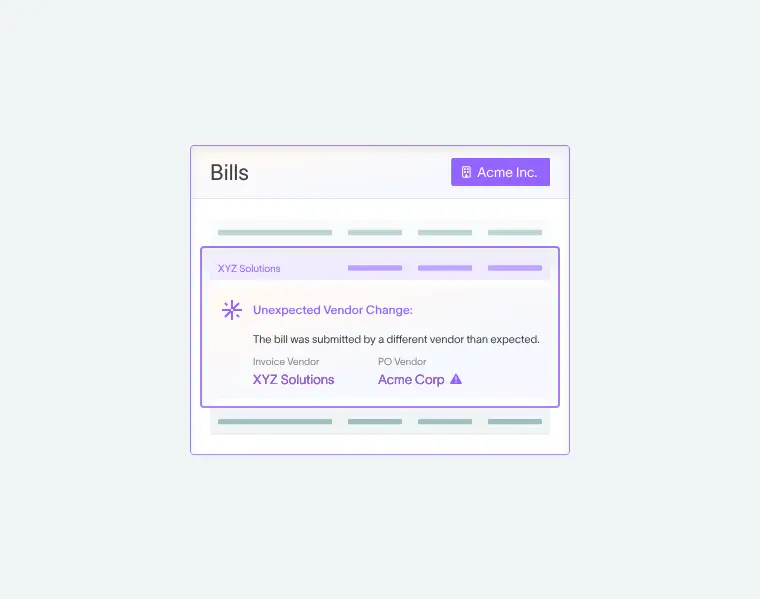
DualEntry is built to make intercompany reconciliation faster and less error-prone, with features like:
- Centralized, high-volume matching: The platform can process millions of transactions simultaneously, supporting one-to-one, many-to-one, and many-to-many matching across all entities so nothing slips through the cracks at close.
- AI anomaly detection: Rather than manually scanning for discrepancies, DualEntry continuously monitors transaction patterns and flags exceptions that need attention, helping teams catch intercompany mismatches early.
- AI rule creation: Learning from your reconciliation patterns, the software suggests custom matching rules tailored to your intercompany transactions – keeping you both efficient and compliant.
- AI flux analysis: DualEntry AI automatically identifies fluctuations between periods – month-over-month, quarter-over-quarter, or year-over-year.
- Multi-currency support: Auto FX-rate and variance tracking handle the complexity of cross-border intercompany activity without manual work, reducing mismatches caused by inconsistent currency treatments.
- Real-time visibility and audit trails: A single dashboard tracks every reconciliation step across entities, with automated alerts for out-of-balance items and a clear record of who did what, when.
You can read more about the ERP’s reconciliation features here.
In summary…
Intercompany reconciliation isn't optional. Under IFRS 10, accurate elimination of intragroup balances is a must for reliable consolidated financial statements. But as entity structures and transaction volumes grow, meeting that requirement through manual processes is no longer realistic.
Automated matching, anomaly detection, and continuous monitoring help businesses to scale globally, adding more entities along the way, without feeling the pain of slow, often-error-prone manual processes.
DualEntry brings these capabilities together in one place, purpose-built for the complexity of intercompany reconciliation. If you're ready to close faster and report with more confidence based on real-time insights, schedule a demo.
See the full power of DualEntry in 30 minutes
Do San (Justin) Myung
Expert Accountant & Former Consulting CFO | DualEntry
Justin (Do San Myung) is Expert Accountant at DualEntry with 20+ years of hands-on experience managing general ledgers, financial close processes, and ERP implementations for mid-market and enterprise companies. As a former Consulting CFO and Controller, he has personally overseen month-end closes, SOX compliance programs, and multi-entity consolidations across technology, manufacturing, and services industries. Justin specializes in transforming manual accounting workflows into automated, AI-driven processes.