Don't worry! The contents here will appear on the published page.
Rillet Alternatives (2026): The CFO's Comparison Guide

Woosung Chun
CFO, DualEntry
Woosung Chun
CFO, DualEntry
Woosung Chun is the CFO of DualEntry with experience in corporate finance, accounting, strategy, and acquisitions. He previously grew from scratch and led the M&A and Finance teams at Benitago, where he completed more than 12 acquisitions in 2 years. He graduated with a BS from NYU Stern. At DualEntry, Woosung writes about AI in accounting, revenue recognition, foreign currency accounting, hedge accounting, and ERP modernization for finance teams navigating complex, multi-entity environments.
Learn about our editorial policies.
Last updated
August 27, 2026
Reviewed by
Do San (Justin) Myung

Do San (Justin) Myung
Expert Accountant & Former Consulting CFO | DualEntry
Justin (Do San Myung) is Expert Accountant at DualEntry with 20+ years of hands-on experience managing general ledgers, financial close processes, and ERP implementations for mid-market and enterprise companies. As a former Consulting CFO and Controller, he has personally overseen month-end closes, SOX compliance programs, and multi-entity consolidations across technology, manufacturing, and services industries. Justin specializes in transforming manual accounting workflows into automated, AI-driven processes.
Learn about our editorial policies.

Summarize this article
A SaaS CFO has Rillet on their shortlist. So does NetSuite. And someone in the last board meeting mentioned DualEntry. The question isn't what's wrong with any of them. The question is: which one is actually right for where we're going, and what does the real cost difference look like?
That's the comparison most articles don't make. They give you a list of tools and call it a guide. This isn't that.
There are two structurally different decisions hiding behind the search "rillet alternatives" in 2026. Track A is Rillet versus legacy ERP: the question of whether you need procurement and operations alongside finance in one system. Track B is Rillet versus AI-native: the question of whether there's a more automated version of what Rillet does, without the implementation pain of NetSuite. This guide routes you to the right comparison based on where your business actually is.
At-a-Glance Comparison
Rillet vs. Legacy ERP vs. AI-Native: Two Different Decisions
Most "alternatives" articles treat this as one question. It isn't.
There are two distinct decisions hiding behind this search, and they point to completely different answers. Getting the routing right matters more than any feature comparison.
Track A: Rillet vs. Legacy ERP
Track A is the question of scope. You need to know whether Rillet's finance-only footprint is enough, or whether your business has reached the point where procurement, inventory, or professional services automation needs to live in the same system as the GL. The fear on one side is under-buying: hitting Rillet's ceiling 18 months from now. The fear on the other is over-buying: committing $75,000–$175,000+ and 5–9 months of implementation time to a NetSuite deployment before the business actually requires it.[1, 2 ,3]
Track A is the right question if you need procurement, inventory, or PSA alongside finance in one system; if you have a confirmed 18-month IPO runway and need NetSuite's track record with auditors; or if your operational complexity has grown beyond what a finance-first tool was designed to handle.
Track B: Rillet vs. AI-Native
Track B is a different question entirely. The CFO asking this one isn't necessarily unhappy with Rillet. They've heard about AI-native alternatives like DualEntry and want to know whether there's something with more automation depth, stronger controls architecture, and better transaction scale, without the implementation overhead that makes NetSuite a six-month project.
Track B is the right question if your transaction volume is scaling faster than your automation is; if you're approaching a Series C audit and your auditor is asking about system-enforced segregation of duties at the GL level; or if you want an accounting system that gets more automated as you grow, not one that requires adding headcount to keep up.
Comparing Campfire too? Here's our Campfire alternatives guide.
Routing Table: Which Comparison Are You Actually Making?
* For a broader ERP comparison by stage, see our guide to the best ERP for tech startups.
Where Each Option Is Designed to Stop
Rillet's ceiling is scope, not quality. It's finance-only. No native procurement, inventory, or PSA modules.[16] As transaction complexity grows beyond standard Stripe-native SaaS billing, the manual intervention required increases. That's not a product failure; it's a profile mismatch.
NetSuite's ceiling is cost and time. Implementation for a mid-market, multi-entity deployment typically runs $75,000–$175,000+ and takes 5–9 months to go live.[1, 2 ,3] For pure SaaS without operational complexity, that overhead is rarely justified.
DualEntry's ceiling is the same as Rillet's in one respect: it's not an operational ERP. No inventory, no procurement, no manufacturing. Finance-first, like Rillet. The difference is AI-native automation depth, SOC 2 Type II controls enforced natively in the GL, and transaction scale that extends further without adding headcount.
The 5 Best Rillet Alternatives in 2026, Ranked
Based on those two comparison tracks, here are the five alternatives worth evaluating, ranked by fit for a scaling SaaS finance team.
#1 DualEntry: Best Overall Rillet Alternative for Scaling SaaS Finance Teams

DualEntry is an AI-native accounting platform built for mid-market and scaling SaaS companies. Where most accounting systems require additional headcount as transaction volume grows, DualEntry is designed to get more automated as the business scales. Slash runs a $140M fintech with a one-person finance team and 90% of manual tasks automated.[10] Signal Ventures manages 20+ entities with one accountant, with 80% of that accountant's day freed after migration.[11] Graphite cut its close time from 20 days to one.[12]
The controls architecture is built into the GL rather than layered on top. Tiered approval workflows enforce approver/preparer separation through staged transactions. AI anomaly detection monitors the ledger continuously. System-generated audit trails are undeletable and per-record. SOC 2 Type II is certified. For finance teams approaching a Series C audit, these aren't features to configure. They're on by default.
Implementation is $0 and runs 24 hours to 6 weeks depending on complexity, confirmed across three published case studies.[10, 11 ,12] "Thanks to DualEntry, we're able to deal with all the nuances of our $140-million revenue business with a finance team of just one person." — Victor Cardenas, CEO, Slash.[10]
Key Features
- Tiered approval workflows: staged transactions enforce approver ≠ preparer at the GL level
- AI anomaly detection: continuous, real-time monitoring across the ledger
- Multi-book accounting: parallel GAAP, IFRS, and tax ledgers with automated posting rules
- System-generated audit trails: undeletable, chronological, and per-record
- Multi-entity accounting: unlimited subsidiaries, included in the core product
- SOC 2 Type II certified
- Purchase Order management
- Fixed Asset management
Pros
- $0 implementation, confirmed across three published case studies [10, 11 ,12]
- Live in 24 hours to 6 weeks depending on complexity
- Controls architecture (approvals, audit trails, anomaly detection) built natively into the GL
- SOC 2 Type II certified
- Multi-entity and multi-book accounting in the core product, not add-ons
- Scales automation with transaction volume rather than requiring headcount to keep up
Cons / Risks
- Finance-only: no procurement, inventory, or manufacturing modules
- Feature depth exceeds what pre-PMF or very early-stage companies will actually use
- Newer entrant: if a large certified implementation partner network is a hard requirement, factor that into your evaluation
Pricing
DualEntry pricing scales with your business. Contact the team directly for a demo and visit: dualentry.com/customers for case studies from Signal Ventures, Slash, and Graphite.
#2 NetSuite: Best for IPO Readiness or Procurement + Finance in One System
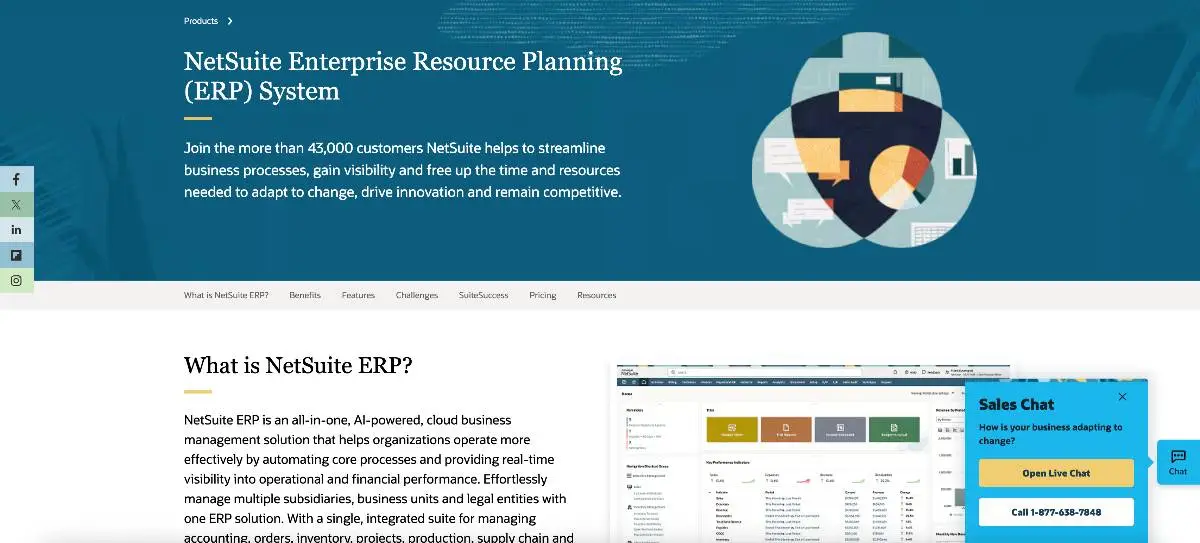
NetSuite is the market-standard choice for Track A decisions: businesses that need procurement, inventory, and finance in one system, or that have a confirmed IPO runway and need an auditor-recognized platform. 61% of tech IPOs since 2011 used NetSuite, per NetSuite's own published datasheet. [1, 3]
The constraints are consistent and well-documented. Implementation for a mid-market, multi-entity deployment runs $75,000–$175,000+ and takes 5–9 months to go live.[1, 2 ,3] A single-entity SuiteSuccess fast-track runs 90–120 days. That's the floor, not the median.[2] Admin burden post-launch is high. For pure SaaS without procurement or inventory requirements, the operational overhead is rarely proportionate to the need.
Jason Adams, President and Founder of Signal Ventures, migrated off NetSuite and put it directly: "It was so heavy, not to mention expensive. And we had no support. Nobody would get back to us." [11]
Key Features
- Procurement, inventory, and finance in a single system
- Multi-entity and multi-currency support
- IPO-ready infrastructure with a long auditor track record
- SuiteSuccess fast-track for single-entity implementations (90–120 days) [2]
- Large certified implementation partner ecosystem
Pros
- The recognized standard for companies approaching IPO
- Handles procurement, inventory, and finance in one system
- 61% of tech IPOs since 2011 ran on NetSuite (per NetSuite's own marketing) [1, 3]
- Large partner network for implementations and ongoing support
Cons / Risks
- $75,000–$175,000+ implementation cost for mid-market multi-entity [1, 2 ,3]
- 5–9 months to go live for multi-entity mid-market deployments [1, 2 ,3]
- High admin burden post-launch
- Overkill for pure SaaS without procurement or inventory complexity
Pricing
NetSuite does not publish pricing publicly. Implementation partners report mid-market projects typically run $75,000–$175,000+, with annual licensing quoted on request. [1, 2 ,3] For the broader NetSuite alternatives landscape, see our dedicated guide.
#3 Sage Intacct: Best for Professional Services + Multi-Entity
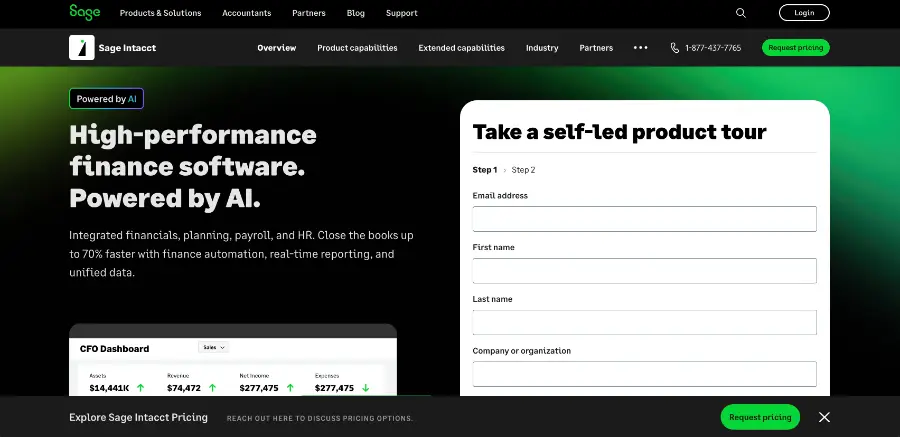
Sage Intacct is the Track A answer for a specific profile: businesses where professional services revenue is a meaningful portion of total revenue and multi-entity structure is already a requirement. Dimensional accounting handles project-based cost allocation and complex AP/AR in a way that generic SaaS-focused tools don't.
It's not the right fit for pure subscription SaaS. If your revenue model is primarily recurring with no significant services component, the feature set maps to a problem you don't have.
Pricing starts at approximately $9,000 per year for a single entity. Mid-market multi-entity runs $25,000–$75,000 per year in subscription, plus $15,000–$30,000 for implementation. [4, 5 ,6]
Key Features
- Dimensional accounting for project-based cost allocation
- Multi-entity consolidation and complex AP/AR
- Multi-currency support
- Strong implementation partner ecosystem
Pros
- Dimensional accounting is genuinely differentiated for project-heavy businesses
- Well-established at mid-market for professional services + multi-entity
- Lower implementation cost than NetSuite
Cons / Risks
- Not built for pure SaaS subscription businesses
- $25,000–$75,000/year at mid-market, plus $15,000–$30,000 for implementation [4, 5 ,6]
- Lower automation depth than AI-native alternatives for standard SaaS use cases
Pricing
Single entity starts at approximately $9,000/year. Mid-market multi-entity: $25,000–$75,000/year, plus $15,000–$30,000 for implementation. [4, 5 ,6] Sage does not publish pricing publicly; figures represent market consensus across independent sources. For the broader Sage Intacct alternatives landscape, see our dedicated guide.
#4 Maxio: Best for Billing Complexity Without Changing Your GL

Maxio is not a GL replacement. It's a subscription billing and revenue management platform that pairs with an existing accounting system. If the GL itself isn't the problem and the primary pain is billing complexity, SaaS metrics reporting (MRR, ARR, churn, LTV), and dunning, Maxio addresses that layer without requiring a full accounting migration.
That distinction matters. A finance team that's outgrown its billing infrastructure but isn't ready to migrate the core accounting system has a legitimate middle path here. Maxio handles the billing and metrics layer. The existing GL continues handling the books.
Key Features
- Subscription billing with support for complex pricing models
- SaaS metrics reporting: MRR, ARR, churn, LTV
- Dunning and revenue recovery
- Integrates with existing accounting systems
- Not a general ledger
Pros
- Addresses billing complexity without requiring a full system migration
- Clean SaaS metrics layer for board and investor reporting
- Faster to implement than a full accounting replacement
Cons / Risks
- Not a GL replacement: doesn't address close process, controls, or audit trail requirements
- A partial Track B answer at best; if the GL is the problem, Maxio doesn't solve it
- Requires a separate accounting system to continue running in parallel
Pricing
Maxio does not publish pricing publicly. Contact Maxio directly for a quote.
#5 QuickBooks Online: Only If You're Stepping Down

QuickBooks Online is typically the system SaaS companies used before Rillet. It belongs on this list for completeness, but it represents a step down in capability, not an alternative at the same level. It's appropriate for pre-PMF companies, businesses under $2M ARR, or situations that call for deliberate simplification. See our guide on upgrading from QuickBooks to ERP if that's your starting point.
If you're evaluating Rillet alternatives because your business is scaling, this isn't the direction.
Key Features
- Core bookkeeping and invoicing
- Basic financial reporting
- Large accountant and bookkeeper ecosystem
- Wide third-party integration support
Pros
- Low cost and minimal learning curve
- Familiar to most accountants and bookkeepers
- Sufficient for single-entity businesses at early stages
Cons / Risks
- Not an upgrade from Rillet for a scaling SaaS company
- Automation depth doesn't keep pace with transaction volume at scale
Pricing
Low monthly cost. Not a meaningful pricing consideration for companies actively evaluating Rillet alternatives at scale.
If you're evaluating the QuickBooks alternatives landscape more broadly, see our dedicated guide.
What Migration Actually Costs, and the Cost of Waiting
The implementation cost difference between these platforms is one of the most cited figures in this comparison, and it's worth stating clearly.
On data migration specifically: transaction history and open AR generally survive the move. Deferred revenue schedules, amortization tables, and historical support packages typically need to be rebuilt. Cutover timing matters too. A mid-year migration requires a parallel-run period. Fiscal year-end is cleaner for audit continuity.
The Cost of Waiting
Every competing article presents alternatives as a menu. None of them address what it costs to keep evaluating.
The manual workarounds, reconciliation time, and controls gaps that accumulate while a decision is pending have a real cost. It's just invisible because it's spread across the finance team's time rather than showing up as a line item on an invoice.
The published customer data from DualEntry's case studies makes this concrete. Signal Ventures recovered 80% of its accountant's day after migration. [11]Graphite cut its close from 20 days to one.[12] Slash automated 90% of manual tasks. [10] These aren't post-migration projections. They're reported outcomes from finance teams that were running the same evaluation you're running now.
If you're going to need a different system in 24 months anyway, because the business will require it, the question isn't whether to migrate. It's whether you can absorb the compounding cost of the delay while your complexity grows.
That's the section no competing article has written. The decision isn't just which platform to choose. It's when the cost of not deciding becomes higher than the cost of moving.
DualEntry vs. Rillet: Head-to-Head
This comparison is limited to capabilities that have been independently verified against DualEntry's published product pages and case studies. Every row is sourced. No claims outside this list.
Both platforms hold SOC 2 Type II certification. That's a baseline, not a differentiator. The meaningful differences are in controls architecture, automation depth, and implementation economics.
One thing worth flagging before you make this comparison your primary frame: if your auditor is asking about system-enforced segregation of duties at the GL level, that's the right question to bring to them directly. Both platforms hold SOC 2 Type II. Whether your specific audit requirements need tiered approvals enforced at the transaction level is a conversation for your auditor, not a vendor comparison article.
When to Stay on Rillet
Stay on Rillet if you're a single-entity, US-based SaaS company with standard subscription billing, no operational complexity beyond finance, and no near-term audit or transaction-scale pressure. Rillet is genuinely excellent at that profile. Fast implementation, Stripe-native, clean SaaS metrics. If that's where you are, the tools in this article represent more system than you need right now. For a full category view, see our guide to the best SaaS accounting software for scaling companies.
That changes. There are specific signals worth watching for, because they represent the natural transition points where the fit starts to shift.
A second entity with a different fiscal year or currency is the clearest one. Operational budget lines outside the GL that require manual reconciliation each month. An auditor requesting system-enforced segregation of duties. Transaction volume scaling faster than the team can reconcile manually. A business model diversifying beyond standard SaaS subscription billing.
None of these are emergencies on their own. But each one is a signal that the profile Rillet was built for is starting to diverge from the profile your business is growing into. When two or three of them are true at the same time, that's when the comparison becomes worth running in earnest.
Rillet Alternatives Frequently Asked Questions
See the full power of DualEntry in 30 minutes
Woosung Chun
CFO, DualEntry
Woosung Chun is the CFO of DualEntry with experience in corporate finance, accounting, strategy, and acquisitions. He previously grew from scratch and led the M&A and Finance teams at Benitago, where he completed more than 12 acquisitions in 2 years. He graduated with a BS from NYU Stern. At DualEntry, Woosung writes about AI in accounting, revenue recognition, foreign currency accounting, hedge accounting, and ERP modernization for finance teams navigating complex, multi-entity environments.