Don't worry! The contents here will appear on the published page.
Deferred Revenue Recognition Under ASC 606: The SaaS Guide

Woosung Chun
CFO, DualEntry
Woosung Chun
CFO, DualEntry
Woosung Chun is the CFO of DualEntry with experience in corporate finance, accounting, strategy, and acquisitions. He previously grew from scratch and led the M&A and Finance teams at Benitago, where he completed more than 12 acquisitions in 2 years. He graduated with a BS from NYU Stern. At DualEntry, Woosung writes about AI in accounting, revenue recognition, foreign currency accounting, hedge accounting, and ERP modernization for finance teams navigating complex, multi-entity environments.
Learn about our editorial policies.
Last updated
August 27, 2026
Reviewed by

Summarize this article
Deferred revenue recognition involves transferring unearned revenue from the balance sheet liability account to the income statement as performance obligations are satisfied. Under ASC 606, SaaS companies must identify every performance obligation in a contract, allocate the transaction price to each, and recognize revenue only as each obligation is fulfilled. For the foundational revenue recognition principle underlying this standard, see our revenue recognition principle explainer.
Say a SaaS company closes a $36,000 annual deal, with a contract bundling platform access, onboarding, and premium support. The Sales team books $36,000 in ARR for this. The CFO, meanwhile, has a tougher job: needing to know how much of that revenue is recognized at signature, how much is deferred, and on what schedule it’s released.
Under old ASC 605 guidance, one price meant one schedule. Now under ASC 606, three performance obligations mean three schedules. Each has its own recognition trigger, deferred balance, and audit trail. This difference in standards changes the deferred revenue balance dramatically, and it's the first thing an auditor will test – especially if you’re handling accounting for venture-backed startups, where revenue treatment’s always scrutinized during due diligence.
So you can build a clean, audit-ready revenue recognition process, this guide walks the ASC 606 five-step model with real SaaS contract scenarios. We’ll cover multi-element bundles, usage-based variable consideration, and mid-contract expansion modifications.
Deferred revenue accounting under ASC 606: what changed for SaaS

Under ASC 606 (effective for public entities for fiscal years beginning after December 15, 2017[1], and private entities for fiscal years beginning after December 15, 2019 under ASU 2020-05[2]), SaaS companies must decompose multi-element contracts into distinct performance obligations and recognize revenue for each separately. The standard replaced ASC 605's simpler criteria and EITF 08-1[1], requiring SaaS companies to revisit every bundled contract containing software, implementation, training, or support elements.
ASC 605 vs. ASC 606: Key differences for SaaS revenue recognition
For a broader overview of revenue recognition methods under ASC 606, see our revenue recognition methods guide.
Why the transition still creates deferred revenue complexity today
Most companies adopted ASC 606 using the modified retrospective method[3], which applies the standard prospectively from the adoption date with a cumulative catch-up adjustment to opening retained earnings—without restating prior-period comparative financial statements. That left a lot of pre-2019 deferred revenue balances on balance sheets under the older VSOE-based allocation logic.
If you’re a new controller joining a company that transitioned this way, you’ll want to avoid an ASC 606 restatement risk by checking that every open recognition schedule has been rebuilt on the 5-step model.
The ASC 606 five-step model applied to a SaaS contract

The ASC 606 five-step model requires SaaS companies to: (1) identify the contract, (2) identify each distinct performance obligation, (3) determine the total transaction price, (4) allocate the transaction price to each PO using standalone selling price, and (5) recognize revenue as each PO is satisfied[1]. Steps 2 and 4 are where most SaaS deferred revenue complexity originates.
The ASC 606 5-step model applied to a $36,000 multi-element SaaS contract
The decision that most often gets challenged by auditors is at Step 2: is implementation actually distinct from the platform?
The test is whether the customer can benefit from the platform on its own. If the implementation is highly bespoke, isn't sold separately, and the platform doesn't function without it, the two performance obligations may be combined into one, recognized ratably over the service term. This changes deferred revenue timing materially: distinct implementation recognized at go-live (e.g. as a $4,000 point-in-time event), vs. blended implementation recognized ratably across 12 months (e.g. at around $333 per month).
In deferred revenue SaaS accounting, the Deferred Revenue balance and the monthly P&L look different in each scenario, so the SSP and distinct-PO analysis should be documented before the close, not after the auditor asks.
Deferred revenue journal entries: the full cycle for a SaaS bundle
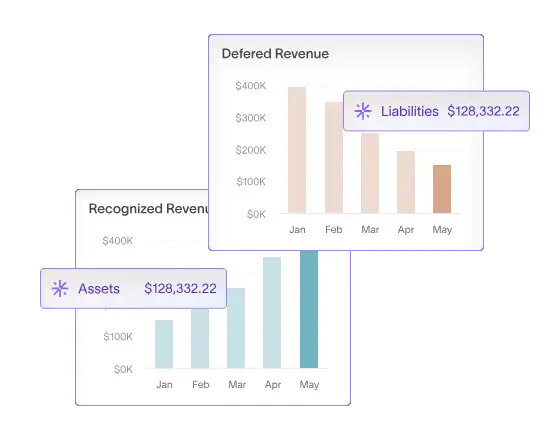
The deferred revenue journal entry cycle for a SaaS subscription has three phases. It starts at contract signing, when cash received is debited and the full contract value is credited to Deferred Revenue. For each period after that, as performance obligations are satisfied, liability is debited and Revenue is credited. At period-end, the remaining Deferred Revenue balance represents the obligations still outstanding.
Deferred revenue journal entries for a SaaS contract
Is deferred revenue a debit or credit?
Deferred revenue is initially recorded as a credit (liability). When revenue’s recognized, the liability is reduced with a debit to Deferred Revenue and a credit to Revenue. Deferred Revenue always has a credit balance on the balance sheet. A debit balance would signal an overpayment or recognition error needing investigation.
A tip for controllers: Keep separate deferred revenue sub-ledger accounts by performance obligation type. Platform, implementation, and support need their own sub-accounts. A single blended Deferred Revenue line on the balance sheet makes it impossible to audit recognition timing per PO. When auditors ask for the sub-schedule (and they will!), reconstructing it after the fact usually triggers a restatement [7] – and can raise questions about operating cash flow reporting – so it’s best to set up the chart of accounts up correctly from day one.
Variable consideration and usage-based SaaS revenue
Variable consideration in SaaS contracts (usage fees, overages, performance bonuses, refund provisions) must be estimated and constrained under ASC 606[1]. A SaaS company with usage-based tiers can’t recognize estimated overage revenue until the usage period’s complete and the amount is no longer subject to reversal. Unrecognized variable fees stay in Deferred Revenue until the constraint is lifted.
Types of variable consideration in SaaS contracts: estimation method, constraint, and recognition timing
Most likely amount works when there's a clear single outcome – the customer will either hit the overage tier or won't.
Expected value works when outcomes are distributed across a range, like SLA credit exposure across a portfolio of customers.
Whatever method you choose, document it for each variable element – noting down why you used it, and recording what the constraint analysis looks like at period-end.
A tip for controllers: If you’re running usage-based revenue, keep a standing variable consideration memo as part of your revenue recognition policy. The memo should document the estimation method for each variable element, the basis for the constraint, and the true-up procedure at period-end. Auditors test the memo against the recognized amounts directly. A missing or inconsistent memo is one of the most common ASC 606 findings in SaaS audits[6][5], but luckily it's also one of the easiest to prevent.
Contract-modification accounting: expansions, contractions and renewals
Under ASC 606, a SaaS contract modification (e.g. adding seats, upgrading tiers, extending a term) is treated as a separate contract only if two tests are met: the new performance obligations are distinct, and the price reflects the standalone selling price. If either test fails, the modification must be folded into the existing contract, requiring either a prospective adjustment to the remaining recognition schedule or a cumulative catch-up.
Types of SaaS contract change: ASC 606 treatment and the effect on deferred revenue
The SSP test is the practical decision point. If you have a documented, current standalone selling price for each product tier and service element, this is what separates a clean "separate contract" treatment from a messy modification. If you don’t have SSP evidence to share, auditors default to the modification position – which means catch-up adjustments, restated schedules, and potentially material movement in recognized revenue.
Deferred revenue on the balance sheet: what auditors scrutinize
Auditors testing deferred revenue under ASC 606 focus on four areas: whether all performance obligations have been identified, whether SSP is documented for each, whether variable consideration has been properly constrained, and whether any mid-period contract changes have been assessed. A deferred revenue balance that can’t be tied to signed contracts and recognition schedules is a material weakness risk.[4]
Checklist: deferred revenue audit readiness
- Tie every deferred revenue balance to a signed contract. When going through a SaaS balance sheet, auditors will ask for the source document behind every material balance.
- Keep separate sub-ledger accounts by performance obligation type. Blended schedules trigger requests for PO-level breakdowns, which are a pain to reconstruct retroactively.
- Document SSP for each PO. Update the SSP study whenever pricing changes, and at least annually as a best practice — ASC 606 does not mandate a specific refresh frequency, but auditors expect documentation to reflect current market rates. Keep hold of both the market assessment and the cost-plus approaches.
- Keep a variable consideration memo for any contract with usage-based or performance-contingent fees. Document the estimation method and the constraint basis.
- Keep a contract-modification log. Every expansion, contraction, and renewal needs to be assessed against the two-part modification test (distinct PO + SSP pricing) before the recognition treatment’s locked in.
- Reconcile the Deferred Revenue roll-forward monthly. Beginning balance + new bookings − revenue recognized = ending balance. Any variances? They’re a sign of incorrect recognition timing.
- Segregate current vs. non-current Deferred Revenue. Any obligation extending beyond 12 months from the balance sheet date should go to non-current Deferred Revenue.
Three key takeaways
- ASC 606 calls for each performance obligation in a multi-element SaaS contract to be identified and accounted for separately. A single deferred revenue account isn't enough, and the sub-ledger structure must reflect that from the start.
- Variable consideration from usage-based billing has to be constrained until significant reversal risk is gone. Estimating and recognizing it upfront is the most common path to a restatement.
- Every expansion deal needs a modification analysis against the two-part SSP test before you decide on a recognition treatment.
DualEntry automates ASC 606 revenue recognition schedules for multi-element SaaS contracts – including performance obligation allocation, variable consideration tracking, and contract modification analysis – so your revenue recognition is audit-ready before the books close. Schedule a demo now.
Deferred Revenue Recognition FAQs
See the full power of DualEntry in 30 minutes
Woosung Chun
CFO, DualEntry
Woosung Chun is the CFO of DualEntry with experience in corporate finance, accounting, strategy, and acquisitions. He previously grew from scratch and led the M&A and Finance teams at Benitago, where he completed more than 12 acquisitions in 2 years. He graduated with a BS from NYU Stern. At DualEntry, Woosung writes about AI in accounting, revenue recognition, foreign currency accounting, hedge accounting, and ERP modernization for finance teams navigating complex, multi-entity environments.