Don't worry! The contents here will appear on the published page.
Month-End Close Process: A CFO's Guide to Closing Faster

Woosung Chun
CFO, DualEntry
Woosung Chun
CFO, DualEntry
Woosung Chun is the CFO of DualEntry with experience in corporate finance, accounting, strategy, and acquisitions. He previously grew from scratch and led the M&A and Finance teams at Benitago, where he completed more than 12 acquisitions in 2 years. He graduated with a BS from NYU Stern. At DualEntry, Woosung writes about AI in accounting, revenue recognition, foreign currency accounting, hedge accounting, and ERP modernization for finance teams navigating complex, multi-entity environments.
Learn about our editorial policies.
Last updated
September 25, 2026
Reviewed by
Do San (Justin) Myung

Do San (Justin) Myung
Expert Accountant & Former Consulting CFO | DualEntry
Justin (Do San Myung) is Expert Accountant at DualEntry with 20+ years of hands-on experience managing general ledgers, financial close processes, and ERP implementations for mid-market and enterprise companies. As a former Consulting CFO and Controller, he has personally overseen month-end closes, SOX compliance programs, and multi-entity consolidations across technology, manufacturing, and services industries. Justin specializes in transforming manual accounting workflows into automated, AI-driven processes.
Learn about our editorial policies.
Summarize this article
The board wants last month's numbers, and your controller says they'll be ready next Thursday. That wait usually comes from a few steps where the close tends to stall, and most of them can be fixed. Below, we'll go through the close step by step, then look at how long it should take and what a slow one costs you.
What is the month-end close process?
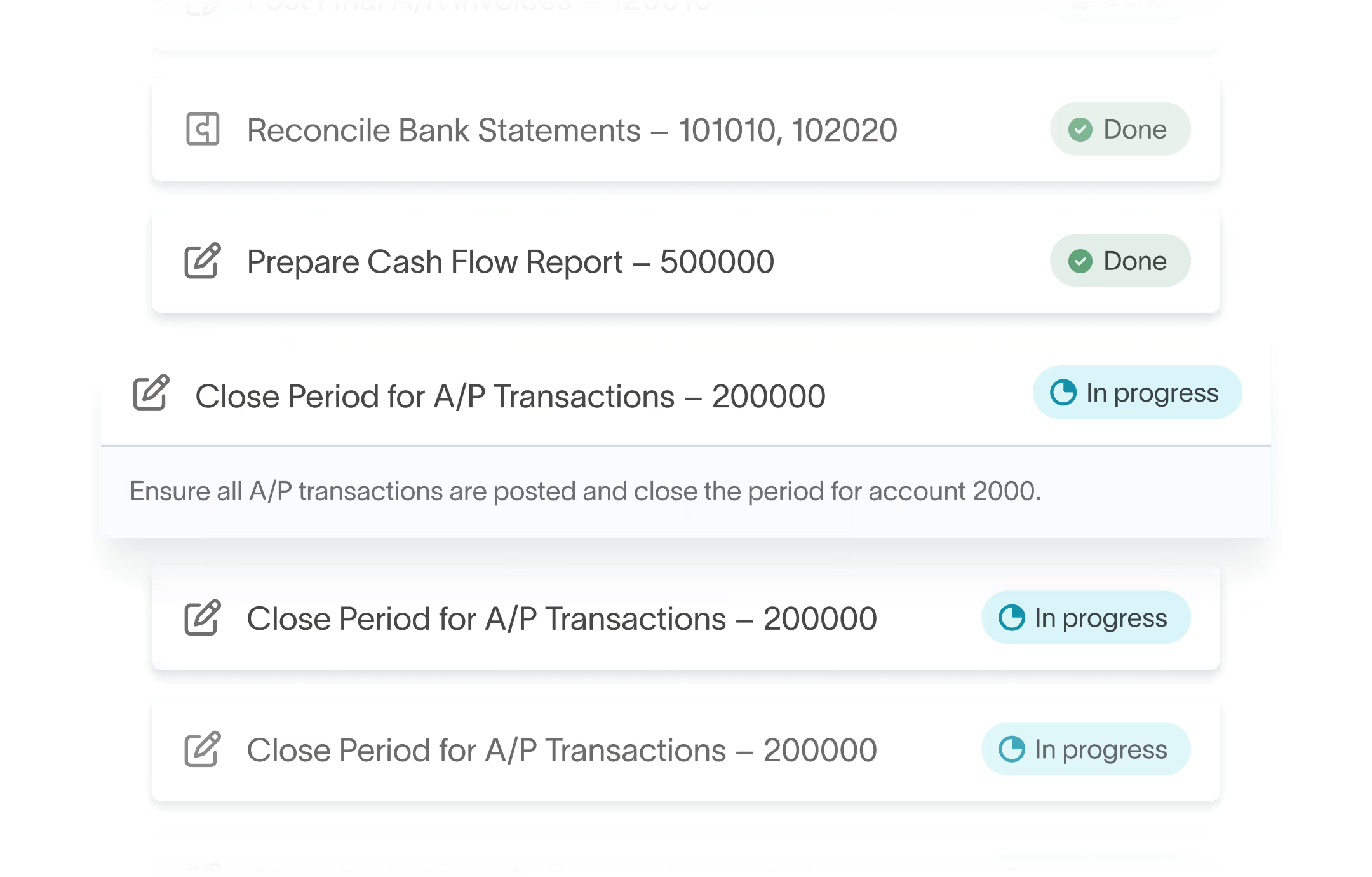
Month-end close is the process of reconciling, adjusting, and finalizing all accounts for an accounting period. Most companies do it monthly, creating the trial balance and financial statements that leadership, lenders, and auditors rely on. As transaction volumes and entity counts increase, the process takes longer and calls for tighter controls.
Closing the books means confirming that every account balance is accurate before anyone reports on it. For statements prepared under GAAP, that means account reconciliation, adjusting journal entries, and financial statement prep – all carefully documented. It’s a control process, not just data entry. [1]
The close does three jobs: verify account balances by reconciling subledgers to the general ledger, adjust the numbers by booking accruals and deferrals, and report results by producing statements and securing sign-off. If you skip any of these, you’ll end up with unreliable numbers.
Closes happen at different points in time. A monthly close covers routine reconciliations, standard adjustments, and a flux review. A quarter-end close goes deeper, adding quarterly board reporting and, for public companies, the Form 10-Q. [2] A year-end close also includes support for the external audit and full disclosure prep.
The monthly close in 8 steps
A monthly close moves through 8 sequential steps, from cutting off transactions to locking the period after sign-off.
The 8-step close, by owner and failure point
Step 1, the cutoff, is where closes can already lose their first day. Every invoice, expense report, and revenue event for the period needs to be captured before the subledger is closed, so a single late bill can throw off the process.
Step 2, the bank reconciliation, is usually done quickly – unless in-transit items or bank fees went unrecorded during the period.
At step 3, AP, AR, and fixed-asset subledgers are tied to the general ledger. At this stage, variances that can’t yet be explained are most likely to appear.
Adjusting journal entries record accruals, deferrals, and corrections before statements are produced. This is done at step 4, which involves judgment calls about cutoff timing – for example, how much of a contractor’s December invoice actually belongs to November.
ASC 606 governs how companies recognize revenue from contracts with customers [3], and for SaaS companies it is often the most judgment-heavy step of the close. At step 5, ASC 606 principles are applied to the period’s contracts, usage data, and deferred revenue roll-forward. This work can easily slow down the close, especially if your billing and revenue systems are disconnected.
Step 6 is where a lot of teams still work in spreadsheets – and consequently drag out the close. Multi-entity consolidation requires intercompany eliminations before consolidated reporting. [4] This is the work that many teams handle by hand, matching intercompany balances across every subsidiary before the numbers can be trusted.
Flux (variance) analysis explains period-over-period movements in account balances. So, step 7 turns raw numbers into an explanation that the CFO can comfortably bring to the board.
Finally, step 8 locks in the period and the audit trail. Reopening the period after sign-off (maybe because a late invoice turned up, or because a number was posted to the wrong account) means redoing reconciliation and explanations that were already signed off. No controller wants to go through that.
The different parts of the close
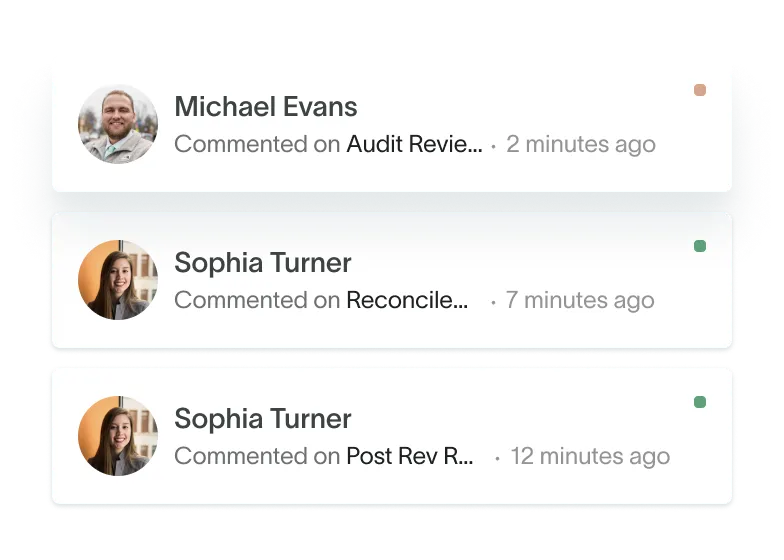
The month-end close touches every workstream that produces a balance sheet or income-statement line: cash, receivables, payables, accruals, prepaid expenses, revenue, payroll, fixed assets, intercompany. Each workstream has different tasks, but all guarantee the same thing: every reported number is backed by evidence and not carried over from the previous period.
The close by workstream
Find the full version of this table – complete with owners, close-day targets, and the evidence to collect for each task – in our complete month-end close checklist and downloadable template.
How long should the close take? Benchmarks and the “fast close” myth
Elite teams, running a continuous close, finish in three business days or fewer, and APQC’s open benchmark puts the median at 6.0 calendar days from trial balance to consolidated statements [6]. Only about one in five finance teams (18%) hit the three-day mark, and half take more than five, according to a 2025 Ledge survey of 100 finance professionals at companies with 51 to 10,000+ employees. [7] Earlier ISG/Ventana Research benchmark data found 61% of companies closing within six business days in 2019, up from 53% in 2015 – and reported anecdotal evidence that some companies reporting a fast close were still booking material corrections in the weeks afterward. [8] So the headline number can be misleading.
Days-to-close benchmark tiers
A close that finishes in 5 days but reopens twice for corrections is a 5-day close on paper only. The tiers above work as a rough diagnosis. A team closing in six or seven days with manual reconciliations – or past seven with disconnected systems – usually has a process problem to fix, and no amount of overtime in the final week will help that.
Days-to-close is a quality-adjusted metric, not a race. If your close takes one extra day and is right the first time, this will always beat a fast close that gets reopened. And reopened periods leave a trail that auditors will see. [9]
How company stage affects the close
A close isn’t one-size-fits-all. It evolves as a company scales – Seed/Series A, Series B/C, Series D, and pre-IPO. At each stage a new layer of complexity comes in, plus a new failure mode. Knowing your stage is the fastest way to know what to fix next. You shouldn’t copy a close process built for a different-sized company.
The close maturity model
Public companies don't get much runway either: Form 10-Q is due just 40 days after quarter-end for large accelerated and accelerated filers (45 days for everyone else). [2] A close that took 10 days at Series D is hard to sustain once quarterly auditor reviews [10] and disclosure controls [11] are added on top – it needs to be compressed. Pre-IPO teams also start compiling a PBC list for the external auditor on a regular basis, not just once a year.
Most Series B-D controllers are sitting in the Series B/C or Series D/growth stage right now. A second entity just went live, ASC 606 got more complicated, and the close that used to take five days now takes nine. That's because the tooling that worked fine at Series A can't keep up at Series C – at least not without a full rebuild. Waiting until it breaks completely to replace it just costs more in the long run. Skipping a stage won’t work either: the tooling gap shows up as extra close days before the org chart can catch up.
Why your close is slow
A slow close is most often caused by reconciliation [7] – above all, the gap between subledgers and the general ledger. Two more structural causes make things worse: handling multi-entity consolidation and intercompany eliminations manually, and using disconnected tools. So it’s usually a systems-architecture problem rather than a discipline one.
The three architecture taxes on your close
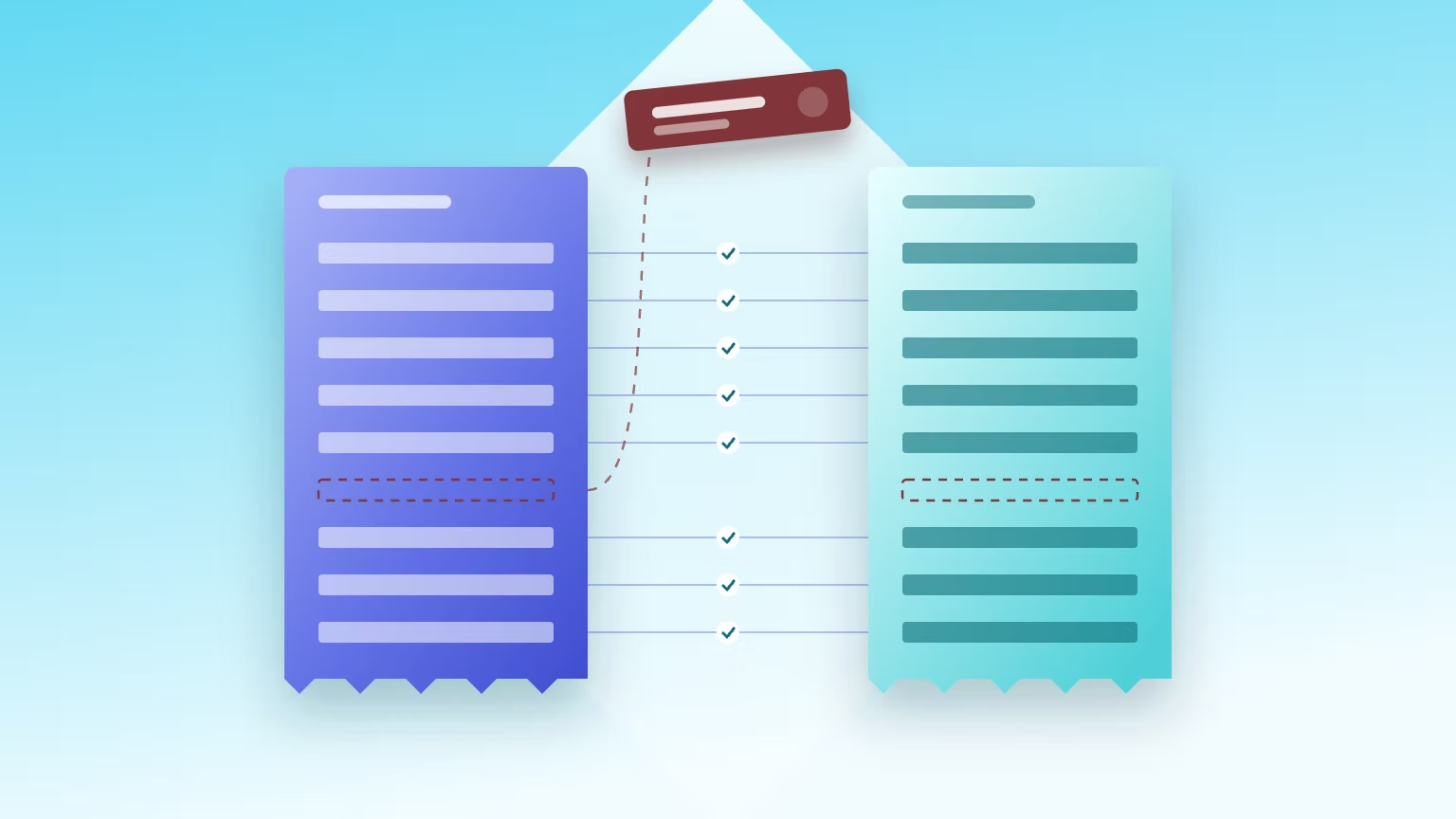
Account reconciliation validates subledger balances against the general ledger. When this validation is done by hand, in a spreadsheet, once a month, it's the first thing that goes wrong under scale. More entities, more transactions, more places for a number to move away from its source.
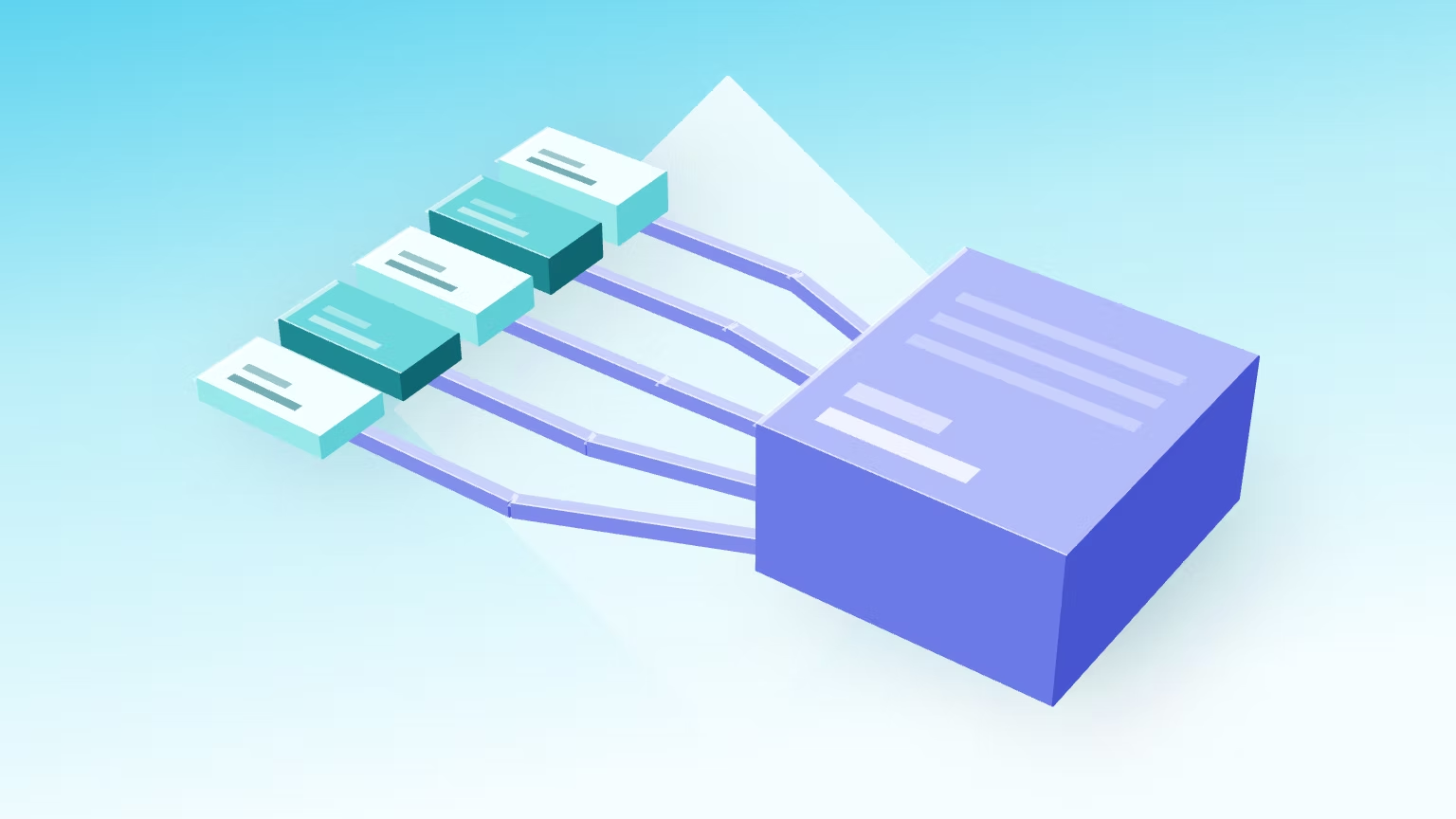
Manual consolidation adds its own days on top. Rolling up entities in a spreadsheet and eliminating intercompany balances manually means someone has to catch every single mismatched entry before the consolidated trial balance is deemed trustworthy. The review process takes longer every time a new entity is added, too.
None of the three architecture taxes show up on a headcount plan. Instead, they appear as extra days on the calendar every single period, whether the team worked overtime or not. These problems compound – fixing only one still leaves the other two dragging down your close.
What does a slow close cost?
Every extra day on the close has a cost across four axes: labor (FTE overtime hours), decision latency (board and investor numbers arriving late), risk (error and audit-fee exposure), and opportunity (finance stuck in R2R instead of FP&A). None of these show up as a line item on the income statement, but all four are calculable.
The cost-of-delay model
Not every team needs to fix the same thing first. Start by determining your main bottleneck:
- If reconciliation is the bottleneck: Automate the subledger-to-GL tie-out first
- If consolidation is the bottleneck: Fix multi-entity consolidation and intercompany eliminations first
- If data collection is the bottleneck: Fix upstream integrations and cutoff discipline first
- If reviews and reworks are the bottleneck: Fix standardization and checklist ownership first
Best practices for a fast close
%C2%A0.webp)
Continuous close distributes close tasks across the period instead of month-end. Teams that reconcile as they go rarely feel the crunch that others feel during week one of the next month.
6 tips for a faster close:
1. Move reconciliation into the period. Opt for a continuous close instead of a month-end crunch.
2. Standardize with a workstream checklist, closing calendar, and named owners for every task. Refer back to table 2 above for more on how to do this.
3. Automate the subledger-to-GL tie-out. This cuts out the biggest reconciliation tax.
4. Automate multi-entity consolidation and intercompany eliminations.
5. Kill CSV bridges. Integrate source systems into one ledger instead of keying between them.
6. Set a materiality threshold for flux and variance review. This keeps your focus only on material swings. [12]
You don’t need to follow the order above. It’s more important just to get started, so remove your biggest architecture tax, then move on to the next. Beyond sequencing, many teams run a soft close vs. hard close cadence: an abbreviated soft close for most months, which leans on estimates and skips some detailed reconciliations, and a full hard close at quarter-end and year-end, when statements go to auditors, lenders, or investors.
Practices 1, 2, and 6 are process fixes. They’re fast, they’re cheap, and they’re available with the tools already in place. Practices 3, 4, and 5 are structural, taking more effort to implement. However, they remove the underlying tax instead of leaving you to work around it every single period, and each ties back directly to one of the three architecture taxes: reconciliation automation removes the subledger-GL gap, consolidation automation removes the multi-entity tax, and killing CSV bridges removes the disconnected-tools tax.
Making the close smoother with an AI-native ERP
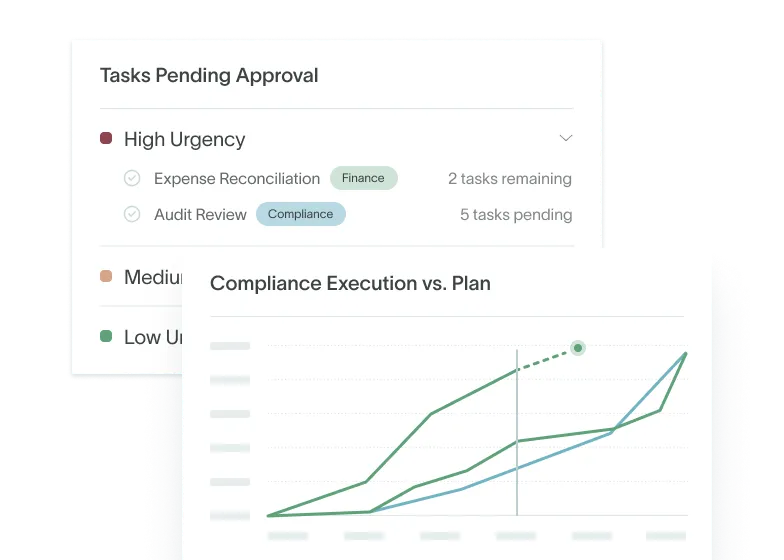
AI-native ERP can reduce days-to-close by automating reconciliation and consolidation. In practice, subledger transactions post straight to the general ledger instead of needing a monthly tie-out, and intercompany eliminations post automatically instead of by hand. At the category level, posting as transactions happen replaces period-end batch work, whichever vendor you choose.
DualEntry is built for Series B-D SaaS finance teams outgrowing QuickBooks (or a close tool bolted onto NetSuite). Bills, invoices, and payments post directly to its general ledger [13], which supports multi-entity and multi-currency structures natively. Elimination entries post when an intercompany transaction is recorded, so there's no separate consolidation run [14] – you close each entity's period and the consolidated view is ready. Bank Match AI proposes bank matches every 30 minutes for an accountant to accept [15], and an hourly anomaly scan flags unusual transactions for review. [16] Flux analysis runs on demand against the materiality thresholds you set, with AI-drafted variance explanations you can accept or edit [17], so step seven becomes a review instead of a scramble.
The result is fewer spreadsheet exports, an end to version-control questions about which tab is current, and a close that doesn't require blocking out a full week on the calendar. Trillion Digital, for example, went from closing its books 15 days after month-end in 2023 to closing within 24 hours of each day’s end in 2024. With a unified ledger and native consolidation, DualEntry removes much of the accounting friction for multi-entity SaaS businesses.
Last thoughts
The fastest closes come down to architecture: decisions about ledgers, consolidation, and system design made months before the period ever closes. Working harder in the last week of the month won’t help solve a structural problem.
Most companies' closes move through a similar maturity curve, and the stage you're in determines which architecture tax is costing you the most days. First, attack the one slowing you down most – be it subledger-to-GL reconciliation, multi-entity consolidation, or disconnected tools – and then the rest of the process will get easier by default.
See how DualEntry saves SaaS teams time by automating the close across multiple entities.
Month-end close process FAQs
See the full power of DualEntry in 30 minutes
Woosung Chun
CFO, DualEntry
Woosung Chun is the CFO of DualEntry with experience in corporate finance, accounting, strategy, and acquisitions. He previously grew from scratch and led the M&A and Finance teams at Benitago, where he completed more than 12 acquisitions in 2 years. He graduated with a BS from NYU Stern. At DualEntry, Woosung writes about AI in accounting, revenue recognition, foreign currency accounting, hedge accounting, and ERP modernization for finance teams navigating complex, multi-entity environments.