Don't worry! The contents here will appear on the published page.
What Is Accrued Revenue? Journal Entry, Examples & ASC 606

Do San (Justin) Myung
Expert Accountant & Former Consulting CFO | DualEntry
Do San (Justin) Myung
Expert Accountant & Former Consulting CFO | DualEntry
Justin (Do San Myung) is Expert Accountant at DualEntry with 20+ years of hands-on experience managing general ledgers, financial close processes, and ERP implementations for mid-market and enterprise companies. As a former Consulting CFO and Controller, he has personally overseen month-end closes, SOX compliance programs, and multi-entity consolidations across technology, manufacturing, and services industries. Justin specializes in transforming manual accounting workflows into automated, AI-driven processes.
Learn about our editorial policies.
Last updated
September 24, 2026
Reviewed by
Woosung Chun

Woosung Chun
CFO, DualEntry
Woosung Chun is the CFO of DualEntry with experience in corporate finance, accounting, strategy, and acquisitions. He previously grew from scratch and led the M&A and Finance teams at Benitago, where he completed more than 12 acquisitions in 2 years. He graduated with a BS from NYU Stern. At DualEntry, Woosung writes about AI in accounting, revenue recognition, foreign currency accounting, hedge accounting, and ERP modernization for finance teams navigating complex, multi-entity environments.
Learn about our editorial policies.
Summarize this article
You finished the work in March, but the invoice won't go out until April. Under accrual accounting, that revenue still belongs in March, so you need to record it before the bill exists. That's accrued revenue, and it shows up in most month-end closes. Below, we'll cover where it sits on the balance sheet, how to book it, and how ASC 606 treats it.
What is accrued revenue?
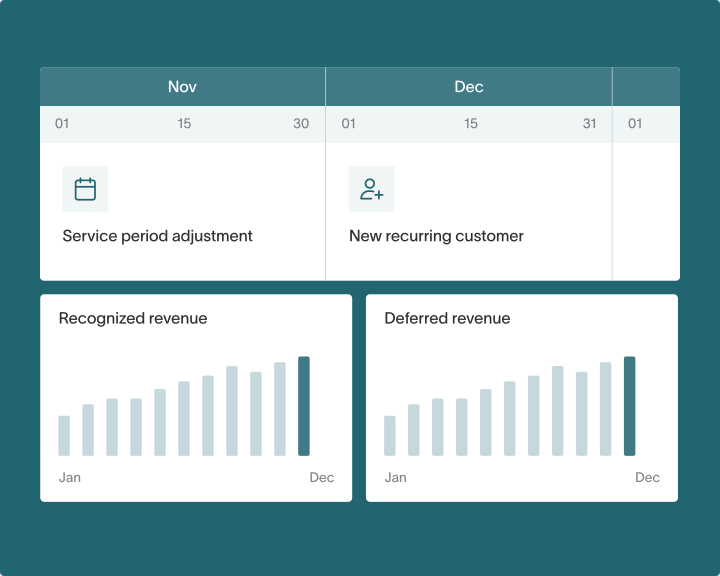
Accrued revenue is revenue earned but not yet billed or received. [1], [2] You’ve delivered the good or service so, under accrual accounting, you recognize the revenue now and record an asset for the payment you’re owed. The timing of the invoice doesn’t change the period the revenue belongs to.
It exists because of accrual accounting. Revenue is recognized when you satisfy a performance obligation, not when you send the invoice, and that also keeps it in the same period as the costs you incurred to deliver it (the matching principle). [3], [4]
Two accounts move: an asset goes up on the balance sheet, and revenue goes up on the income statement.
Accrued revenue is just one part of the wider revenue recognition rules, which set out when a performance obligation is satisfied and when revenue can be booked.
As a quick side note before we go deeper: you might see accrued revenue called “accrued income” (a common label under IFRS 15 and in the UK) [5], [6] or “unbilled revenue”, depending on who’s writing. [7], [2] Broadly, all three mean the same thing, although ASC 606 splits the balance into contract assets and receivables. [8] More on that below.
Is accrued revenue an asset?
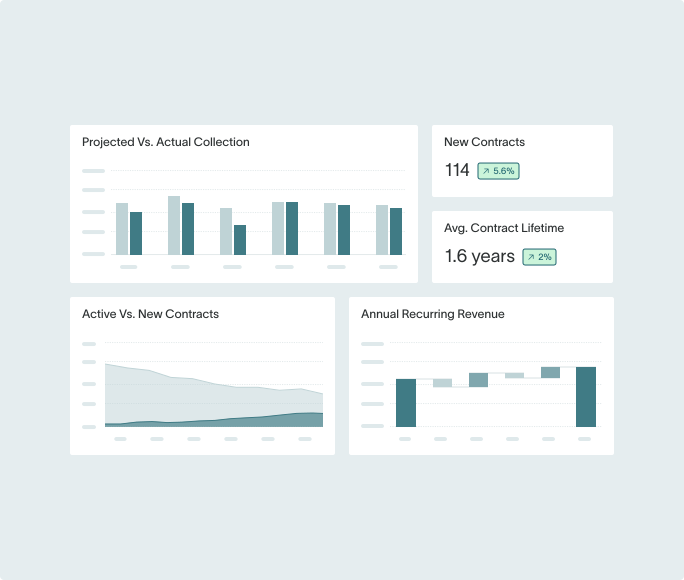
In short: yes. Accrued revenue is classified as a current asset on the balance sheet. This is because it represents a right to payment for value you’ve already delivered. Deferred revenue, meanwhile, works the other way: you’ve been paid (or have billed) for something you still owe, which makes it a liability. [9] Accrued revenue sits with your other current assets, usually next to accounts receivable. Under ASC 606, contract assets and receivables have to be kept apart, either as separate lines on the balance sheet or broken out in the notes. [8], [10]
Calling it a current asset is the right classification most of the time, as you’d typically expect to invoice and collect within 12 months. Under ASC 606, accrued revenue gets a more precise label. It’s a contract asset if your right to payment still depends on something other than time, and a receivable (often called an unbilled receivable) if it doesn’t. [11]
This is important to know if you’re reporting under GAAP, which we’ll cover later.
The accrued revenue journal entry, step by step
An accrued revenue journal entry is a debit to accrued revenue (a contract asset, or an unbilled receivable if your right to payment is already unconditional) and a credit to revenue, posted when you’ve earned the money but haven’t invoiced yet. When the invoice does go out, you need to debit accounts receivable and credit accrued revenue. The final step is collection, which clears the receivable to cash.
Here’s how the 3 steps look. Step 1 is the adjusting journal entry you post at close, before any invoice exists. The example assumes your right to bill is still conditional at month-end, so step 1 creates a contract asset.
Accrued revenue example: recognition → reclassification → collection
Step two is often described as “reversing the accrual”. Plenty of teams do book it that way: an auto-reversing entry on the first day of the next period, then the full invoice to revenue. Done correctly, the reversal and the invoice net off, and revenue stays in the month it was earned. Under ASC 606, though, what step two actually does is reclassify the contract asset to a receivable. [12]
The revenue was recognized in step one and isn’t touched again. What changes is the asset: a conditional right to payment becomes an unconditional one, so the debit moves from one asset account to another and the income statement sees nothing.
This matters at close. Reverse-and-rebill goes wrong when the reversal and the invoice don’t line up: the invoice amount differs from the accrual, or it lands in a different period from the reversal. Then revenue is double-counted or ends up in the wrong month, and your cut-off’s broken. Reclassifying directly avoids that.
Step three is ordinary collection. Cash goes up, the receivable clears, and the contract asset is
long gone.
Accrued vs. deferred vs. unbilled vs. accounts receivable
Three questions separate these terms. Has the revenue been earned? Has it been billed? And has the cash arrived? Accrued revenue is earned but unbilled. Accounts receivable is earned and billed. Deferred revenue is billed or paid, but unearned. A customer prepayment is cash in before anything is earned.
The revenue decoder: accrued vs. deferred vs. unbilled vs. AR
Unbilled revenue and accrued revenue are the same thing wearing different labels, and which one you see depends on the company and its system. Either way, the entry’s the same.
Once you issue an invoice, it moves from unbilled to accounts receivable. To sum up its whole journey: earned and unbilled -> earned and billed -> collected.
Deferred (unearned) revenue is the mirror of accrued revenue – a contract liability. You’ve taken the money before doing the work, so you owe the customer delivery.
The line between deferred revenue and a customer prepayment is narrower. Both are contract liabilities. [9]
Deferred revenue usually follows an invoice under an existing contract, while a prepayment or deposit can arrive before the obligations have started.
If you only remember one row of the table above, it should be the first. Why? Because accrued revenue is the only one of the four items that involves you delivering value but having nothing on paper to show for it yet. That makes it easy to miss at close. And when it’s missed, the revenue either slips into a later period or never gets billed at all, which is where revenue leakage starts.
When accrued revenue is a contract asset under ASC 606
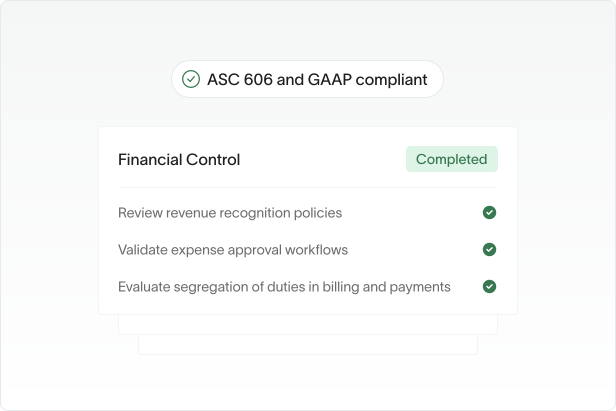
Under ASC 606, accrued revenue is a contract asset when your right to payment is conditional. The condition is something other than time passing (usually another obligation you still need to complete). Once only time stands between you and the payment, it’s a receivable, whether or not you’ve invoiced yet.
The distinction comes from ASC 606-10-45-3 and 45-4, and the wording is deliberately precise. A receivable is a right to consideration that’s unconditional, meaning “only the passage of time is required before payment of that consideration is due.” [11] That can be true before you’ve sent an invoice.
So what does ‘conditional’ mean in practice? Say you’re delivering a three-phase implementation and the contract only lets you bill once the second phase is complete. You’ve earned revenue on phase one, but your right to collect depends on finishing phase two. This is a contract asset, and it mirrors Example 39 in ASC 606’s implementation guidance. [12]
Until phase two is done, the contract gives you no right to bill for phase one.
Compare that with a straightforward monthly service, billed in arrears. Once the month’s service is delivered, nothing else has to happen before you can bill, and only the invoice and payment terms stand between you and the cash. This is a receivable, even on the last day of the month before the invoice goes out. [11]
Both contract assets and receivables sit under the credit-loss model in ASC 326, so both are subject to credit-loss testing. [13] Contract assets can be overlooked here, because teams often assume the reserve only applies to invoiced amounts. Since ASU 2025-05 (effective for annual periods beginning after December 15, 2025), any entity can elect a practical expedient for current receivables and current contract assets from ASC 606 transactions: it assumes conditions at the balance-sheet date hold for the rest of the asset’s life. [14]
ASC 606: contract asset vs. receivable
Accrued revenue in SaaS and usage-based billing
Usage-based billing in arrears creates recurring accrued/unbilled revenue at period end. Customers consume through the month and are invoiced after it closes, so the revenue is earned inside the period and billed outside it. Every close carries an accrual, and whenever metering isn’t final by close, that accrual needs an estimate.
- How it happens: Say a customer runs 40,000 API calls in March, metering finalizes on April 6, and the invoice goes out on April 8. March close is on April 4. The revenue belongs to March, so it accrues. Because the usage has already happened and only invoicing and payment terms remain, this is usually an unbilled receivable under ASC 606 rather than a contract asset. [11]
- Estimating before the final numbers are in: Common approaches are partial-month metering, a trailing average, or contracted minimums. The method used matters less than applying it the same way every single month (and documenting why you chose it, too). [15]
- The true-up: When actuals arrive after close, the difference is a change in estimate and adjusts revenue in the current period, not March. [16] Small variances are normal, but a pattern of large ones suggests your estimation method needs a rework.
- The control risk: An over-accrual inflates revenue without anyone touching an invoice, so it’s hard to spot. [17]
Estimated accruals need supporting calculations, as well as a reviewer who isn’t the preparer.
Milestone billing creates accrued revenue too, for a different reason. Revenue recognizes as you satisfy performance obligations, while the billing schedule follows contract milestones – so the two rarely line up. [3]
Percentage-of-completion work (recognition ‘over time’ under ASC 606) has the same problem. Under ASC 606 it’s revenue recognized over time against a measure of progress, while billing waits on the contract schedule. [18]
Automating accrued revenue with an AI-native ERP
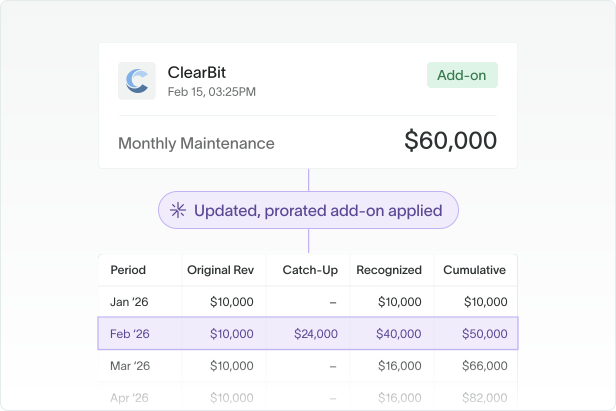
An AI-native ERP recognizes revenue as it's earned and posts the recognition entries without anyone opening a spreadsheet. It builds the revenue schedule from the contract and recognizes usage-based revenue from the consumption you record. DualEntry is one example built for teams billing on usage.
The difference you instantly notice is that revenue recognition goes from a month-end spreadsheet exercise to a schedule the system maintains from the contract.
DualEntry generates the revenue schedule when a contract is activated and creates the journal entries automatically at each recognition cadence you set, from daily to annually. It supports usage-based and milestone recognition strategies, and each entry links back to its source obligation, with status changes logged in the audit trail. [19]
For a Series B to D SaaS team billing on usage or milestones, that's the difference between rebuilding the schedule by hand every month and reviewing entries the system has already drafted from the contract and the usage you’ve recorded.
Getting accrued revenue right
Accrued revenue is a gap that opens once the work’s done but the invoice hasn't gone out yet. It’s recorded as an asset, so the revenue arrives in the period you earned it. Under ASC 606, that asset is a contract asset while your right to payment is conditional, and a receivable the moment it stops depending on anything but time.
If you bill on usage, that gap opens every month – which makes the accrual a permanent fixture of your close. Handling it in spreadsheets only works on a smaller scale. For ambitious, fast-growing companies, bringing automation into the workflow is key.
See how DualEntry takes the manual work out of revenue recognition, or read our companion guide to deferred revenue.
Accrued revenue FAQs
See the full power of DualEntry in 30 minutes
Do San (Justin) Myung
Expert Accountant & Former Consulting CFO | DualEntry
Justin (Do San Myung) is Expert Accountant at DualEntry with 20+ years of hands-on experience managing general ledgers, financial close processes, and ERP implementations for mid-market and enterprise companies. As a former Consulting CFO and Controller, he has personally overseen month-end closes, SOX compliance programs, and multi-entity consolidations across technology, manufacturing, and services industries. Justin specializes in transforming manual accounting workflows into automated, AI-driven processes.
.webp)