Don't worry! The contents here will appear on the published page.
AI Is Getting Cheaper. Why Are Companies Spending So Much More?

John Iwuozor
Content Lead, Finance and Research
John Iwuozor
Content Lead, Finance and Research
John Iwuozor leads content, finance, and research at DualEntry. He writes for the people who actually close the books: controllers running month-end, CFOs weighing an ERP migration, accountants buried in reconciliations. Before DualEntry he spent five years covering B2B SaaS and fintech for Forbes Advisor, Ramp, and Infosecurity Magazine. He builds every piece on primary data, including benchmarks, practitioner interviews, and product testing, rather than recycled advice. He is also an avid chess player.
Learn about our editorial policies.
Last updated
September 22, 2026
Reviewed by
Summarize this article
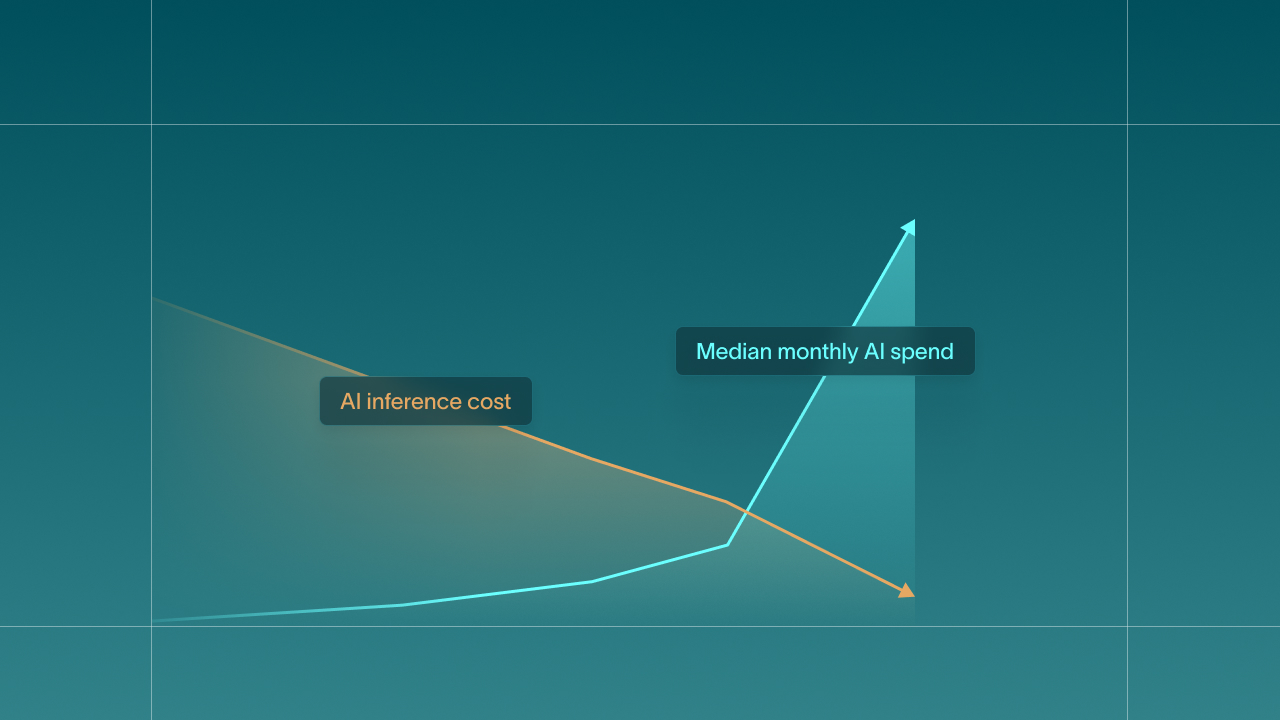
AI is getting cheaper fast enough that a price war is now visible across the market. Vercel, whose AI Gateway routes tens of trillions of tokens every month, says the average token costs less than half what it did five months ago and fell 23.2% in August.
The same is happening with frontier models. OpenAI reduced Luna pricing by 80% and Terra by 20% before cutting Sol by more than 20% for three months in August, while Anthropic says Fable 5.1 costs about 25% less on a typical workload and up to 45% less on highly agentic ones.
Normally, price cuts of that magnitude should show up as savings, but cheaper AI is also making far more usage economical. After OpenAI cut Luna's price, CFO Sarah Friar said usage increased 10x.
Falling unit costs are being offset by a rapid expansion in consumption. The oddity shows up in the ledger: across DualEntry customers, median monthly AI spend rose from $196 in January 2024 to $14,276 in August 2026, or roughly 73x.


Agents are changing what “cheap AI” even means
A 160-year-old economic idea helps explain what is happening. In 1865, William Stanley Jevons observed that making steam engines more efficient did not reduce coal consumption. It made steam power cheaper and useful in more places, which ultimately increased the amount of coal being consumed. The phenomenon became known as the Jevons paradox.
AI is beginning to show the same pattern. As inference gets cheaper, companies can afford to use it more often, across more products and for tasks that would previously have been too expensive to automate.
Agents can extend that further because a single task may involve several rounds of reasoning, searches, tool calls and retries rather than one prompt and one response. That is why price per token is becoming a less complete measure of what AI actually costs.
AI is becoming a finance problem
The financial impact becomes much larger as companies use more AI vendors. Across the latest 12 months, median annual AI spend was about $800 among companies using one or two vendors.
That increased to $9,774 for companies using three to five vendors, $120,024 for six to nine vendors and $392,278 for companies using 10 or more.

More vendors do not necessarily cause higher spending. Companies making heavier use of AI are also more likely to pay for more tools. But the relationship shows how quickly AI can move from another software expense into a significant and less predictable cost for finance teams.
Rising AI spend doesn’t settle the AI bubble debate
The spending growth answers one question hanging over the AI boom: businesses are putting real money behind the technology. It does not tell us whether that demand can support the valuations and infrastructure commitments being built around it.
Anthropic is heading toward an IPO that could value it around $2 trillion, while OpenAI expects nearly $280 billion of negative free cash flow through 2030 despite forecasting enormous revenue growth. At the same time, cheaper open-weight and Chinese models are making frontier intelligence more competitive on price, creating the possibility that the product becomes more widely used while the margins available to its suppliers get squeezed.
AI is becoming cheaper to consume, and companies are finding considerably more places to spend on it. Whether that consumption creates enough economic value to justify the capital being poured into the industry is the much larger wager.
See the full power of DualEntry in 30 minutes
John Iwuozor
Content Lead, Finance and Research
John Iwuozor leads content, finance, and research at DualEntry. He writes for the people who actually close the books: controllers running month-end, CFOs weighing an ERP migration, accountants buried in reconciliations. Before DualEntry he spent five years covering B2B SaaS and fintech for Forbes Advisor, Ramp, and Infosecurity Magazine. He builds every piece on primary data, including benchmarks, practitioner interviews, and product testing, rather than recycled advice. He is also an avid chess player.
.webp)