Don't worry! The contents here will appear on the published page.
Airtable, Then Miro: Bending Spoons Is Buying $1 Billion of SaaS ARR in Just 5 Weeks

John Iwuozor
Content Lead, Finance and Research
John Iwuozor
Content Lead, Finance and Research
John Iwuozor leads content, finance, and research at DualEntry. He writes for the people who actually close the books: controllers running month-end, CFOs weighing an ERP migration, accountants buried in reconciliations. Before DualEntry he spent five years covering B2B SaaS and fintech for Forbes Advisor, Ramp, and Infosecurity Magazine. He builds every piece on primary data, including benchmarks, practitioner interviews, and product testing, rather than recycled advice. He is also an avid chess player.
Learn about our editorial policies.
Last updated
September 17, 2026
Reviewed by
Summarize this article
In a little over five weeks, Bending Spoons announced agreements to acquire two of the best-known software companies of the last decade.
First came Airtable. On August 4, Bending Spoons agreed to acquire the company for $1.285 billion in enterprise value, against roughly $480 million in annual recurring revenue. The deal closed on September 4. Six days later came Miro, which Bending Spoons agreed to acquire for $1.355 billion, against around $600 million in ARR.
Between them, Airtable and Miro generate roughly $1.08 billion in ARR against $2.64 billion in enterprise value, or about 2.4 times ARR.
We wrote last month about what Airtable’s 2.7-times multiple says about the reset in software valuations. Adding Miro raises some questions: how does Bending Spoons keep doing deals like these, and why are companies of this scale available at these prices in the first place?
The first answer is in Bending Spoons’ operating model. It buys established digital businesses, makes them more efficient, and uses the earnings to fund more acquisitions.
Evernote, Vimeo, Eventbrite, Meetup, and AOL are already part of the portfolio, and the company has completed more than 50 acquisitions. The aggregate enterprise value of the businesses it acquired rose from $194 million in 2023 to $2.01 billion in Q1 2026.
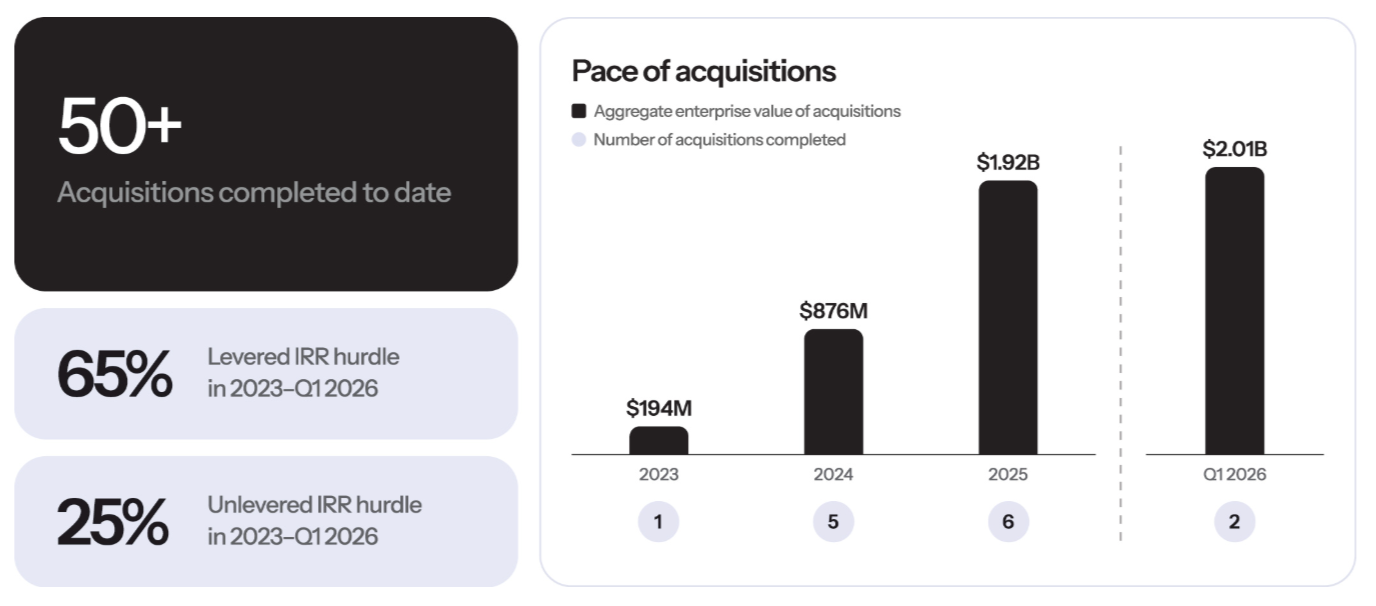
Its July 1 Nasdaq listing added more firepower, with the IPO ultimately raising $1.10 billion in net proceeds. But its IPO prospectus also shows how high the bar is for putting capital to work. For acquisitions completed from 2023 through Q1 2026, Bending Spoons generally applied a 65% levered IRR hurdle and a 25% unlevered hurdle.
How Bending Spoons makes these deals work
Its filings show three recurring moves:
- Buy demand that already exists. Bending Spoons tends to acquire products with established brands and large existing user bases. Airtable serves more than 500,000 organizations, Miro has nearly 4 million paying users, and more than 200 million people had created an Evernote account before Bending Spoons acquired it.
- Make the business cheaper to run. At StreamYard, Bending Spoons cut the team from 154 people to 44, absorbed most back-office work into the wider company, removed unnecessary vendor contracts, and reduced infrastructure costs. At Remini, it rewrote the codebase, removed non-core features, and built systems to use cheaper computing resources when demand spiked.
- Get more revenue from the customers already there. Bending Spoons ran more than 140 monetization tests at StreamYard, helping lift conversion from organic users to subscribers by 66%. Remini shifted heavily toward subscriptions and went through more than 1,000 monetization experiments, while Evernote’s average revenue per monthly active user reached 2.5 times its pre-acquisition level by 2025.
It’s a pretty brutal model. Bending Spoons calls part of the process bringing established businesses “back to startup mode,” which can mean much smaller teams, fewer management layers and repeated changes to pricing and monetization. Push that too far and optimization can tip into enshittification, but so far the financials say the model is working.
Revenue rose from $387 million in 2023 to $1.31 billion in 2025, while adjusted operating margin climbed from 36% to 47%. By Q2 2026, that margin had reached 54%, so whatever you think of the model, the economics are difficult to argue with.
The other side of the SaaSpocalypse
Airtable and Miro show how quickly the economics around a SaaS company can change even when the business itself is still substantial.
Airtable was valued at $11.7 billion in 2021, but its sale to Bending Spoons implies about $2.25 billion of equity value, roughly 81% lower.


Miro’s drop is even steeper. It went from a $17.5 billion valuation in 2022 to about $1.79 billion today, a fall of almost 90%.

Part of what makes Miro interesting is how much the market around the product has changed. It now has plenty of rivals, including Canva, Microsoft and Figma. Some of the companies that might once have looked like obvious buyers have built their own whiteboarding tools, while more capital is flowing toward AI instead.
A workflow that once required another $20-a-month subscription might now be something a team builds with Claude Code, connects through an MCP server, or handles inside a larger product it already pays for. There are still plenty of reasons to buy specialized software, but simply turning a workflow into SaaS is no longer much of a moat by itself.
That leaves a growing group of software companies with strong recurring revenue and useful products, but without the growth profile that once justified enormous private-market valuations.
What happens next?
- There will probably be more Airtables and Miros. A lot of venture-backed SaaS companies are still good businesses, but the valuations from their last rounds are getting harder to grow back into. For some of them, selling at a lower price may simply become a more realistic exit.
- Buyers with an operating model may have the advantage. Bending Spoons is not buying these companies and hoping the market suddenly loves them again. It already has a clear idea of what it wants to change after the deal closes, from headcount and infrastructure to pricing and monetization.
- The multiple has to be earned now. Recurring revenue is still valuable, but it no longer guarantees a huge valuation on its own. Once growth slows, buyers start looking much harder at margins, cash flow and how defensible the business really is.
What Bending Spoons is exploiting is not the death of SaaS, but the gap between what some of these companies were once expected to become and what buyers are willing to pay for them today. The question now is how many other late-stage SaaS companies are sitting in that same gap.
See the full power of DualEntry in 30 minutes
John Iwuozor
Content Lead, Finance and Research
John Iwuozor leads content, finance, and research at DualEntry. He writes for the people who actually close the books: controllers running month-end, CFOs weighing an ERP migration, accountants buried in reconciliations. Before DualEntry he spent five years covering B2B SaaS and fintech for Forbes Advisor, Ramp, and Infosecurity Magazine. He builds every piece on primary data, including benchmarks, practitioner interviews, and product testing, rather than recycled advice. He is also an avid chess player.
.webp)