Don't worry! The contents here will appear on the published page.
ARR vs MRR: Why ARR Isn't MRR × 12

Woosung Chun
CFO
Woosung Chun
CFO
Woosung Chun is the CFO of DualEntry with experience in corporate finance, accounting, strategy, and acquisitions. He previously grew from scratch and led the M&A and Finance teams at Benitago, where he completed more than 12 acquisitions in 2 years. He graduated with a BS from NYU Stern. At DualEntry, Woosung writes about AI in accounting, revenue recognition, foreign currency accounting, hedge accounting, and ERP modernization for finance teams navigating complex, multi-entity environments.
Learn about our editorial policies.
Last updated
October 16, 2026
Reviewed by
Do San (Justin) Myung

Do San (Justin) Myung
Expert Accountant & Former Consulting CFO
Justin (Do San Myung) is Expert Accountant at DualEntry with 20+ years of hands-on experience managing general ledgers, financial close processes, and ERP implementations for mid-market and enterprise companies. As a former Consulting CFO and Controller, he has personally overseen month-end closes, SOX compliance programs, and multi-entity consolidations across technology, manufacturing, and services industries. Justin specializes in transforming manual accounting workflows into automated, AI-driven processes.
Learn about our editorial policies.

Summarize this article

TL;DR
MRR measures normalized recurring revenue earned in a single month. ARR annualizes the recurring revenue of all active contracts at a point in time. Use MRR to manage monthly momentum and ARR for planning, valuation, and board reporting. ARR equals MRR × 12 only when contract mix and usage are stable.
By convention, both metrics exclude one-time fees, implementation, and professional services – though as we’ll see, “by convention” is doing real work in that sentence. The difference to keep in mind is timing. MRR is a flow, telling you what a month produced. ARR, meanwhile, is a snapshot telling you what the contract base is worth right now if nothing changes.
In this article, we’ll cover when the ×12 shortcut breaks down and which number belongs in front of a board.
ARR and MRR: the differences at a glance
What is MRR?
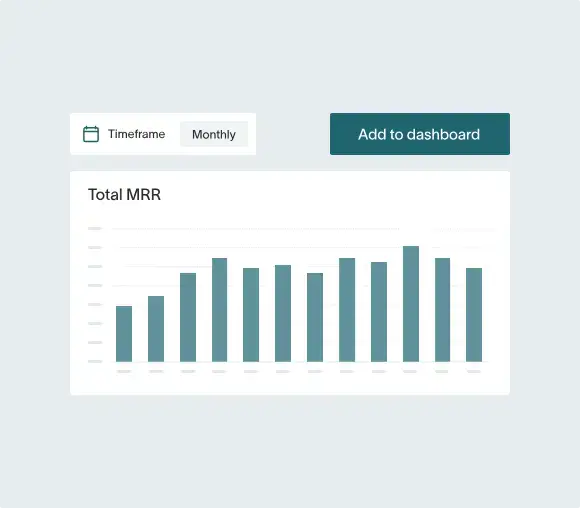
Monthly recurring revenue (MRR) is the normalized value of all active recurring subscriptions in a single month. You calculate it by summing each customer's monthly-equivalent subscription fee – an annual $12,000 contract contributes $1,000. One-time fees, services, and non-recurring charges are excluded.
The MRR formula
As outlined above: you need to add up all active subscription revenue at its monthly-equivalent value.
Take a company with 40 customers paying $500 a month and 12 customers on $18,000 annual prepay contracts. The monthly payers contribute $20,000, and the annual cohort contributes $1,500 each (or $18,000 together). MRR is $38,000.
What makes up MRR
Add new MRR and expansion MRR, then subtract contraction and churn MRR. What's left is net new MRR. Public filers draw the same line: CrowdStrike’s ARR “includes any expansion and is net of contraction or churn over the trailing 12 months, but excludes revenue from new subscription customers in the current period” [1] – the retention components on one side of the bridge, new business on the other. Built that way, the bridge shows you why the number changed. Two companies can report the same $38,000, yet move in opposite directions. Some bridges add a fifth line for reactivation MRR; the full formula set is in our SaaS metrics cheat sheet.
MRR normalizes recurring revenue to a single month, which makes it the fastest feedback loop finance owns. Where customers bill monthly, a pricing change or churn spike shows up within 30 days. On an annual-prepay base it surfaces only at renewal.
You shouldn’t use MRR for valuation purposes or for anchoring your annual budget. Both of those things need the contracted base, not one month's output.
What is ARR?

Annual recurring revenue (ARR) is the annualized value of all active recurring contracts at a point in time. It’s a forward-looking operating metric, not revenue recognized under ASC 606. [2] A $36,000 three-year contract contributes $12,000 of ARR while active.
The ARR formula (with mixed contracts)
Normalize every active contract to a 12-month value, then add them up.
Take four contracts:
- A $60,000 one-year deal
- A $210,000 three-year deal
- A $36,000 two-year deal
- And a monthly customer at $2,000.
Their current-year values are $60,000, $70,000, $18,000, and $24,000. ARR is $172,000, against $306,000 of contracted value – plus a month-to-month customer with no contracted term at all, which is exactly the kind of line that has to be disclosed rather than blended.
Note what just happened. The three-year deal is straight-lined at $70,000, which assumes flat pricing across the term – and the monthly customer is annualized at $24,000, which is MRR × 12. Three contracts on a contracted-value basis, one on a run-rate basis. That blend is normal. Leaving it undocumented is not.
Another thing to keep in mind: ARR isn’t annual revenue. GAAP revenue is backward-looking, recognized under ASC 606, and audited [2]. ARR isn’t GAAP revenue – it’s an operating metric, forward-looking and defined by management rather than by an accounting standard.
Because of this, ARR definitions vary by company. Take Datadog, which defines ARR as “the annualized revenue run-rate of subscription agreements from all customers at a point in time,” [3] calculated by taking MRR and multiplying it by 12 – usage revenue included. Other filers annualize the contracted base instead. Datadog’s choice is not an error: it is a disclosed convention, applied consistently, with the method stated – and Datadog is explicit that ARR and MRR “should be viewed independently of revenue” and are “not intended to be replacements or forecasts of revenue.”
That is the standard the rest of this article is arguing for. Investors value SaaS companies as a multiple of ARR, adjusted for growth rate and net revenue retention – the three variables
SaaS Capital’s private-company valuation model is built on [4][5]. Their index tracks annualized current run-rate revenue rather than trailing or projected revenue, and is refreshed monthly – so any multiple you quote needs a date attached.
The 12× trap: when ARR ≠ MRR × 12
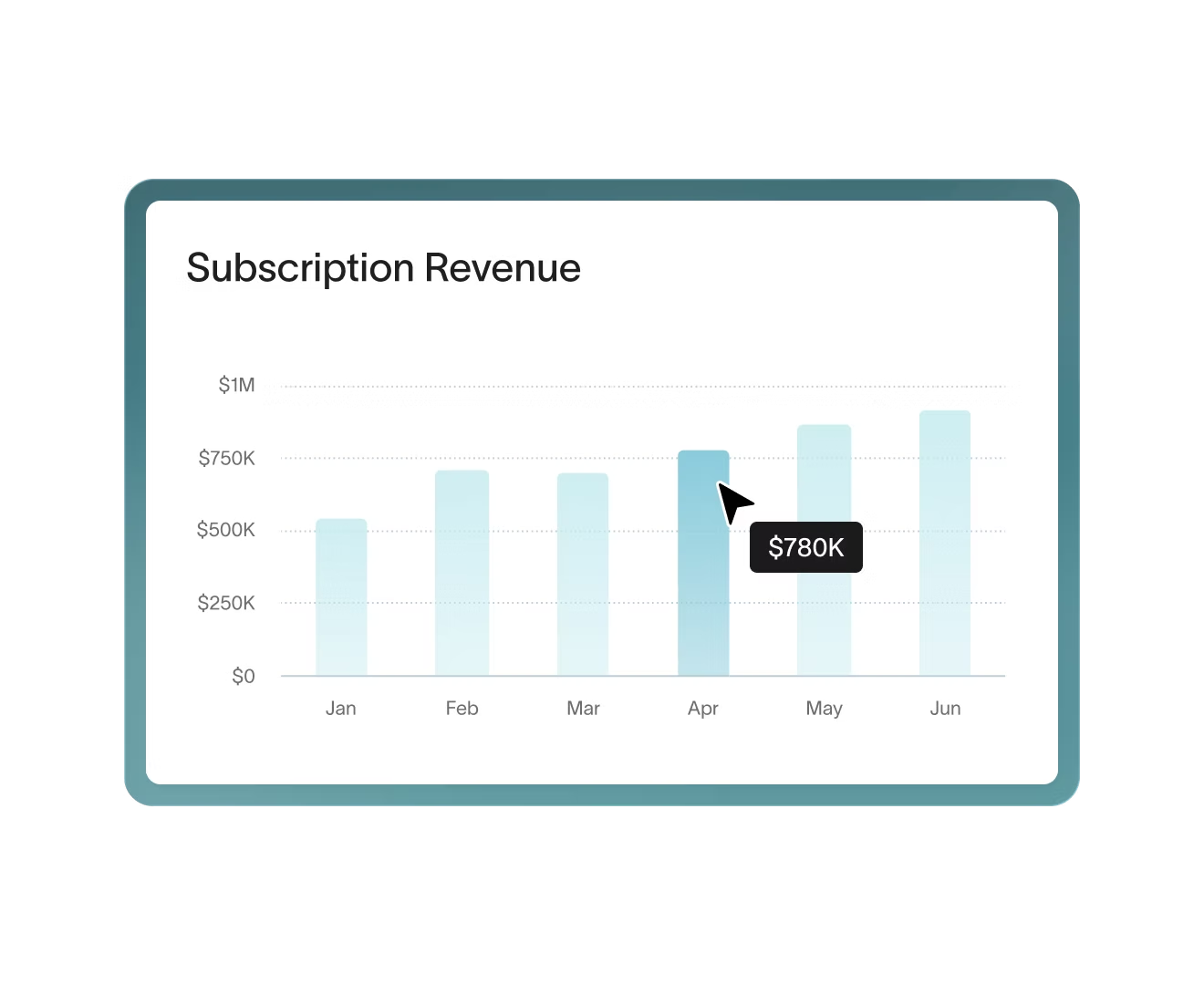
ARR equals MRR × 12 only when contract mix, usage, and customer count are stable. Usage-based pricing, ramped multi-year deals, mid-month starts and churn, seasonal usage, and FX translation in multi-entity groups all make annualized MRR diverge from contracted ARR. The examples below run from a 29% spread to a two-thirds gap.
5 scenarios where ARR ≠ MRR × 12
MRR is a flow, meaning an unusual month is just that: an unusual month. ARR annualizes active recurring contract value at a point in time – so whatever is true on that one date sets the figure for a full year. The ×12 shortcut mixes the two: it takes a single month's result and claims it will hold for the next twelve.
Here’s how each of the scenarios above looks in terms of numbers:
- Usage-based pricing: A data platform bills $310,000 in a peak month and $240,000 in a quiet one, so ×12 gives $3.72M or $2.88M from the same contract base. Usage-based pricing breaks the ARR = MRR × 12 identity.
- Ramped multi-year deals: A 3-year contract priced at $8,000, $12,000, and $16,000 a month annualizes to $96,000 today. The term’s worth $432,000, and next year's run rate is 50% higher.
- Mid-month starts and churn: A $120,000 annual contract that goes live on the 21st adds about $3,333 to that month’s MRR if you prorate. Annualized, that’s $40,000 against a contract worth $120,000. Normalize instead – count the full $10,000 from day one – and the gap disappears. Same contract, same month, two answers: which one you get is a policy choice, not a fact.
- Seasonal usage or pauses: A K-12 education platform posts $900,000 of MRR in September and $300,000 in July. Annualize either and you project one season across all four quarters.
- FX in multi-entity groups: A €1M contract is fixed in euros. Translate at $1.05 per euro one month and $1.12 the next, and reported MRR rises about 7% on a contract that hasn’t changed.
The rule of thumb? The more usage-based your pricing is, the less meaningful ×12 is. It’s important to report both figures and footnote the annualization method used. This way, anyone comparing one quarter to the next will know the number was built the same way each time.
Which metric should you report?
Report MRR when most customers bill monthly and the audience is operational. Report ARR when annual or multi-year contracts dominate and the audience is a board or investors. By Series B, our advice is to run both: MRR for management cadence, and ARR for external reporting.
Decision framework: how to choose your leading metric
Billing cadence and ACV do most of the work in the table above: a $3,000 self-serve product billed monthly has no annual contract to annualize, while a $40,000 sales-led contract on 3-year terms already has an annual value. Audience settles the rest. Growth benchmarks are denominated in ARR as well, and they taper as scale rises: SaaS Capital’s survey of more than 1,000 private B2B SaaS companies puts the 2025 median at 22%, with 2024 medians running from 40% below $1M ARR down to 20% above $10M [6]. OPEXEngine, Bain & Company’s software benchmarking arm, tracks the taper further up the curve – 18% growth for the $10–50M cohort in 2025, falling to 11% at $100–500M [7]. A board tracking net new ARR against the market is doing that math, whether you present it or not.
If you're a PLG company, you'll usually make the switch from MRR to ARR when you sign your first annual contracts. You should keep MRR for the internal cadence and add ARR for external reporting. Announce the change, restate the prior periods, and show both series side by side for a few quarters on the same SaaS metrics dashboard.
Consistency matters more than choosing the metric that’s ‘better’ in theory. If you switch metrics halfway through, diligence teams will read it as manipulation, even if your reasoning was sound.
Why ARR needs a definition policy
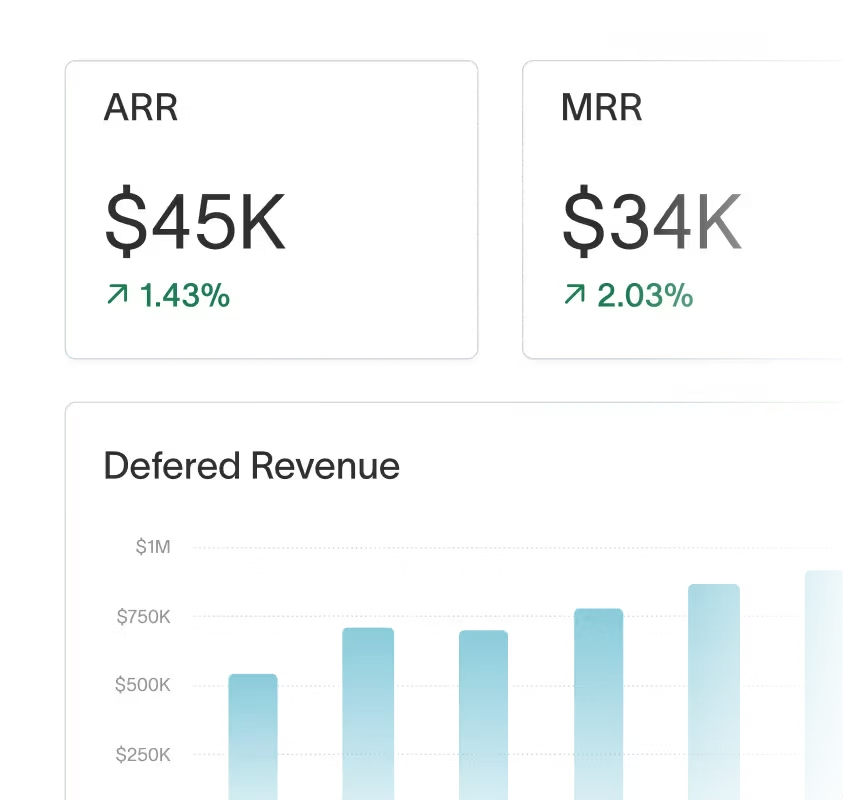
ARR and MRR are operating metrics, not non-GAAP financial measures: no accounting standard defines them, and auditors don’t opine on them – though an auditor does have to read them for material inconsistency with the audited financials, a duty that attaches to annual reports and Exchange Act filings, not to every investor update. [8][9] A written definition policy – what's included, how usage is annualized, the snapshot date, FX treatment – is what makes the metric survive diligence and SEC scrutiny.
ARR is not a non-GAAP financial measure. Item 10(e)(4)(i) of Regulation S-K carves out operating and statistical measures [10], and the SEC restated the point at footnote 10 of Release 33-10751 [11]. What governs ARR is that release itself: the SEC’s MD&A guidance on key performance indicators. The Commission said it would generally expect a filer to give a clear definition of the metric and how it is calculated, a statement of why it provides useful information to investors, and a statement of how management uses it in monitoring the business. It also asks the filer to consider whether estimates or assumptions underlie the metric, and whether disclosing them is necessary for the metric not to be materially misleading. That is a definition policy, described by the SEC. (The line moves once a metric starts from a GAAP amount: “calculated billings” – revenue plus the change in deferred revenue – is one filers routinely present as a non-GAAP measure, reconciled to revenue.) [12]
And the staff enforces it. In March 2023 the SEC asked Alteryx about its ARR metric: “It is unclear how annualizing the value of these short-term contracts results in a measure that accurately depicts annual recurring revenue.” [13] Alteryx renamed the metric “Annualized Recurring Revenue” and added a line to its definition: “Annualizing contracts with terms less than one year results in amounts being included in our ARR calculation that are in excess of the total contract value for those contracts at the end of the reporting period.” [14] That is the ×12 trap, in a comment letter, with a filer conceding it in writing.
Public filers do disclose RPO under ASC 606-10-50-13 – but the exemptions are wide. 606-10-50-14 carves out performance obligations where the contract has an original expected duration of a year or less, and 606-10-50-14A carves out variable consideration allocated entirely to a wholly unsatisfied performance obligation. A monthly-billing SaaS business, or a usage-priced one, can be fully compliant with very little RPO on the page. [2][15] ARR fills that gap, and sits outside that discipline entirely.
A run-rate definition like Datadog’s [3] and a contracted-base definition produce different numbers from the same book of business. Neither is wrong. Undefined is wrong.
The checklist below covers the 8 decisions that come up in diligence. Usage treatment matters most: annualizing a trailing month, a trailing-quarter average, or committed minimums only can move ARR by double digits – the mid-month example above swings it by two-thirds. The CARR boundary keeps signed-but-not-live contracts on their own line. Blending committed ARR into the headline figure is something a buyer will challenge early on.
Private companies shouldn’t assume they are exempt. Buyers, lenders, and their quality-of-earnings teams can apply the same discipline in diligence.
ARR definition policy checklist: the 8 questions you need to answer
Keeping ARR and MRR tied to the general ledger
ARR and MRR should be derived from a subscription ledger that reconciles to deferred revenue in the general ledger – the contract liability, in ASC 606’s language [2] – and not from CRM pipeline or billing exports. When the metric ties to the GL, the board, investors, and auditors see the same number.
A company can get into diligence and find it has three ARR numbers. Say the CRM says $4.2M because it counts signed deals, the billing system says $3.9M because it counts what has been invoiced, and the GL-derived figure (the one a buyer will rebuild) is $3.8M.
A $400,000 gap between the CRM and the ledger rarely comes down to a rounding issue. It’s usually about a signed contract with a future start date, a downgrade the CRM never recorded, or a churned account still invoicing.
DualEntry derives ARR and MRR from the general ledger, tied to deferred revenue, in real time. The same contract records drive ASC 606 revenue recognition, so the operating metric and the audited financials stay reconciled.
Closing thoughts
MRR measures a month, and ARR annualizes the contract base at a point in time. The two reconcile at ×12 only when contract mix and usage stay stable. Our advice? Lock your definition policy in as early as possible. And pull both metrics from the ledger so everyone, from investors to auditors, can work from the same number.
If you’re tired of tracking ARR, MRR, and deferred revenue in disconnected systems, schedule a DualEntry demo to see how a unified ERP can help you close faster and take one agreed set of subscription numbers into every board meeting.
ARR vs MRR FAQs
Is ARR just MRR × 12?
Only when the contracted base is stable. MRR × 12 is an annualized run rate — a projection from one month, not a signed commitment. Usage-based pricing, ramped multi-year deals, mid-month starts and churn, seasonality, and FX translation all make annualized MRR diverge from contracted ARR. Companies with volatile usage should report both figures and disclose the annualization method.
Is ARR the same as annual revenue?
No. GAAP revenue is backward-looking, recognized under ASC 606, and audited. ARR gives a forward-looking snapshot of the recurring contract base. A company can grow ARR while GAAP revenue lags, or the reverse. The two answer different questions.
Do GAAP or the SEC require ARR or MRR?
No accounting standard defines either metric, and auditors don't opine on them. ARR is an operating metric, not a non-GAAP financial measure — but once a public company discloses it, the SEC's KPI disclosure guidance applies (Release 33-10751), which is why filers that disclose ARR define it in their 10-K, and why private companies should write a definition policy too.
What's included in MRR?
All active recurring subscription revenue, normalized to one month: base subscriptions, recurring add-ons, and recurring platform fees, net of discounts. Excluded are one-time setup fees, implementation, professional services, hardware, and non-recurring credits.
What is the difference between ARR and CARR?
CARR (committed ARR) adds signed contracts that haven't gone live — future start dates and committed expansions. ARR counts only the active base. Keep them as separate lines; blending signed-but-not-live deals into headline ARR is one of the first things a buyer will challenge.
Which metric do investors use to value a SaaS company?
ARR. Private B2B SaaS companies are typically valued as a multiple of ARR, adjusted for growth rate and net revenue retention. MRR still matters in early rounds as evidence of momentum, but the valuation math is denominated in ARR.
References
-
 CrowdStrike Holdings, Inc. Form 8-K, Exhibit 99.1 (26 August 2026) — ARR and dollar-based net retention rate definitions, naming expansion, contraction, churn and new subscription customers.
-
Financial Accounting Standards Board. (2014). Accounting Standards Update No. 2014-09, "Revenue from Contracts with Customers (Topic 606)," Section A — source text for ASC 606-10-45-1 through 45-5, 606-10-50-13 through 50-16, and the Master Glossary definition of "contract liability."
-
Datadog, Inc. "Datadog Announces Second Quarter 2026 Financial Results," Form 8-K Exhibit 99.1 (filed 6 August 2026), "Operating Metrics" — ARR and MRR definitions.
-
SaaS Capital. "The SaaS Capital Index" — multiples stated on annualized current run-rate revenue rather than trailing or projected revenue, updated monthly.
Valuation model (index level, ARR growth rate, net revenue retention):
"What's Your SaaS Company Worth?"
-
McKinsey & Company. "The Net Revenue Retention Advantage: Driving Success in B2B Tech" (19 November 2025).
-
SaaS Capital. "2026 Private B2B SaaS Company Growth Rate Benchmarks" (19 August 2026; 15th annual survey, more than 1,000 private B2B SaaS companies, 2025 data — population median 22%, down from 25% in 2024).
Medians by ARR band from the prior edition:
"2025 Private SaaS Company Growth Rates"
(2024 data).
-
OPEXEngine. "What the 2026 Benchmarks Reveal About SaaS Growth and Profitability" (22 May 2026) — cohort growth for 2025, from a benchmark database of 1,200+ participating B2B SaaS companies, majority private.
OPEXEngine is
part of Bain & Company
.
-
Public Company Accounting Oversight Board. AS 2710, "Other Information in Documents Containing Audited Financial Statements," paragraphs .02–.04 (SEC issuers).
-
American Institute of Certified Public Accountants. Statement on Auditing Standards No. 137, "The Auditor's Responsibilities Relating to Other Information Included in Annual Reports" (AU-C 720, non-issuer audits).
-
17 CFR § 229.10(e)(4)(i) — Item 10(e)(4)(i) of Regulation S-K, excluding operating and other statistical measures from the definition of a non-GAAP financial measure. eCFR, current edition.
-
U.S. Securities and Exchange Commission. Release Nos. 33-10751; 34-88094; FR-87, "Commission Guidance on Management's Discussion and Analysis of Financial Condition and Results of Operations" — Key Performance Indicators and Metrics (issued 30 January 2020; published at 85 FR 10568, 25 February 2020).
-
Zscaler, Inc. Form 8-K, Exhibit 99.1 (29 May 2025) — calculated billings defined as revenue plus the change in deferred revenue and presented as a non-GAAP financial measure.
-
U.S. Securities and Exchange Commission, Division of Corporation Finance. Comment letter to Alteryx, Inc. (Form UPLOAD, 16 March 2023), "Annual Recurring Revenue, page 73."
-
Alteryx, Inc. Response to SEC staff comment on ARR (Form CORRESP, 27 March 2023).
-
Financial Accounting Standards Board. (2016). Accounting Standards Update No. 2016-20, "Technical Corrections and Improvements to Topic 606, Revenue from Contracts with Customers" (December 2016) — adds ASC 606-10-50-14A.
See the full power of DualEntry in 30 minutes
Woosung Chun is the CFO of DualEntry with experience in corporate finance, accounting, strategy, and acquisitions. He previously grew from scratch and led the M&A and Finance teams at Benitago, where he completed more than 12 acquisitions in 2 years. He graduated with a BS from NYU Stern. At DualEntry, Woosung writes about AI in accounting, revenue recognition, foreign currency accounting, hedge accounting, and ERP modernization for finance teams navigating complex, multi-entity environments.