Don't worry! The contents here will appear on the published page.
AI in Accounting: The Complete 2026 Guide

Woosung Chun
CFO
Woosung Chun
CFO
Woosung Chun is the CFO of DualEntry with experience in corporate finance, accounting, strategy, and acquisitions. He previously grew from scratch and led the M&A and Finance teams at Benitago, where he completed more than 12 acquisitions in 2 years. He graduated with a BS from NYU Stern. At DualEntry, Woosung writes about AI in accounting, revenue recognition, foreign currency accounting, hedge accounting, and ERP modernization for finance teams navigating complex, multi-entity environments.
Learn about our editorial policies.
Last updated
October 20, 2026
Reviewed by
Do San (Justin) Myung

Do San (Justin) Myung
Expert Accountant & Former Consulting CFO
Justin (Do San Myung) is Expert Accountant at DualEntry with 20+ years of hands-on experience managing general ledgers, financial close processes, and ERP implementations for mid-market and enterprise companies. As a former Consulting CFO and Controller, he has personally overseen month-end closes, SOX compliance programs, and multi-entity consolidations across technology, manufacturing, and services industries. Justin specializes in transforming manual accounting workflows into automated, AI-driven processes.
Learn about our editorial policies.

Summarize this article

TL;DR
What it is: AI in accounting refers to how artificial intelligence automates and augments core finance functions - from data entry to reporting, audit support, and predictive insights - shifting the profession beyond manual bookkeeping.
Why it matters: Adoption has moved past experimentation - AI now drives measurable time savings, smarter reporting, and higher accuracy, turning routine tasks into near-real-time workflows.
Where it’s used now: AI accelerates financial reporting, cash flow tracking, AP/AR, tax compliance, general ledger reconciliation, and controls testing - areas rich in structured data and clear rules.
Current limits: Legacy systems and data quality gaps slow implementation; human judgment still matters for interpretation, compliance decisions, and context.
What’s next: Generative and agentic AI promise even deeper automation - from drafting analyses to executing end-to-end workflows - making AI-native platforms foundational for modern finance teams.
The global AI accounting market is projected to reach $10.87 billion in 2026, with SME adoption driving at 44.6% CAGR.[1] According to Gartner's 2024 Productivity Impact Survey, AI delivers an average of 5.4 hours per week in gross time savings, though organizations are still optimizing workflows to minimize rework and training overhead.[2] As implementation matures, these efficiency gains are translating to measurable value for tax and accounting firms moving beyond initial adoption challenges.
The technology has moved beyond experimental pilots, with adoption accelerating across the profession. Some firms report over 80% automation of individual tax return preparation, while audit and advisory teams are reducing document analysis time by 50% or more through AI-powered research tools.
Accounting is finally having an overhaul: data entry and other key bookkeeping tasks are being automated, and job descriptions are refocusing on strategic and analytical skills. To pull off all this change successfully, AI-native accounting platforms like DualEntry are key to success.
[tldr]
How AI is changing accounting
From early automation → generative and agentic AI
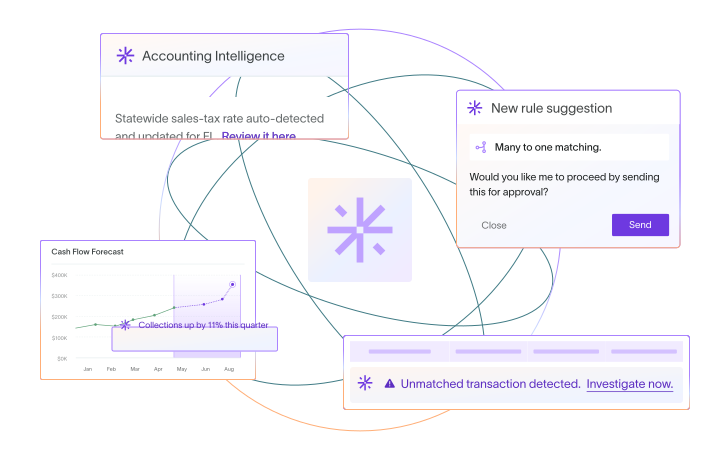
AI in accounting might feel very fresh, but the technology’s impact began back in 2015. It started with rules-based automation, focusing on structured data processing and machine-learning algorithms. With this change, businesses started exploring their options for automated data entry, simple categorization tasks, and rule-based transaction matching.
In 2023, generative AI arrived – and so came a bigger shift. Large language models (LLMs) let companies go beyond pattern recognition and instead look into content generation and complex reasoning. According to McKinsey, the move from traditional machine learning to generative AI represents a quantum leap in capabilities, enabling automation of higher-order accounting functions previously impossible with rule-based systems. [3]
AI is now a powerful tool for Finance teams. It can draft reports, summarize regulatory changes, enforce compliance policies, track cash flow patterns, and more – without human effort.
And in the future? Agentic AI will play a bigger role, planning and executing complete accounting workflows automatically. According to Dokka [4], an agentic system can identify what needs to be done, pick the right tools to get it done, handle the job, then deliver the work in the desired format. This covers everything from preparing journal entries, tackling variance analysis, and putting together reports and commentaries for management.
AI’s place in finance now
Popular use cases for AI in finance include bankruptcy prediction, stock-price forecasting, and portfolio optimization. But that's only the start: the technology's also being used for oil-price prediction, anti-money laundering (AML) compliance, and behavioral finance analysis. Big-data analytics and blockchain integrations are other focus points.
These use cases show how broad AI’s reach really is. Investment firms use predictive models to support market analysis. Banks use AI for fraud detection and risk assessment. Energy companies use intelligent forecasting models to better understand commodity markets. Across all these clusters, the investment is enormous. Each represents billions in deployed capital and operational spend.
For most organizations, AI’s having the biggest impact on everyday accounting, like:
- Financial reporting and statement prep
- Accounts-payable and accounts-receivable management
- Tax compliance and planning
- Audit workflows and controls testing
- General ledger (GL) maintenance and reconciliation
So: the foundations of Finance. They work particularly well with AI because the benefits are easier to measure, the implementation path is clearer, and – most importantly – they’re rooted in two areas AI excels in: working with high volumes of data, and following clear structures and rules. We’ll look into all these applications in depth later.
Enterprise platforms are using AI… but not without limits
Major enterprise resource planning (ERP) vendors have started embedding AI directly into their existing systems. SAP, for example, has embedded AI that uses semantic understanding to classify financial data. But there's a catch: these capabilities are being bolted onto legacy architecture that was built long before modern AI development took off.
Oracle has gone for a similar approach, using autonomous database technology and integrated analytics in its finance modules. It automates routine tasks and shares predictive insights. Microsoft has expanded its Copilot across Dynamics 365, Office apps, and Teams, so companies can use it for financial reporting and approvals.
This level of adoption from some of tech’s biggest players shows that AI’s quickly becoming a must, and not just a nice-to-have, in Finance. More and more businesses see AI features as a baseline need. But legacy systems’ embedded approaches have their limits: the outdated architecture restricts how deeply AI can be integrated, and vendors still need to maintain backward compatibility with older modules and workflows.
That’s where the top AI-native accounting software platforms come in. ERPs like DualEntry are built from day one around AI-powered accounting, so they can automate workflows more intuitively and share more intelligent insights than retrofitted enterprise systems. As businesses think through long-term platform decisions, the difference between embedded AI and native AI architecture is becoming harder to ignore.
The status quo
Current adoption rates
According to Bank of England's "Artificial Intelligence in UK Financial Services - 2024" report, around 75% of UK financial services firms are already using AI, and another 10% plan to roll it out in the next three years. [5]
That said, not all companies are using AI in the same way, or getting the same results. Most fall into clear maturity tiers based on how deeply they’ve integrated the technology. KPMG's Global AI in Finance Report [6] breaks AI adoption down into three groups:
- Leaders (24% of companies) have embedded AI across multiple processes. They’re seeing the biggest efficiency gains and the strongest competitive advantages.
- Implementers (58% of companies) have rolled out AI in specific functions, but haven’t achieved full integration yet.
- Beginners (18% of companies) are still in pilots or early-stage deployments.
Moving up in these tiers means performance improvements. Leaders are using AI across multiple functions with 87% adoption at scale [7], while implementers report moderate to emerging use cases. Organizations advancing from early-stage experimentation to mature AI implementation strategies are seeing significant productivity improvements across functions.
US buyer data points the same way. Capterra's 2026 AI accounting software report, which surveyed 500 US accounting decision-makers, found that 46% of buyers have switched providers specifically to get AI tools, and 89% of those using AI report a positive ROI. On the vendor side, 8 of the 10 platforms Capterra surveyed (DualEntry among them) report that AI now automates more than half of previously manual accounting tasks, with bank reconciliation and invoice processing as the biggest time savers.[4][2]
SMEs are driving the next wave
SMEs are dominating artificial intelligence investment in accounting. As mentioned earlier, Mordor Intelligence's 2025 market research reports that SME adoption is driving AI accounting market growth at 44.6% CAGR, with the global AI accounting market projected to reach $10.87 billion in 2026.[1] That marks a major shift in market dynamics, and it's largely driven by better access. Cloud infrastructure, application programming interfaces (APIs), and subscription pricing models have made advanced AI easier to adopt.
Not long ago, AI was mostly an enterprise-only advantage. Implementation needed serious capital, technical resources, and time. Those barriers don't exist anymore. Smaller firms can now access enterprise-grade AI through no-code and low-code platforms. Plug-and-play integrations make it possible to deploy AI without needing dedicated IT support.
This shift goes beyond basic automation. SMEs are already using AI to handle more sophisticated workflows like:
- Automated financial reporting
- Intelligent document processing
- Predictive cash flow analysis
- Real-time anomaly detection
These kinds of tools used to cost millions to build and maintain. Now you can get the same functionality through cloud-based platforms and monthly subscriptions. Small accounting practices and businesses can reach automation levels that match (or even exceed) much larger competitors.
The barriers – and how firms overcome them
Even with adoption climbing fast, implementing AI in accounting isn't always straightforward. Most companies run into the same set of roadblocks, as identified in recent industry research: skills gaps in teams (58% of finance departments), legacy system limitations, data quality issues (causing 63% of early project delays), and internal resistance to change. [8]
The skill gaps are usually the first hurdles. Finance workers need new skills to manage AI tools and interpret their outputs. Legacy systems like Netsuite can also slow progress, especially when they don’t support the integrations modern AI deployments depend on. Data quality’s another big one: inconsistent or incomplete data creates unreliable outputs. And internal resistance is common too, usually because of concerns about job displacement or disrupting existing workflows.
Successful companies handle these issues with things like:
- Vendor-managed implementation that includes training programs and technical support
- Tools that are easy to use and don’t need IT or coding expertise to be understood
- Phased rollouts that allow for gradual adoption
Businesses that tackle these barriers thoughtfully will probably see higher implementation success rates. Having external support and a structured rollout cuts risk and avoids early obstacles.
Where is AI being used now?

Financial statements
AI changes how financial statements are built. There’s less heavy lifting around data collection and processing: systems can pull information directly from general ledgers, trial balances, and journal entries. Machine learning maps transactions to the right line items, and natural language processing (NLP) interprets and applies accounting policies. AI-native systems can generate income statements, balance sheets, and cash flow statements – all with minimal human involvement.
Properly implemented AI tools have accuracy rates of 95%+ in preparing standard financial statements.[9] They also catch issues along the way, flagging up missing entries, classification errors, and any unusual balances. Plus, intelligent document processing can extract supporting details from source documents, including invoices, contracts, and bank statements. AI agents can then pull everything together into draft statements that follow the relevant accounting standards.
The operational impact is huge. Monthly close cycles shrink from weeks to days, and many companies can move to daily or real-time reporting.[10] Internal stakeholders get more frequent updates on performance, and external reporting becomes more transparent and timely. Automation also reduces manual compilation errors and keeps reporting consistent across periods. [11]
Forecasting and planning
AI is also reshaping management accounting, especially in forecasting, planning, and analysis. It can:
- Automate variance analysis, comparing actual results against budgets and highlighting major deviations
- Run cost-benefit analyses using historical patterns and predictive modeling
- Set rolling forecasts up to update automatically as new transaction data comes in
- Handle predictive cash flow models that take in multiple variables, like seasonality or payment history
- Continuously improve forecasting accuracy by adjusting predictions based on actual outcomes
As a result, planning cycles that once took weeks now take hours (or less),[12] and forecasting is estimated to be 30-50% more accurate than traditional methods.[13] Leadership teams also benefit here: real-time scenario modeling allows them to test assumptions instantly, and strategic planning becomes more robust, backed by the most up-to-date financials.
Payroll accounting
Payroll is one of the clearest areas where AI shines, especially for companies working in multiple jurisdictions. AI can streamline everything by pulling and processing data automatically with OCR technology. So there’s no more manual data entry needed to handle timesheets, payroll registers, or tax forms – whether handwritten, digital, or scanned.
Automation also handles calculation of gross pay, deductions, tax rates, and compliance rules based on the relevant regulatory requirements. This is especially valuable for multi-state and international payroll, and the results are significant. Organizations implementing AI-powered payroll systems achieve 60-80% reductions in processing errors through automated validation and real-time compliance checking.[14] Compliance violations fall sharply because systems stay up to date with regulatory requirements. Manual intervention drops by up to 70%. And organizations can run payroll for thousands of employees across dozens of jurisdictions at once – so smaller teams can manage bigger, more complex payroll setups.
Tax accounting
Tax workflows are another strong match for AI, mainly because so much of the work is document-heavy and rules-based. AI-powered document parsing makes it possible to process tax returns, receipts, and forms like W-2s and 1099s at scale. Intelligent document processing extracts data from supporting schedules and supplementary documentation, and machine learning helps with expense categorization and deduction identification.
In practice, AI can automate a large portion of tax prep. Research suggests that over 80% of individual tax-return preparation can be automated.[15] Platforms like DualEntry can:
- Handle data gathering and populate the required tax forms
- Optimize deductions and apply tax rules consistently
- Process thousands of transactions efficiently (especially helpful for corporate tax returns)
- Keep audit trails and full documentation for every tax position
- Support compliance by monitoring for regulatory changes
Overall, AI cuts tax preparation time by up to 65%.[16] It also improves compliance and helps uncover planning opportunities that messy manual processes often miss.
Auditing
AI is changing auditing by making it possible to review every transaction, not just a sample. Instead of testing 5-10% of activity, auditors can now run 100% population reviews.[17] Machine learning algorithms scan millions of transactions at once and flag anomalies by vendor, amount, time period, and frequency. They can spot duplicate payments, round-dollar transactions, and entries posted outside normal business hours,[18] while statistical models spot outliers that break expected behavioral patterns.[19]
AI-native tools enhance – rather than replace – professional judgment.[20] The technology handles data-heavy scanning and anomaly detection, leaving it to auditors to interpret the results and investigate any exceptions. There’s more time for higher-value advisory work.
AP & AR
Accounts payable (AP) and accounts receivable (AR) processes go faster when AI takes over document handling, workflow routing, and risk detection.
On the AP side, automation starts with intelligent invoice scanning. OCR technology and machine learning extract vendor details, line items, and payment terms with 99% accuracy rates according to recent leading tools/vendor benchmarks.”(DualEntry Labs' independent accounting AI benchmark grades the frontier models on the same AP/AR tasks) [21] Once this data’s been uploaded into the ERP, AI can:
- Handle three-way matching between POs, receiving documents, and invoices
- Detect any duplicates
- route invoices through the correct approval workflows
- Flag anything suspicious – like unusual vendor info or payment instructions – for human review
In AR, the value of this new tech comes from prediction and prioritization. AI can forecast payment delays by analyzing customer payment histories, credit scores, and economic indicators to calculate default probabilities. Today’s tools can then prioritize collections based on invoice value (and likelihood of recovery) and send custom payment reminders at the right time.
All these new automations have big gains: processing costs drop by 60-81%,[22] and manual error rates fall from 2% to 0.8%.[23] Plus, companies can handle higher transaction volumes without adding staff.
Inventory and fixed-assets accounting
AI improves inventory accounting with real-time tracking and more accurate forecasting. The best systems can use live stock data to predict demand using historical sales, seasonality, and market signals. AI also supports inventory valuation by comparing FIFO, LIFO, and weighted average methods to optimize tax outcomes and financial reporting.
Fixed asset accounting becomes more automated through AI-driven asset registers and depreciation schedules. Systems calculate depreciation based on asset class and useful life, adjust automatically for impairments and disposals, and use predictive maintenance models to reduce downtime. When inventory and fixed asset systems are integrated, companies achieve inventory accuracy of 98% or higher,[24] reduce carrying costs by 20-30%,[25] and improve asset use rate without adding to maintenance expenses.
Enterprise AI in corporate finance
Enterprise finance teams can now use AI across treasury and corporate finance to manage cash, forecasting, and risk. AI systems track liquidity in real time and forecast cash needs based on payment patterns and receivables. They can also use predictive analytics to lower borrowing costs and improve investment returns. Risk tools continuously assess counterparty exposure, currency movements, and interest rate changes.
This shift moves finance away from static reporting toward what’s called “real-time financial intelligence”. AI enables rolling forecasts, continuous risk updates, and automatic resource reallocation. Alerts replace monthly reports and give leaders useful, live insights that can actually influence results.
The technology behind it all
AI chatbots, copilots and virtual assistants
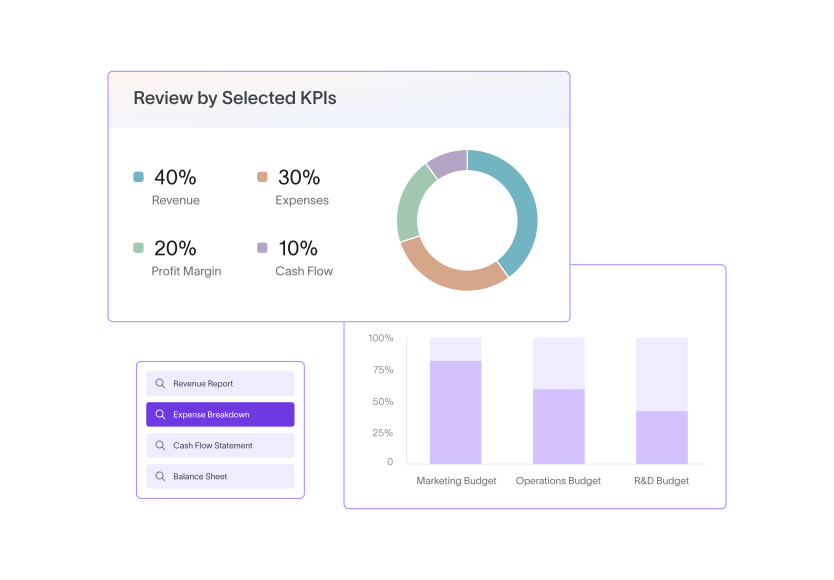
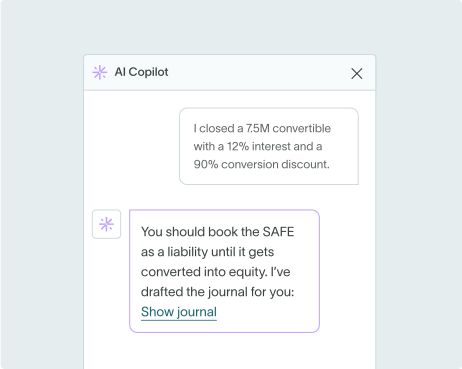
AI-powered chatbots and virtual assistants give accounting teams a simple, conversational way to access data and get work done. Users can ask natural-language questions to pull financial reports, explain budget variances, or get answers on accounting policies – using chat interfaces that feel like everyday messaging apps. The system interprets the request, retrieves the right data, and returns it in a formatted response. More advanced assistants can also trigger workflows through simple commands, including approval processes, payment releases, and report generation.
Not all bots deliver the same value. Basic FAQ bots handle routine questions about policies, deadlines, and procedures by matching keywords to preset answers, and they can reduce helpdesk inquiries by around 40%.[26] Advanced virtual assistants go further by completing accounting tasks autonomously: drafting journal entries from transaction descriptions, generating account reconciliations, and creating financial queries – using machine learning to understand context and intent instead of relying on exact phrasing. These advanced assistants can cut task completion time by 60% or more,[27] and organizations use them to broaden access to financial information across the business.
AI agents and agentic workflows
AI agents are autonomous systems that can break down complex accounting tasks, choose the right tools, and complete multi-step workflows on their own. Dokka [4] notes that they’re especially effective for repetitive, rules-based processes. Unlike traditional automation, which follows fixed scripts, agents can make decisions based on context and adapt when data or conditions change.
Accounts payable is a common example. According to Auxis (2025) [28], an AI agent processing invoices can verify vendor details, route invoices through the correct approval paths, and schedule payments – all without manual intervention.
These systems cut processing time by around 75%,[29] handle exceptions using business rules, and escalate issues to humans only when needed.
Generative AI and large language models
Large language models (LLMs) are changing how accounting teams create and analyze content. They generate financial commentary for earnings reports and management discussions, summarize accounting standards into practical guidance, and draft policies, procedures, and control documentation. In tax, generative AI supports regulatory research, interpretation of tax code changes, and preparation of technical memoranda.
Because financial outputs are regulated, these tools require strong controls. Companies define clear usage policies, add human review checkpoints, and monitor outputs for accuracy and compliance. Version control keeps audit trails for all AI-generated content. With the right guardrails in place, finance teams can cut documentation time by around 50%.[30]
Predictive analytics and forecasting
Predictive analytics uses historical financial data to forecast future outcomes. AI models can analyze years of transactions to spot growth trends and other patterns.They can predict revenue and flag budget variances before period-end close.[11]
In this case, AI can support cash management, credit control, treasury planning, and currency hedging. Accuracy improves by 30-45% compared to traditional forecasting,[13] helping companies allocate capital more effectively and avoid surprises. Because models update continuously as new data comes in, many companies are replacing static annual budgets with dynamic rolling forecasts.
The biggest benefits of AI in accounting
Efficiency
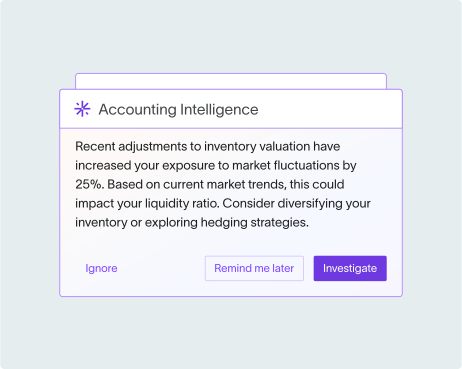
One of the most immediate benefits of using AI for accounting is speed. Everyday workflows get much faster with AI’s help: from invoice processing to bank reconciliations to journal entries to the monthly close. The real win, though, is what teams do with the time they get back. Think less data entry, more analysis, and handling transaction higher volumes without needing to add to headcount.
Accuracy, risk reduction, and compliance
SuperAGI notes that AI-powered invoice processing can reach 99% accuracy, compared to manual error rates of 10-15%.[31] Each error costs companies about $53 to fix, and that’s before compliance penalties come in. For high-volume teams, reducing errors quickly turns into meaningful savings.
AI-powered systems can continuously validate data, cross-check entries, and flag issues before financial statements are finalized. They also keep full audit trails and can make automatic updates when regulations change. As a result, audits tend to run more smoothly. Auditors can access the documents they need faster, testing takes less time, and firms see lower audit fees because of this.
Real-time insight and better decisions
Getting real-time visibility used to be difficult (unless you had the resources to hire multiple people to stay on top of it), but AI makes it easy. Instead of waiting for month end, leaders can now see up-to-date performance through AI-powered dashboards. Lucid [11] and CPA.com [2] both note that businesses working with real-time insights act up faster than those relying on traditional reporting cycles.
This makes a big difference in day-to-day decision-making. AI can spot payment delays, recalculate cash positions instantly, and flag any issues early. Scenario modeling is fast and pain-free, and forecasts update continuously. Overall? Fewer surprises – and more decisions based on what’s happening now, not what happened last month.
Cost savings and scalability
Good news: it’s possible to grow your company without growing your headcount. Labor costs typically drop by 30-40% when automation takes over routine work.[32] Accounting firms can serve around 50% more clients with the same staff levels, and revenue per full-time employee rises by about 35%. [33]
This isn’t about cutting jobs. Most companies end up moving their people into higher-value work – for example, bookkeepers move into analysis and tax preparers move into strategy. This shift increases average billing rates by 25-30%.[34]
Employee and client experience
Automation also improves the human side of accounting. Research shows a 30-45% increase in employee engagement when repetitive data entry’s out of the picture, and there’s around 20-30% lower turnover in firms that adopt AI fully.[35] Probably because people spend more time on meaningful work, developing new skills alongside their accounting expertise.
Clients feel the difference too. Response times drop from days to hours. Reports are available on demand. There are fewer errors in the books, meaning fewer frustrating corrections. More importantly, clients can get proactive insights instead of basic compliance outputs. All this means that relationships get stronger, and firms see up to a 20-25% higher retention rate.[36]
AI accounting tools – and how DualEntry fits
What’s currently out there
Most AI accounting tools today fall into four categories:
- Legacy enterprise finance suites
These are large ERP platforms with AI added into existing modules. They support things like automated journal entries, intelligent reconciliations, and predictive analytics, usually inside familiar interfaces. While powerful, they’re often built on legacy architecture, which makes them expensive, complex to implement, and slow to adapt. They’re typically aimed at orgs with revenues above $100M. [37]
- Cloud accounting platforms for SMEs
Subscription-based tools aimed at smaller teams. Popular AI features here include bank reconciliation, expense categorization, and basic workflow automation.
- Specialized automation tools
These are targeted solutions that sit on top of existing general ledgers. Think AP automation, AR tools, or intelligent document processing platforms. They deliver strong results in specific workflows, but most companies will need several of them to cover all their use cases, so integration can be an issue.
- Modern, AI-first platforms
And then there’s the newest category, which is changing everything. Platforms like DualEntry combine the scale and precision traditionally linked to enterprise systems, with the flexibility, usability, and pricing model of modern SaaS ERP. AI-native from the start, these systems scale from growing teams all the way to enterprise and IPO-ready finance functions. No legacy architecture or bolt-on automation involved.
What to look for
When choosing an accounting platform, you want to keep three things in mind: AI capability, fit, and governance.
On the capability side, AI should go beyond simple “if-then” rules. Strong platforms handle exceptions, improve over time, and explain why decisions are made (especially important in regulated finance environments).
Fit is all about whether the platform actually works in practice based on your current setup. Whatever system you choose, it needs to integrate smoothly with your GL, banks, payroll, and the rest of your tech stack. Strong APIs matter here, especially as your teams grow and processes become more complex.
Finally, governance can’t be an afterthought. Role-based access controls, segregation of duties, audit trails, SOC 2 Type II certification, and GDPR compliance are essential.
How DualEntry approaches AI in accounting
DualEntry is an AI-native ERP that takes the manual effort out of everyday accounting work, helps teams to close faster, cut out manual tasks and stay in control.
Some of the AI-native ERP’s most popular features:
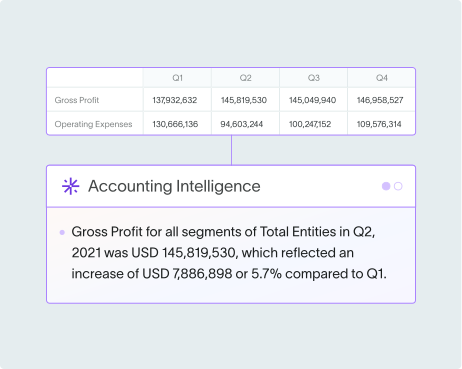
- Accounting Intelligence: DualEntry's AI accounting intelligence gives instant answers to complex accounting questions. Teams can explore data, surface insights, and get recommendations without having to dig through reports or spreadsheets.
- Anomaly & fraud detection: The system continuously monitors transactions for unusual patterns or potential risks. Instead of finding issues at month-end, teams get early signals when something looks off.
- Predictive insights & forecasting: AI-generated analysis helps uncover patterns and predict future performance. This improves forecast accuracy and supports better planning, without any complex modeling.
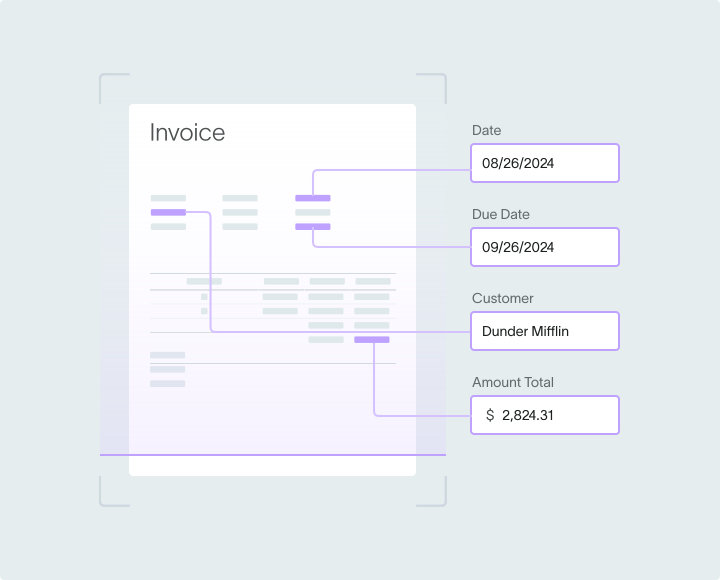
- AI OCR and bulk import: Upload invoices, bills, or supporting documents – individually or in bulk – and DualEntry automatically extracts the details needed to automatically create the accounting entries.
- Auto transaction categorization: Transactions are coded before they hit the general ledger. DualEntry suggests the right categories, and can also recommend new ones based on how your business usually operates.
- Auto distribution: Shared costs can be split automatically using reusable allocation templates. Distributions can be percentage-based or amount-based, and applied consistently across subsidiaries.
- Streamlined reconciliation & bank matching: With 13,000+ live bank connections, DualEntry can automatically match bank data to transactions, create missing entries, and flag gaps. Reconciliation and consolidation happen faster, with fewer manual steps.
Best practices for implementing AI in accounting
Work out your strategy (and some clear KPIs)
A successful AI implementation starts with figuring out your pain points. Before choosing tools, teams should identify where things break down today (slow closes, AP backlogs, manual reconciliations, high error rates…). From there, define what success looks like. Clear KPIs make it possible to measure progress instead of relying on gut feel.
Useful benchmarks include days to close, invoice processing time, reconciliation completion rates, post-close adjustments, and error frequency. Establish a baseline first, then set targets that align with broader business goals. Agreeing on these metrics upfront helps avoid rolling out technology that looks impressive but doesn’t deliver real value.
Start small and low-risk
The best place to start is with processes that are well understood and easy to measure. Bank reconciliations, expense categorization, and invoice capture are common first steps. They’re structured, rules-based, and deliver quick time savings without disrupting core workflows.
A pilot approach keeps risk low. Pick one process, set a clear goal — like cutting time in half or hitting a specific accuracy threshold — and roll it out to a limited group. Once it works, expand from there. This step-by-step approach builds confidence, avoids overwhelming teams, and creates momentum through early wins.
Make sure your team is AI-ready
AI adoption only works if people are on board. Teams need to understand that AI is there to support their work, not replace them. Organizations that frame AI as augmentation — not automation for automation’s sake — see much higher adoption.
Practical change management helps. Appoint internal champions, provide hands-on training, and create space for questions and feedback. Share progress regularly and celebrate small successes. While this takes time and effort, it often matters more than the technology itself when it comes to long-term success.
Get data governance, security, and compliance right
Strong data governance is non-negotiable in accounting. Financial data needs enterprise-grade protection, including encryption, role-based access, detailed audit logs, and clear data classification. AI systems should also keep transparent audit trails showing how decisions were made and data was modified.
Compliance adds another layer. GDPR, SOC 2 Type II, and regional financial regulations all come into play. The safest approach is to work with vendors that build security and compliance into their products from day one. Before deploying anything, check certifications and understand how regulatory requirements are handled.
Tool evaluation and budgeting
When comparing AI platforms, price is only part of the equation. Integration with existing systems, plus scalability, security, and stability, matter just as much. A cheaper tool that doesn’t fit your stack can cost more in the long run.
Progressive firms are putting real money into AI. CPA.com says 10%-25% of tech budgets go to AI initiatives now.[2] That covers licenses, implementation, training, the whole thing. Most companies scale gradually with AI adoption, increasing investment once they see results. Don't just calculate direct savings when looking at ROI. Factor in productivity gains too. And think multi-year, because costs change as you scale up and add more use cases.
Managing the transition period
Change always takes time. There will always be teething problems. Most teams go through a transition period – around 3 to 6 months – where productivity might actually drop, because staff need some time to learn the new systems. Error rates might also briefly rise. This “messy middle” is totally normal and doesn’t mean that implementation failed.
What matters most at this time is how people think about the change. AI skills are quickly becoming career differentiators in accounting. As routine tasks get automated away, finance teams will spend more time on analysis and advisory work. Companies that communicate this clearly, and support skill development by offering training in new areas, will hold onto their employee’s trust. For a step-by-step rollout plan, see our guide on how to use AI in accounting.
What’s the future of AI and accounting jobs?
Support, not replacement
Research from Ashdown Group (2025) shows that AI reshapes roles without reducing demand for talent.[38] AI is supporting, rather than killing, accountant roles – allowing automation to take care of routine processing, and the human experts to refocus on strategy. ICAEW describes accountants of the future as blending technical expertise with analysis and advisory skills. [39] If you’re worried about what this means for your career, we break it down in more detail in our article on whether AI will replace accountants.
These accountants know how to use AI tools effectively, while bringing in the human judgment and relationship management that AI can’t. The real value comes from translating AI-generated insights into clear business recommendations.
New roles and skills for accountants
New job descriptions are starting to appear as companies look for specialists who can manage AI-enabled accounting tools. Murray Resources has identified emerging positions like AI Accounting Analyst, AI Financial Reporting Specialist, and AI Risk & Controls Specialist.[40] These roles combine accounting fundamentals with responsibility for managing, validating, and overseeing AI-powered work.
As for the skills that now matter most: look to analytical thinking, communication and data interpretation. Manual processing matters less. To stay ahead, accountants should be comfortable in evaluating AI outputs and explaining decisions to auditors, regulators, and shareholders.
Senior-level responsibilities are changing too
Similarly, senior accountants are moving away from checking individual transactions and toward overseeing AI-generated outputs. This shift can be described as a move from transaction verification to scenario analysis and judgment-heavy review. Less time’s spent on validating calculations, and more is focused on assessing possible outcomes and issues.
CFOs are seeing an even bigger change. According to Workday, finance leaders now own AI strategy, governance, and risk management.[41] They set policies for automated decision-making, oversee compliance, and coordinate AI initiatives across finance, technology, and the wider business. In many companies, the CFO is becoming a technology leader, responsible for vendor choices, investment priorities, and measuring the impact of AI systems.
Conclusion
Teams using AI are already seeing impressive results, like faster processing, fewer errors, and more time for higher-value work. Over time, workflows become more efficient, companies scale more easily (without adding heavily to headcount), and accountants are freed from manual tasks, instead spending more time on analysis and advice.
Not brought AI into your org yet? The good news is that it’s not as big of a leap as you might think – if you choose a modern, customizable platform like DualEntry, you have an ERP that adapts to your workflows, gives you granular control, and integrates with your existing tools. 100% cloud based, it’s accessible from anywhere and doesn’t require a complicated, expensive on-premise setup.
If you’re ready to get started, download our implementation checklist to figure out where AI will fit best in your existing finances setup. Or schedule a demo now to see what DualEntry can do for your team.
AI in Accounting FAQs
What is AI in accounting?
AI in accounting means using machine learning, natural language processing (NLP), and automation for financial processes. These tools handle data entry, transaction processing, report generation, and compliance monitoring. In practice, AI automates manual accounting tasks while also delivering predictive insights and flagging anomalies in your data.
How can AI be used in accounting?
Companies use AI across core accounting functions like accounts payable (AP), bank reconciliations, financial statements, and audit procedures. Common workflows include invoice capture, expense categorization, journal entry creation, and variance analysis—combining routine processing with more advanced analytical work.
How is AI used in accounting and finance today?
AI adoption is accelerating across finance operations, from basic task automation to advanced predictive analytics. Many teams use AI for real-time cash flow monitoring, automated month-end close, and continuous compliance checking. Some enterprise platforms embed AI directly into their ERP systems, while specialized solutions focus on specific workflows.
Is AI going to replace accountants?
No. AI augments accounting professionals—it doesn’t replace them. The technology takes on manual data entry and repetitive processing, which frees accountants to focus more on review, controls, and strategic advisory work. Accountants who pair domain expertise with AI fluency and oversight skills are typically better positioned for career growth.
How much can AI reduce accounting errors?
AI can significantly reduce errors in workflows like invoice processing and classification. Modern systems can reach very high accuracy in structured tasks like invoice capture, while manual processing is more prone to issues like misclassification, duplicates, and transcription errors. Fewer errors means lower correction costs, stronger controls, and improved compliance.
What are the main risks of using AI in finance?
The main risks include data privacy and security exposure, biased or low-quality model outputs, and over-reliance on automation without proper human review. Strong governance matters: clear approvals, audit trails, access controls, and continuous monitoring help ensure reliability and regulatory compliance.
How long does it usually take to implement AI tools in accounting workflows?
Implementation timelines vary based on company size, system complexity, integrations, and data quality. With modern cloud platforms—especially those designed to speed setup with AI-assisted mapping—some teams can get up and running in as little as 24 hours. More complex environments typically take longer due to integrations, controls setup, and validation.
References
 Mordor Intelligence (2025) — AI in Accounting Market Size & Share Analysis
 - CPA.com (2025) — 2025 AI in Accounting Report
- McKinsey & Company (2023) — The Economic Potential of Generative AI
- Dokka (2025) — Agentic AI
- Bank of England & FCA (2024) — Artificial Intelligence in UK Financial Services
- KPMG (2024) — Global AI in Finance Report
- KPMG (2024) — AI Adoption Across Finance Functions Achieves Standout Levels of ROI (Press Release)
- OpenLedger (2025) — Getting Started With AI Accounting: A 2025 Implementation Guide
- Trullion — AI Accuracy for Accounting: What You Should Know
- Datagrid — AI Automates Month-End Close for Finance Controllers
- Lucid — How AI Improves Financial Report Accuracy
- Every.to — How AI Can Cut Your Planning Cycle From Two Weeks to Two Days
- Dost — Financial Forecast Accuracy with AI: How It Works
- World Journal of Advanced Research and Reviews (Nov 2025) — AI Driving Payroll Management Systems: A Multi-Case Study Analysis
- Thomson Reuters — How Agentic AI Is Transforming Corporate Tax Departments
- Thomson Reuters — AI for Tax Professionals: A Guide
- Grant Thornton — Audit, Accelerated: How AI, Analytics and Automation Turn Assurance into Insight
- ZenStatement — AI-Powered Anomaly Detection in Finance
- World Journal of Advanced Research and Reviews (May 2025) — Integrating Machine Learning in Cloud-Based Accounting Systems
- Trullion (2026) — Internal Audit Process Automation: 2026 Guide
- Veryfi (2025) — Invoice OCR in 3–5 Seconds: 2025 Benchmark of Top Invoice OCR APIs
- Payouts.com (citing PayStream Advisors / Levvel) — Accounts Payable Automation: Cut Costs By 80% in 2024
- APQC — Open Standards Benchmarking® Accounts Payable Survey
- Altavant Consulting (2025) — Prevent Stockouts & Maximize Inventory Accuracy: 2025 Guide
- ATC — Smart Inventory Management with AI: Reduce Costs and Increase Accuracy
- MaxSourceWorld — How AI-Powered Chatbots Reduce Support Costs by 40%
- Iterators HQ — How AI Personal Assistants Are Shaping the Future of Work
- Auxis (2025) — Agentic AI for Finance and Accounting: Key Use Cases & Tips
- Extend.ai — Invoice Processing Automation Guide
- Trintech — How AI Is Revolutionizing the Financial Close Process
- SuperAGI (2025) — AI vs Manual: Comparison of Invoice Processing Efficiency and Accuracy in Accounting
- McKinsey — Operations Management, Reshaped by Robotic Automation
- Prometai.app — Accounting Firm Case Study Examples (Nova Accounting)
- CPA.com — Business Model Trends Report (Whitepaper)
- SolvixAI — Real-Time Feedback at Work: Proven Automation Strategies
- HypeStudio (2025) — AI Automation ROI Guide
- HouseBlend — ERP Systems: A Comprehensive Cost Breakdown and Comparison
- Ashdown Group — AI and Entry-Level Roles
- ICAEW (2025) — Five In-Demand Skills for Accountants in 2025
- Murray Resources (2025) — 25 Top AI Accounting Jobs
- Workday — The 5 Things Every CFO Must Know About AI
See the full power of DualEntry in 30 minutes
Woosung Chun is the CFO of DualEntry with experience in corporate finance, accounting, strategy, and acquisitions. He previously grew from scratch and led the M&A and Finance teams at Benitago, where he completed more than 12 acquisitions in 2 years. He graduated with a BS from NYU Stern. At DualEntry, Woosung writes about AI in accounting, revenue recognition, foreign currency accounting, hedge accounting, and ERP modernization for finance teams navigating complex, multi-entity environments.