Don't worry! The contents here will appear on the published page.
General Ledger in ERP: A Complete Guide to Modernizing Your Accounting Backbone

Woosung Chun
CFO
Woosung Chun
CFO
Woosung Chun is the CFO of DualEntry with experience in corporate finance, accounting, strategy, and acquisitions. He previously grew from scratch and led the M&A and Finance teams at Benitago, where he completed more than 12 acquisitions in 2 years. He graduated with a BS from NYU Stern. At DualEntry, Woosung writes about AI in accounting, revenue recognition, foreign currency accounting, hedge accounting, and ERP modernization for finance teams navigating complex, multi-entity environments.
Learn about our editorial policies.
Last updated
August 27, 2026
Reviewed by
Do San (Justin) Myung

Do San (Justin) Myung
Expert Accountant & Former Consulting CFO
Justin (Do San Myung) is Expert Accountant at DualEntry with 20+ years of hands-on experience managing general ledgers, financial close processes, and ERP implementations for mid-market and enterprise companies. As a former Consulting CFO and Controller, he has personally overseen month-end closes, SOX compliance programs, and multi-entity consolidations across technology, manufacturing, and services industries. Justin specializes in transforming manual accounting workflows into automated, AI-driven processes.
Learn about our editorial policies.

Summarize this article
The general ledger is a finance team’s control center. It’s where all financial activity lands before it feeds into the balance sheet, income statement, and cash-flow report.
People outside the accounting business might be surprised by how many companies still rely on spreadsheets or entry-level tools to manage their books. That can work for a while, but when growth brings about higher transaction volumes and more complexity, control and visibility drop if you’re still running on the basics.
That’s where ERP systems come in. In these integrated platforms, the GL automatically pulls postings from accounts payable, receivable, inventory, payroll, and more – giving you more accuracy and live insights.1
Here, we’ll cover GL fundamentals, how ERP strengthens them, when to upgrade, and where AI-native ERP solutions like DualEntry fit.
The GL’s place in the ERP world
What is a general ledger? And why does it matter?
The general ledger is the main accounting record for a business. It brings every debit and credit across asset, liability, equity, revenue, and expense accounts together in one structured system.2 Behind the scenes, it’s supported by a chart of accounts, account balance tables, transaction histories, and budget tables.
From this foundation, core financial statements are created – including the balance sheet, income statement, and cash flow statement – along with supporting reports like the trial balance and detailed account activity.
For businesses that aren’t using ERPs to manage their finances, things can get messy once the company’s grown to a certain size. Subledgers may live in separate tools. Journal entries might be inputted manually. Timing differences between systems can make reconciliations painful. As businesses scale, relying on spreadsheets and disconnected tools increases the risk of errors and a slower close. There’s also limited transparency for decision-makers.
What an ERP finance module is, and where it fits into the GL
An ERP finance module is a set of integrated applications that centralize accounting and reporting within a broader enterprise platform.It typically includes the general ledger, accounts payable, accounts receivable, cash management, and reporting – with optional modules for fixed assets, budgeting, and more.
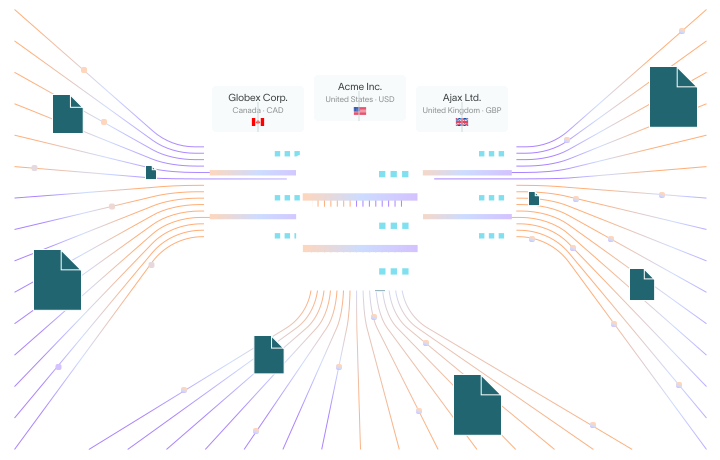
In an ERP, the GL is the central hub for financial data. It receives postings automatically from order management, inventory, payroll, purchasing, and more.
As everything’s connected, you don’t need to rely on manual imports or reconcile disconnected systems. Instead, you can view consolidated, real-time results across the business, all flowing through the GL.
Key features of the general ledger in ERPs
Posting and the chart of accounts
In ERPs, the general ledger is built around a structured chart of accounts. Inside each account, you’ll find balances, transaction history, and often budget comparisons across reporting periods.
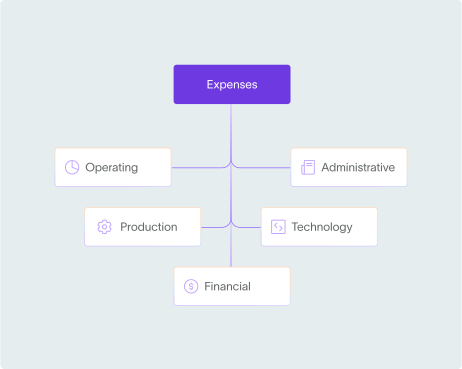
The most powerful systems support multi-entity setups and multi-dimensional account coding, so it’s possible to track finances by individual business unit, cost center, project, or region without needing duplicate accounts.
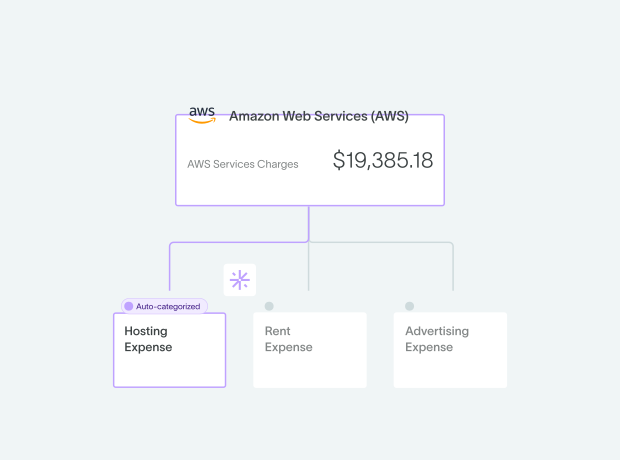
Every operational transaction, whether it’s an AP invoice or a customer payment, generates GL journal entries with offsetting debits and credits.
Subledgers are tightly integrated and entries are automated, not manually entered. For example, approving an AP invoice would automatically record an expense and liability in the general ledger. Once the payment is processed, the general ledger software automatically reduces both the liability and cash balance – no manual reposting needed.
If you want to check real life general ledger examples check our complete guide.
Real-time integration for continuous GL updates
ERP GL modules are set up to receive transactions continuously from the likes of accounts payable, accounts receivable, fixed assets, and inventory management.3
Because transactions move through the ERP automatically, you’re less likely to have problems with timing gaps between your subledgers and your GL. This means simpler reconciliations and reliable, real-time balances – which you’ll be grateful for come reporting-time.
Reporting, analytics, and dimensional accounting
The GL produces standard reports: balance sheet, income statement, cash flow statement, trial balance, and also detailed account-activity reports for any period.
Modern ERP systems take this a step further. Finance teams can use them to build custom financial statements, management reports, and variance analyses, pulling directly from GL data.4
These platforms make dimensional accounting possible – meaning that you can tag transactions with additional categories (e.g. product, region, department) to analyze performance in different ways without endlessly expanding your chart of accounts.
Features like role-based dashboards and real-time analytics give CFOs and controllers instant visibility into KPIs, trends, and variance drivers. It’s possible to drill from a high-level P&L line all the way down to an individual journal entry and supporting documents.
How ERPs enhance general-ledger processes
Workflow automation and faster closes
ERPs can take much of the manual effort out of GL posting. Recurring journals, allocations, accruals, and depreciation schedules can be automated so there’s less repetitive month-end work. Instead of rekeying the same entries each period, finance teams can simply review and approve what’s been generated. In some platforms, like DualEntry, this process is even smoother: custom approval controls mean that, if you prefer, human review’s only needed in certain cases – like with transaction anomalies or anything suspicious-looking.
Automation can also extend to bank reconciliation and cash management. Imported bank transactions can be matched and posted automatically, for example.
Combined with real-time consolidation across entities, cloud ERP platforms make closing faster… and far less chaotic.
Better data accuracy, compliance, and audit trails
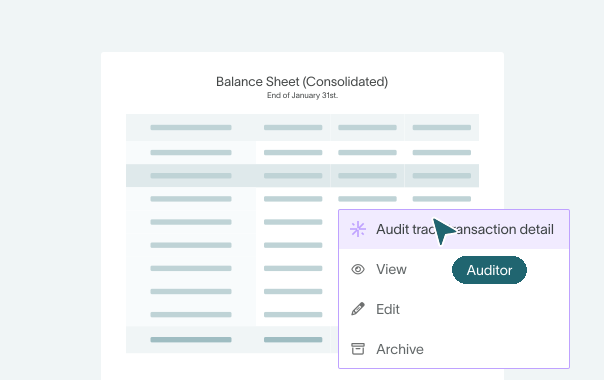
Centralizing accounting inside an ERP cuts out a common issue: duplicate data entry and mismatches between systems. When everything goes through one GL, financial data becomes more consistent and easier to trust.
Every debit and credit is stored in detailed transaction logs, letting users trace balances from financial statements back to individual postings. Modern ERP systems also track user IDs, timestamps, and changes to records (along with who made them). You end up with clear audit trails – with minimal human effort.
Plus, future audits will feel much less stressful when you have revenue, expenses, and leases consolidated into one GL. Keeping everything together makes it simpler to consistently apply accounting policies and create supporting schedules.
Live visibility – and better decisions
Having a unified GL doesn’t just help accounting teams; it also helps their leaders, who will be able to see sales, inventory, production, and financial performance in one place.
Real-time dashboards let managers monitor margins, cash positions, and cost drivers without waiting for month-end reports (or calling on their team for support).
This level of visibility supports faster scenario planning and smarter decisions around pricing, spending, investment, and more. Finance professionals at every level benefit from having access to up-to-date numbers rather than last month’s snapshot.
General ledger in the ERP vs standalone accounting software
What’s the difference? When is an ERP needed?
At a high level, both standalone AI accounting software and ERP systems will take care of your general ledger, but they’re built for very different levels of complexity. A quick comparison:
Standalone tools work well for smaller businesses with straightforward operations. But as transaction volumes grow – or when multiple entities, currencies, or intercompany transactions enter the picture – manual integrations and spreadsheet consolidations inevitably slow things down.
ERPs are designed for that next stage of growth. Because operational modules feed directly into the GL, consolidation is more consistent and reporting is faster. A simple takeaway is that, with an ERP, you spend less time stitching data together and more time interpreting it.
An example scenario: Manual GL vs. ERP GL
In a manual setup, billing, inventory, and payroll systems often sit separately. Accountants have to first export data into spreadsheets, then reconcile differences, then post consolidated entries into the GL. There’s a lot of reconciliation work, and more error risk.
In an ERP environment, subledgers post directly to the GL in real time. Trial balances and financial statements can be generated automatically at period end. Instead of chasing tie-outs, finance teams spend more time analyzing results and partnering with the business.
Implementing or upgrading to an ERP-based general ledger
Planning your chart of accounts and dimensions
Getting the chart of accounts right from the start is critical. It becomes the backbone of every report you run – and once transactions start piling up, changing it can be painful.
You should design your structure with both statutory reporting and management reporting in mind. That often means including segments for legal entity, cost center, project, or product line where relevant. A good starting point is to think about how leadership will want to analyze performance, either right now or in the near future.5
It’s also smart to document example journal entries early on. Map how revenue, cost of goods sold, payroll, and other common transactions will flow through accounts and dimensions.
Clear governance matters as well. Consistent naming conventions and approval processes for new accounts help keep your structure clean as your business grows.
People, processes, and controls
Technology alone doesn’t guarantee a successful upgrade. Because in reality, most finance transformations struggle more with process and behavior changes than with software. And yes: sometimes it all just comes down to teams, or individuals, who don’t like change.
As soon as you can, get teams on board with new workflows, software, or reporting tools with thorough trainings. If it makes sense, you could also consider phasing the rollout by entity or function. These steps make any transition more manageable.
Modern ERP-based GL setups include role-based access, segregation of duties, and approval workflows. One of your first to-dos should be to configure these thoughtfully, aligning with your internal control framework. When processes and controls are clear, adoption gets easier – and the benefits of the system show up faster.
Industry-specific and advanced use cases
Public sector and fund accounting
Public-sector organizations often work under fund accounting rules. This means that, instead of tracking everything in one pool, they separate restricted and unrestricted funds into dedicated structures within the GL.
ERP systems built for municipalities support multi-fund reporting, budget control, and integration with modules like tax billing, utilities, and grants management.
Because public money needs careful tracking, integrated fund accounting improves transparency and compliance. It helps make sure that resources are collected, allocated, and spent in line with legal and regulatory requirements.
Multi-entity, multi-currency, and global operations
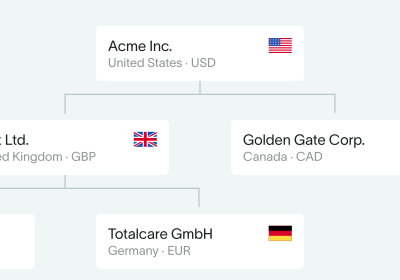
For growing groups, each legal entity may need to maintain its own books while still reporting at a consolidated level. ERP-based general ledgers make that possible in one platform.
Multi-currency features record transactions in local currency, apply exchange rates, and translate balances into a reporting currency for group consolidation. Intercompany transactions can also be automatically recorded and eliminated during consolidation. This cuts out the tedium of manual journal entries and also improves accuracy, especially for companies working across borders.
Future Trends: AI, Automation, and Cloud
Modern ERP systems like DualEntry have already embedded AI directly into finance modules. This brings up new, time-saving (and game-changing) features like anomaly detection, predictive variance analysis, and alerts that catch issues before they have a chance to make it into your month-end reports.
Cloud-based platforms make these capabilities easier to roll out, as you benefit from continuous updates and scalable infrastructure.
Finance teams are increasingly using AI assistants and automated workflows to handle routine GL checks and reconciliations. The result? Less time reviewing transactions, and more time back for analysis, planning, and decision-making.6
Spotlight: DualEntry as an AI-driven ERP general ledger
The AI-native general ledger
DualEntry is an AI-native, cloud-based general ledger platform built for mid-market companies that need scalable, secure financial management without adding unnecessary complexity.7 Its GL supports multi-entity operations, supporting finance teams to manage subsidiaries and business units from a centralized dashboard – while maintaining consolidated reporting needs too.
The platform automates complex accounting processes like amortization, depreciation, and profit and loss allocations8, putting an end to manual journal entry and repetitive month-end work.
Looking beyond core posting, DualEntry includes tightly integrated capabilities like revenue recognition, subscription billing, and fixed-asset management, all feeding directly into the GL in real time.
Users often highlight the intuitive interface and live dashboards, which make it easier to monitor close progress, review balances, and monitor performance without toggling between systems.
Automation, anomaly detection, and a faster close
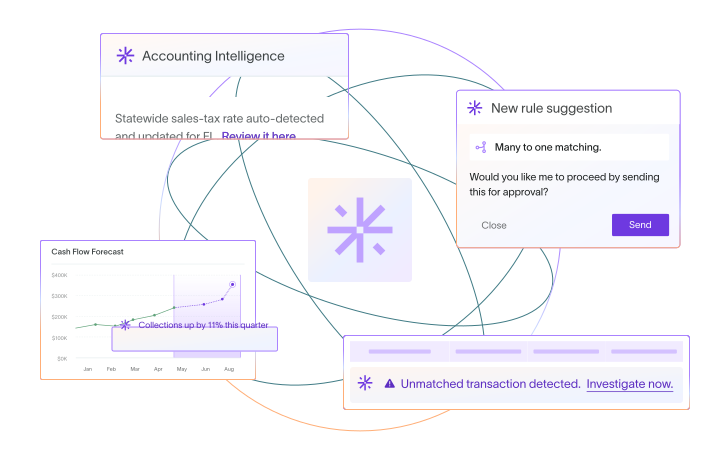
DualEntry uses AI to automate reconciliations and transaction matching, comparing bank feeds and ledger data to surface missing, unmatched, or inconsistent items.
Built-in anomaly detection continuously scans the GL for duplicate payments and unusual patterns, supporting a more proactive, “continuous audit” type of approach instead of relying on periodic checks. As routine reviews like this are handled automatically, finance professionals can focus on investigating exceptions, refining processes, and delivering higher-value analysis. No more manually reviewing every line item.
Plus, DualEntry’s AI-driven tools like balance-change alerts, built-in sign-offs, and real-time close tracking help teams move through month-end faster, with fewer surprises.
General Ledger in ERP FAQs
Summary
By bringing together data from across a business to create accurate reports, reliable numbers, and timely insight, an ERP-based general ledger is a real game-changer.
If you’re still working with fragmented systems or find yourself stuck in spreadsheets at every month end, switching to an integrated, cloud-based ERP will be a turning point. Especially when AI’s built in, automation can slash your close time, reduce manual entry, and strengthen internal controls without adding complexity.
Not sure if you’re ready? Take a deeper look at your current GL workflows, chart of accounts structure and reporting blind spots. Are multi-entity reporting or multi-currency management starting to hold you back? Can you see some gaps that automation could easily fill? If yes, it might be time to evaluate ERP solutions designed for growth.
As the leading AI-driven general ledger ERP, DualEntry saves you time and keeps you in control with features like anomaly detection, automated reconciliations, and close-management tools. This means less repetitive work, faster closes, and cleaner audits. If this sounds good to you, and you’d like to turn your GL from a record keeper into a strategic asset, schedule a demo now.
See the full power of DualEntry in 30 minutes
Woosung Chun is the CFO of DualEntry with experience in corporate finance, accounting, strategy, and acquisitions. He previously grew from scratch and led the M&A and Finance teams at Benitago, where he completed more than 12 acquisitions in 2 years. He graduated with a BS from NYU Stern. At DualEntry, Woosung writes about AI in accounting, revenue recognition, foreign currency accounting, hedge accounting, and ERP modernization for finance teams navigating complex, multi-entity environments.