Don't worry! The contents here will appear on the published page.
AI Benefits in Accounting

Woosung Chun
CFO, DualEntry
Woosung Chun
CFO, DualEntry
Woosung Chun is the CFO of DualEntry with experience in corporate finance, accounting, strategy, and acquisitions. He previously grew from scratch and led the M&A and Finance teams at Benitago, where he completed more than 12 acquisitions in 2 years. He graduated with a BS from NYU Stern. At DualEntry, Woosung writes about AI in accounting, revenue recognition, foreign currency accounting, hedge accounting, and ERP modernization for finance teams navigating complex, multi-entity environments.
Learn about our editorial policies.
Last updated
August 27, 2026
Reviewed by
Do San (Justin) Myung

Do San (Justin) Myung
Expert Accountant & Former Consulting CFO | DualEntry
Justin (Do San Myung) is Expert Accountant at DualEntry with 20+ years of hands-on experience managing general ledgers, financial close processes, and ERP implementations for mid-market and enterprise companies. As a former Consulting CFO and Controller, he has personally overseen month-end closes, SOX compliance programs, and multi-entity consolidations across technology, manufacturing, and services industries. Justin specializes in transforming manual accounting workflows into automated, AI-driven processes.
Learn about our editorial policies.

Summarize this article
As of 2025, AI adoption among tax and accounting firms rose from 9% in 2024 to 41%, according to Wolters Kluwer’s Future Ready Accountant report.¹ You don’t need to be a fortune teller to know that those numbers are only going to rise in 2026. Many companies have moved past pilot programs and are now rolling out AI at scale – in finance and beyond. 77% of firms plan to increase AI investment, while 72% report using AI at least weekly and 35% report daily use.¹
Different types of AI are being used, each tackling specific accounting needs. Machine learning algorithms analyze patterns within financial datasets. NLP (natural language processing) interprets text from contracts and invoices. RPA automates routine processes like data entry, and OCR technology digitizes paper documents.
According to Mordor Intelligence, the global AI accounting market is expected to grow from roughly $7 billion in 2025 to more than $37 billion by 2030, representing a compound annual growth rate of over 40%.²
Why AI matters in accounting now
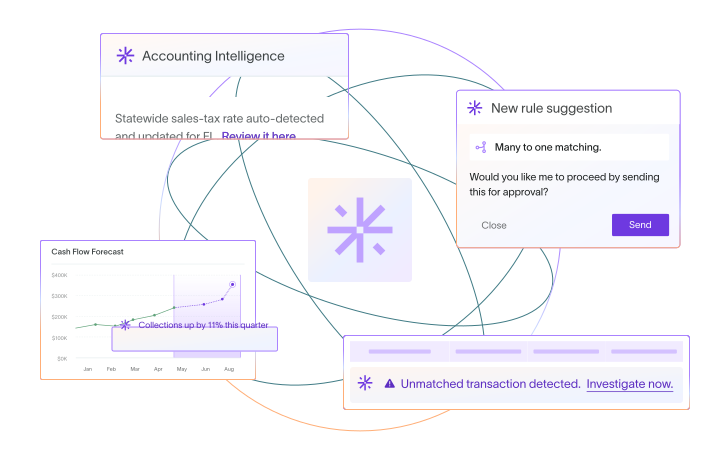
Efficiency gains, smoother workflows, and more: there are many reasons why implementing AI feels like an easy win for accounting firms right now. Let’s look at some of the top benefits.
Time and cost savings
According to Deloitte CFO surveys, finance leaders increasingly view AI and automation as key drivers of productivity improvements and cost management.³ Mid-sized businesses can see benefits from AI automation in several areas:
- Account reconciliation
- Data extraction from invoices
- Expense categorization
- Bank-statement matching
- Recurring-transaction processing
Data-entry costs can drop sharply once you switch to automated invoice processing. IOFM benchmarking shows cost per invoice can fall from about $6.30 with no automation to about $2.68 with end-to-end automation.⁴ Monthly close cycles? Faster, with less rework. CPA.com notes vendors report time savings of 30–70% across workflows including bank reconciliations, month-end close, and reporting.⁵
A revenue and productivity boost
According to CPA Trendlines research, firms adopting AI report higher revenue per employee, often in the $250,000–$350,000 range compared with traditional peers.⁶ But the value goes beyond efficiency: AI-driven cash flow forecasting has been shown to materially improve forecast accuracy and enable more confident planning by finance teams.⁷
Companies that have embraced AI report meaningful gains in cash management—for example, J.P. Morgan reports that Prysmian reduced manual forecasting work by 50% and saved $100K annually after adopting AI-powered cash flow forecasting.⁷ Benefitting from game-changers like live financial insights, teams can now spot cash-flow issues earlier. Fewer overdraft fees; more proactive financial decisions.
More accuracy
AI also improves accuracy across the board. Companies often see significant error reduction with AI-powered anomaly detection, with research showing up to a ~76% decrease in material misstatements compared with traditional methods,⁸ while AI-based fraud detection can improve detection rates by around 40%.⁹ Fewer errors mean lower audit risk, smoother compliance, and less time spent fixing mistakes.
AI's impact on risk management and compliance
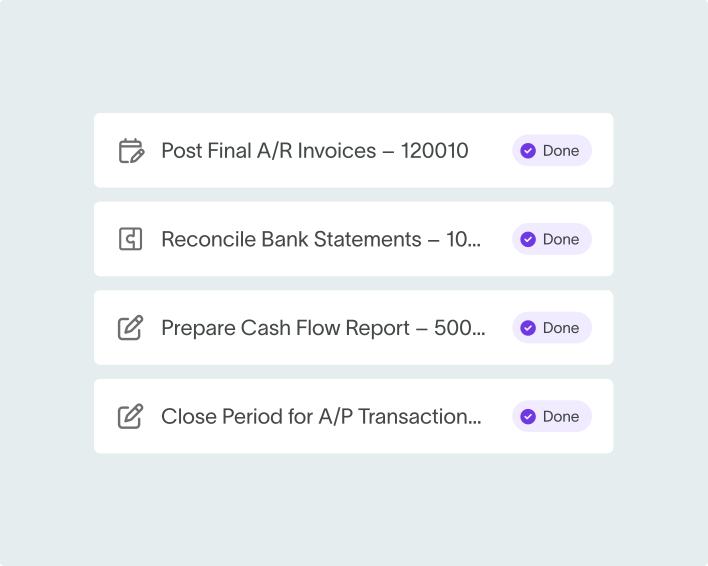
Companies are dealing with more regulatory pressure and more sophisticated fraud risks. It’s not a huge surprise that traditional, manual approaches struggle to keep up. AI can add real value here, giving teams new ways to manage risk and stay compliant without piling on more manual checks.
Fraud detection
AI-based fraud detection tools can analyze entire transaction populations (rather than small samples), making it easier to spot unusual patterns at scale. Automated anomaly detection can pick out issues that traditional, manual audits often miss.¹⁰
The popularity of AI in this space is growing. The 2024 ACFE/SAS Anti-Fraud Technology Benchmarking Report shows that 18% of anti-fraud professionals already use AI or machine learning. Another 32% plan to adopt it in the next two years. The same study found that 83% expect to add generative AI to their anti-fraud programs over that timeframe – a clear sign that AI is becoming a standard part of fraud prevention.¹¹
Compliance automation
Analysts estimate the global banking industry could achieve $1 trillion in cost savings by 2030. KYC and AML automation specifically contributes $217 billion of this total.¹² Manual verification decreases; real-time monitoring increases. Compliance monitoring for GAAP, IFRS, and local tax regulations is getting more and more automated through AI systems.
These systems handle different workflows, like:
- Real-time regulatory updates
- Automated tax logic mapping across jurisdictions
- Continuous auditing
- Early detection of compliance issues
Financial reporting errors decrease by around 5% when companies invest in AI, and audit- and compliance-related costs fall by about 1% as processes become more automated.¹³ Companies can monitor compliance around the clock without needing to add to their headcount. And most importantly, they’re always ahead: there’s no more addressing problems after they occur.
Predictive analytics and strategic decision-making
Predictive analytics and strategic decision-making
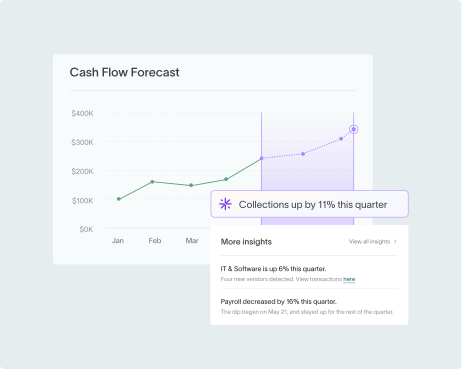
AI helps finance teams to stop looking backward and start planning ahead. Predictive analytics take away the usual pain and make it simple to forecast, allocate resources, and make truly informed decisions. Plus, everything can be rooted in real-time data – not just historical reports.
Financial forecasting accuracy
McKinsey research shows widespread AI adoption, with 88% of organizations reporting regular AI use in at least one business function.¹⁴ Common use cases include cash flow forecasting, working capital optimization, and real-time reporting, with reporting cycles speeding up as a result. ¹⁵
AI-driven cash flow forecasting improves accuracy, so treasury teams can manage liquidity better. Predictive models also spot seasonal patterns and demand shifts more accurately, slashing forecast errors by 20–50% (compared to traditional spreadsheet-based methods).¹⁶ This way, finance teams feel more confident when making strategy adjustments.
Advisory service expansion
AI also changes how accounting firms grow. Organizations that adopt AI more quickly generate three times more revenue per employee than slower adopters.¹⁷ That’s a meaningful difference, coming from increased capacity, not increased headcount. With AI handling more compliance and routine work, accountants can spend more time on advisory services.¹⁸ If you want to learn more about whether AI will replace accountants, we cover it here.
Ready to start using AI?
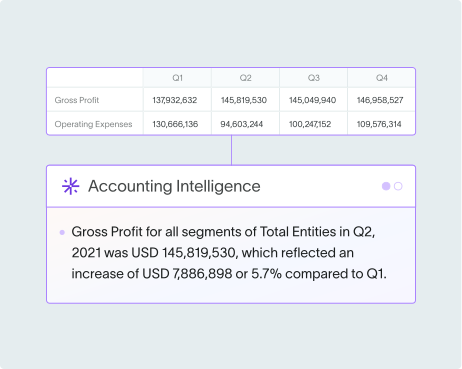
Making the move from planning to actually adopting AI is about more than picking the right tool. Successful implementations usually come down to preparation, especially when it comes to data, security, and setting clear expectations.
Start by looking at your data
Data quality is a big blocker for many teams at first. Forrester research shows that inconsistent, incomplete, or siloed data is the top reason GenAI projects stall.¹⁹
So, before you implement AI, it’s worth doing a data audit to make sure whatever AI accounting software you choose runs smoothly. Patchy or badly structured datasets are harder for AI to work with.
You might also want to think about following a phased approach. Some companies prefer to pilot “quick wins” (e.g. invoice processing or bank reconciliation) first before rolling out AI automation into other workflows, like accounts receivable or taxes. Gartner’s 2025 AI in Finance Survey found that about 25% of finance teams struggle to move from AI planning to piloting — so taking baby steps can be a smart route.²⁰ This is tool-dependent, though: modern, AI-native accounting software are built to work across workflows from day one, so teams have the flexibility to start small or adopt automation more broadly without complex setup or long pilot phases.
How to approach ROI
ROI should be measured broadly. That includes reduced labor hours, fewer errors, faster closes, lower audit effort, and a cut in compliance costs, not just license savings. If you want to learn more about how AI is used in accounting, we break it down in detail here.
Implementation concerns – and how to fix them
Security and integration
Security and privacy are obviously top priorities. Deloitte’s 2026 State of AI in the Enterprise report shows that only about 21% of companies have mature governance in place for autonomous AI — highlighting how significant data protection and oversight risks still are.²¹
To keep your systems secure, you’ll want to have these basics in place with whatever AI platform you choose:
- Encryption
- Access controls (best if they’re role-based and fully customizable to different workflows)
- Always-on audit trails
- Data protection that meets GDPR / CCPA requirements
Another point you need to reinforce to your team? CPAs should still be responsible for accuracy and compliance, even when AI’s supporting financial reporting.
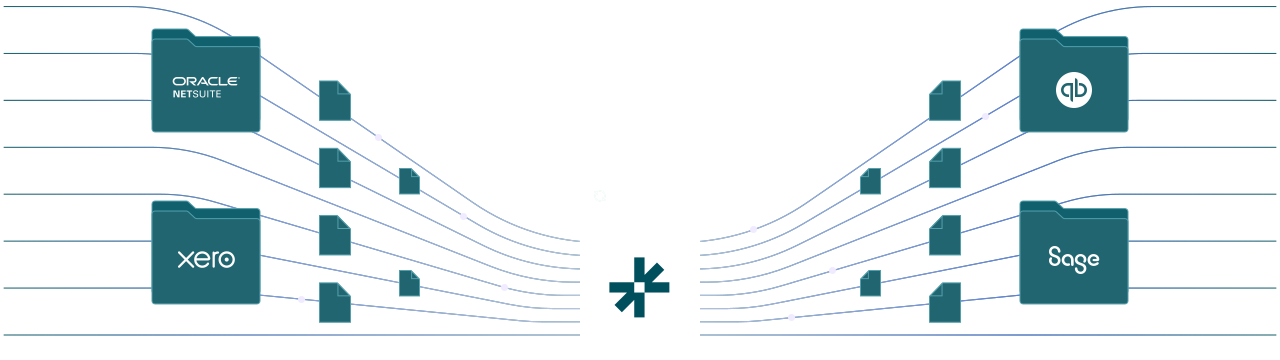
Integration also matters. Many companies still struggle to pull meaningful data from legacy systems or face data-availability issues because of disconnected tools. Make sure to look at your tech stack and ensure it can easily integrate with any new AI software. Modern platforms like DualEntry offer 13,000+ native bank and app integrations.
People, skills, and trust
Nearly two-thirds of finance teams still express some hesitation about AI adoption, according to industry surveys — driven mainly by concerns around job security, skill gaps, and uncertainty about ROI.²²
The most successful firms focus on role evolution, not role replacement. They transition bookkeepers into AI analysts and tax preparers into tax strategists. While 47% of professionals worry AI could weaken client relationships, 71% of firms already using AI report improved service levels.¹
Trust takes time. Fewer than half of accounting professionals say they fully trust AI today, and only a minority believe leadership shares their enthusiasm for new technology.¹ Clear communication, training, and visible wins can help close that gap.
The future of AI in accounting
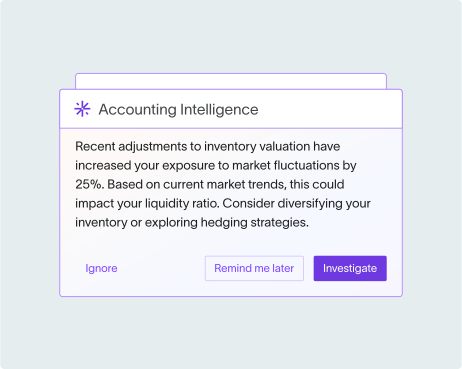
AI is continuing to change how everything accounting looks, from the way tasks get done to how services are delivered. This technology is always evolving, so it’s important to think about the future as well as the status quo.
What’s coming next
One major shift is continuous auditing. Instead of making periodic checks, AI can monitor transactions in real time and flag issues as they arise.
Generative AI for financial report automation is also moving fast. It can now:
- Automatically create financial statements
- Create audit-ready documents
- Generate personalized reports with minimal human involvement
- Keep reporting accurate and consistent
Looking further ahead, AI is increasingly being combined with blockchain to boost transparency and auditability. This area is expected to grow quickly (up to $973 million by 2027),²³ as businesses look for systems that make financial data both more trustworthy and easier to analyze.
The competitive edge
Firms already using connected, cloud-based technology report up to 39% higher revenue per employee and believe AI adoption helps attract and retain talent.²⁴ As AI takes the lead on compliance work, many firms now have more capacity to expand and offer advisory services too. High-growth firms are about 49% more likely to emphasize advisory services as a result. ²⁵
The profession itself is changing as well. AICPA and the Big Four are now developing ways to audit AI systems, not just use them. This shift, from AI accounting to AI governance as a service offering, is a strong signal of where things are headed.
The early-adoption window for AI is still open… but not for much longer. Companies that act now and roll out the new technology have the chance to position themselves as industry leaders. Delaying the AI decision could mean a lot of playing catch-up later.
AI Benefits in Accounting FAQs
See the full power of DualEntry in 30 minutes
Woosung Chun
CFO, DualEntry
Woosung Chun is the CFO of DualEntry with experience in corporate finance, accounting, strategy, and acquisitions. He previously grew from scratch and led the M&A and Finance teams at Benitago, where he completed more than 12 acquisitions in 2 years. He graduated with a BS from NYU Stern. At DualEntry, Woosung writes about AI in accounting, revenue recognition, foreign currency accounting, hedge accounting, and ERP modernization for finance teams navigating complex, multi-entity environments.
.webp)