Don't worry! The contents here will appear on the published page.
Will AI Replace Accountants? What’s Really Changing in 2026

Do San (Justin) Myung
Expert Accountant & Former Consulting CFO
Do San (Justin) Myung
Expert Accountant & Former Consulting CFO
Justin (Do San Myung) is Expert Accountant at DualEntry with 20+ years of hands-on experience managing general ledgers, financial close processes, and ERP implementations for mid-market and enterprise companies. As a former Consulting CFO and Controller, he has personally overseen month-end closes, SOX compliance programs, and multi-entity consolidations across technology, manufacturing, and services industries. Justin specializes in transforming manual accounting workflows into automated, AI-driven processes.
Learn about our editorial policies.
Last updated
October 20, 2026
Reviewed by
Woosung Chun

Woosung Chun
CFO
Woosung Chun is the CFO of DualEntry with experience in corporate finance, accounting, strategy, and acquisitions. He previously grew from scratch and led the M&A and Finance teams at Benitago, where he completed more than 12 acquisitions in 2 years. He graduated with a BS from NYU Stern. At DualEntry, Woosung writes about AI in accounting, revenue recognition, foreign currency accounting, hedge accounting, and ERP modernization for finance teams navigating complex, multi-entity environments.
Learn about our editorial policies.

Summarize this article


TL;DR
What it is: AI isn't poised to replace accountants entirely - but it will change what they spend their time on, taking over repetitive work while humans focus on judgment, interpretation, and strategy.
Why people worry: Rapid progress in AI (e.g., LLMs scoring well on CPA exam sections) makes it easy to think machines will take over, especially for data entry and pattern tasks.
Where AI helps: Tools automate transaction processing, OCR invoice capture, bank matching, reconciliation, and first-pass analysis - freeing up time and reducing burnout.
Limits of automation: AI works on probability, not certainty, and can hallucinate - but accounting requires 100% accurate, context-rich decisions and compliance judgments.
The human edge: Trust, advisory relationships, deep judgment, and interpreting complex standards still demand accountants - AI augments these skills, it doesn't replace them.
Is accounting, as we know it, over? Scroll down any accountant’s LinkedIn feed and, in minutes, you’ll come across the first post talking about the death of the profession in the AI age. And the conversation goes on: ChatGPT’s passed the CPA exam.[1] New software is handling thousands of invoices without any human involvement. The latest tools are closing the books in record time. Every headline adds to the anxiety for people working in finance, whatever level they’re at.
It’s easy to get swept up in the AI hype. So it’s important to pause and sense check – because the reality is, AI won’t replace accountants. At least not entirely. It will, however, take over some of their work and change their day-to-day routines.
If you want a deeper breakdown of how AI is actually being used across accounting workflows today, see our complete guide to AI in accounting — and our guide to practical AI adoption in accounting.
The AI-ification of finance is coming at a critical time for the industry, which is facing multiple challenges at the same time. 75% of CPAs are due to retire in the next decade, and companies are struggling to fill vacant positions.[2] Burnout is driving experienced professionals away from the field. And on top of this, AI’s power is growing fast. Combine all these challenges, and you have a blend of uncertainty and opportunity – because the technology that might seem threatening is actually providing solutions to accounting’s most pressing problems.
In this blog post, we’re breaking down AI’s impact on accounting and how to keep up as Finance changes the way it works. Whether you’re a recent graduate, a CPA or a CFO, if you want to win in the industry’s shifting landscape: take notes.
[tldr]
Why people are worrying – and what’s actually happening
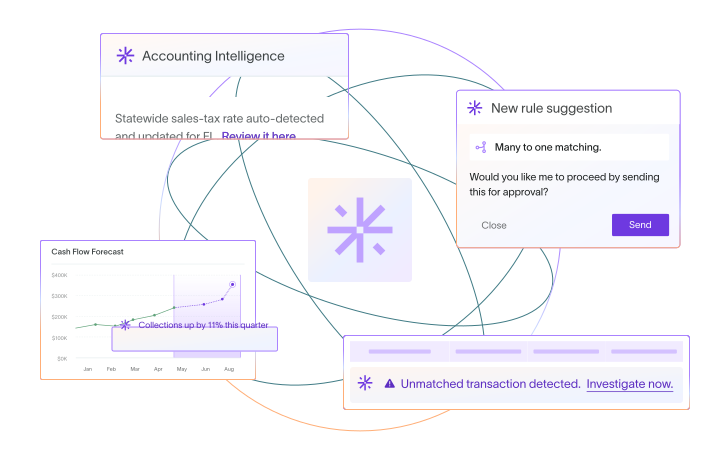
A lot of the fear around AI replacing accountants comes from very real (and very fast) progress in the technology. Take the CPA exam as an example. Open AI’s GPT-3.5 failed the exam with a 48% average score – but 18 months later GPT-4 averaged 85.1% across all sections, including a 91.5% in Auditing and Attestation.[1] That’s a big leap in a short amount of time, so it’s hard to ignore.
You then also need to consider how accounting is viewed from the outside. Many people think the job is mostly about data entry, calculations, and spreadsheets. AI excels at math and pattern recognition, so it’s easy to jump to the conclusion that machines will simply take over. But that view misses what professional accounting actually involves: judgment, context, interpretation, and responsibility.
In reality, AI’s already being used in finance teams’ workflows, but not in the way people imagine. KPMG, Deloitte, PwC, and EY have built AI into their audit practices.[3] KPMG’s Clara platform, for example, analyzes 100% of transactions instead of relying on small samples.[4] Where an auditor once checked 50 invoices out of 50,000, Clara can review all 50,000 and flag what looks unusual. Humans spend less time ticking boxes and more time understanding why something looks off.
Large language models are also getting better at reading and analyzing financial statements. That’s something the profession needs to acknowledge, but it’s just as important to recognize the limits here. These systems can support accountants and speed up parts of the job – they don’t replace professional judgment, accountability, or experience.
AI is best at automating the boring stuff
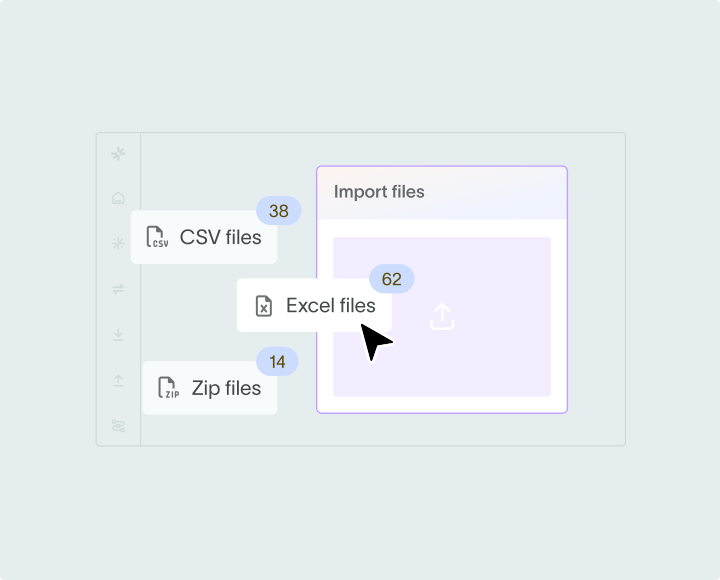
One of the biggest ways AI is changing accounting? Taking repetitive work off people’s plates. Stanford GSB professor Jung Ho Choi describes it as removing the “drudgery” from the profession.[5] When routine tasks are automated, teams can close the books faster, with less pressure and less burnout. The focus isn’t on replacing accountants, but on cutting out work that takes up time without adding much strategic value. We break down those gains in more detail in our overview of the benefits of AI in accounting.
Transaction processing is a good example. Optical Character Recognition (OCR) technology can read receipts and invoices with close to 100% accuracy, pulling out vendor names, amounts, dates, and line items automatically.[6] That means thousands of documents can be processed each month without manual data entry: upload them, and AI will read them and log them as accounting transactions.
AI Accounting software has also moved toward what’s often called “zero-entry” bookkeeping. Machine learning handles transaction coding by recognizing patterns in bank data. Software subscriptions, insurance payments, and other recurring transactions are categorized automatically. When human accountants need to jump in and make corrections, the system’s AI learns from them – so over time, accuracy gets even better.
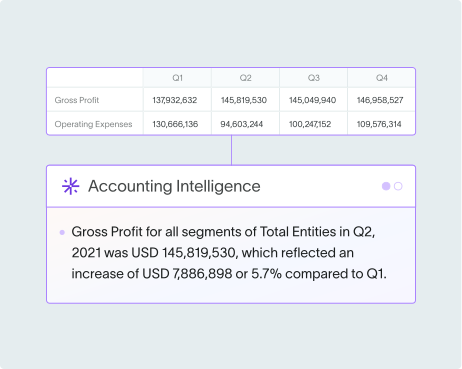
Generative AI is also starting to act like a junior analyst. It can scan P&Ls, spot trends, and create plain-language summaries like “Revenue increased 10% due to a new product launch” or “Operating expenses rose 15% because of higher marketing spend.” These tools can also create variance analyses and draft management commentaries, giving finance teams a head start and saving time on the data-collection groundwork.
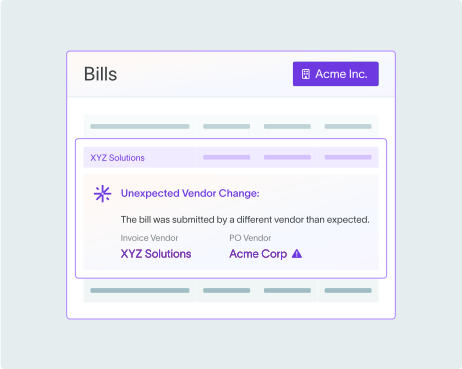
Other popular time-saving AI workflows include automatic bank matching, bank-fee automation, and automatic distribution. And reconciliation can now be done hands-free: AI can match invoices to POs and delivery records, and run bank reconciliations in minutes. Three-way matching happens automatically, across multiple documents, without constant human involvement.
The work best left to the real experts
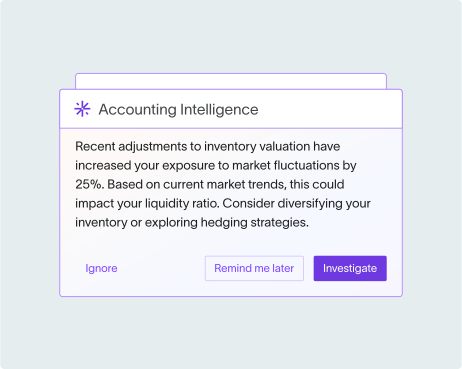
AI generates outputs based on probability, not certainty. This is a real problem in accounting, because accuracy isn’t optional. Financial reports need to be 100% correct.
Hallucinations (when AI confidently produces information that sounds right, but is actually wrong) are a big risk. These blips happen because AI predicts what looks correct based on patterns – not because it understands facts or carefully checks sources. There’s always a risk that AI might reference the wrong section of the tax code, invent a financial ratio, or misstate a figure.
So, having a real person in the loop is a must. The SEC holds management responsible for the accuracy of financial statements, and auditing standards require professional judgment and skepticism. Under current SEC rules, AI systems cannot replace management’s accountability in financial reporting. [7]
Accounting standards also demand interpretation that goes beyond pattern matching. Revenue recognition under ASC 606 depends on understanding contract intent.[8] Fair value measurements rely on judgment about assumptions and market conditions. Lease classification, materiality thresholds, and contingent liabilities all depend on context and professional assessment. These are decisions AI can support, but not make on its own.
Finally, there’s the human side of the job. Client-accountant relationships are just as much about trust and relationships as they are about numbers. Tax planning depends on personal goals and risk tolerance. Advisory work involves reading between the lines and asking the right questions. All things that even the best AI accounting software can’t help you with.
Why we should see AI as support, not a threat
Before we put the current state of accounting down to a tech problem, let’s rethink. Because is it not actually a people problem?300,000+ professionals left the field between 2019 and 2024 and the AICPA reports that 75% of current accountants are eligible to retire.[9] At the same time, fewer students are enrolling in accounting programs each year.
Burnout is a huge driver. Long tax seasons and audit busy periods push weeks to 60-80 hours, often for months at a time. AI can make a real difference here: by handling routine transactions, data entry, and first-pass analysis – even outside normal hours – AI reduces overtime and takes pressure off teams. Firms can do more with fewer people, and the work that sticks around becomes more interesting and sustainable. Used this way, AI isn’t replacing accountants, but rather helping to keep them in the profession.
How the accountant job description is changing
For a long time, accounting was mainly about looking backward. The job was to record transactions, close the books, and make sure everything complied with the rules.
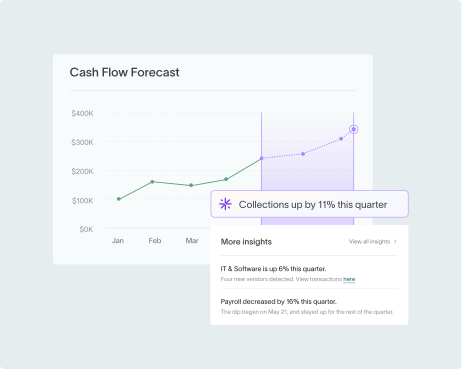
AI is changing this so that today’s most successful accountants are less like scorekeepers and more like strategic partners. Instead of just reporting on what happened last month, they’re focusing more on understanding what’s to come. Financial planning and analysis takes center stage – cash flow forecasting becomes more important than bank reconciliation, and the focus on tax compliance is moving more toward tax optimization.
Future-proofing your career: the skills you need now
As the role changes, so do the skills. One of the most important new capabilities is knowing how to work with AI effectively. Prompting AI systems well – asking the right questions in the right way – is becoming as essential as knowing Excel formulas once was.
At the same time, skepticism and validation skills matter more than ever. Accountants need to review AI outputs, spot errors or hallucinations, and verify results against source data. There’s a lot of talk at the moment about critical-thinking skills disappearing the more we rely on AI – but in accounting in particular, critical thinking remains incredibly important. If you get lazy, accuracy and compliance are at stake.
Finally: soft skills rise to the top. Communication, relationship-building, and judgment can’t be automated. As technical work fades into the background, explaining insights, advising stakeholders, and translating numbers into decisions are big differentiators.
The hybrid future
It’s easy to get swept up in the AI hype. So it’s important to pause and sense check – because the reality is, AI won’t replace accountants.
The future of accounting isn’t humans or AI – it’s both, working together. Where AI brings speed and scale, humans bring judgment, context, and experience. Combining these two powers is a no-brainer for high-performing teams.
The idea of a “robo-accountant” replacing people misses the point. AI is great at handling the spreadsheets, data entry, and repetitive work that previously took huge chunks out of the average accountant’s week. Finance professionals, in turn, now can spend more time on strategy, problem-solving, and advising the business. Human insight is still needed to make sense of the numbers and guide decisions.
Will AI Replace Accountants FAQ
Will AI replace accountants?
No. It's taking over the repetitive stuff, data entry, categorization, first-pass reconciliations, and it's good at that. But DualEntry Labs' 2026 benchmark shows even the best models still miss enough real accounting tasks to need a human check. Judgment, controls, and client advisory stay with people. The job is moving toward review, not going away.
Will accounting be replaced by AI?
No. Every leading model tested on real accounting workflows still missed a meaningful share of tasks, and reconciliation, reporting, and month-end close are exactly where a small error snowballs. AI is fine for the first draft. Accuracy, judgment, and sign-off belong to the accountant. The U.S. Bureau of Labor Statistics still projects accountant employment growing 5% through 2034.
Can AI replace accountants?
It can replace tasks, not people. Give it high-volume, rules-based work like transaction coding or bank-feed matching and it's genuinely useful. Give it something needing judgment and it slips: DualEntry Labs' benchmark shows even top models still miss real accounting tasks. Estimates, audit defense, anything you'd justify later still needs a human. It's augmentation, an accountant supervising AI.
Will AI replace CPAs?
No. CPAs live in the work AI is worst at: judgment calls, regulatory interpretation, assurance, advisory. The AICPA reports that firms adopting AI mostly shift time toward higher-value advisory work rather than cut headcount, with one study citing 25% more advisory revenue. AI raises the ceiling on what a CPA can do. It doesn't replace the credential.
Will AI take over accounting?
It's taking over routine tasks, not the profession. Automation is already delivering around 30% faster month-end close and 50 to 70% less time on standard tax returns, per the AICPA. But the benchmarks are clear that AI can't be trusted on complex work without a check, so accountants are moving into review, exception-handling, and advisory instead.
References
-
 SSRN Electronic Journal — Can LLMs Pass the CPA Exam? Evaluating Large Language Model Performance on the Certified Public Accountant Test
-
Andreessen Horowitz (a16z) (Dec 2024) — Death, Taxes, and AI: How Generative AI Will Change Accounting
-
Thomson Reuters Institute (2025) — How Do Different Accounting Firms Use AI in 2025?
-
KPMG LLP — KPMG Clara: Intelligent Audit Platform – Powered by AI
-
Stanford GSB Insights (Choi, Jung Ho) — AI Is Reshaping Accounting Jobs by Doing the “Boring” Stuff
-
Klippa (2026) — Best OCR Software for Receipts in 2026
-
U.S. Securities and Exchange Commission (June 5, 2003) — Management’s Report on Internal Control Over Financial Reporting and Certification of Disclosure in Exchange Act Periodic Reports (Release Nos. 33-8238; 34-47986)
-
KPMG (2024) — Handbook: Revenue Recognition
-
The CPA Journal (Aug 15, 2025) — ICYMI | The Accounting Profession Is in Crisis
See the full power of DualEntry in 30 minutes
Justin (Do San Myung) is Expert Accountant at DualEntry with 20+ years of hands-on experience managing general ledgers, financial close processes, and ERP implementations for mid-market and enterprise companies. As a former Consulting CFO and Controller, he has personally overseen month-end closes, SOX compliance programs, and multi-entity consolidations across technology, manufacturing, and services industries. Justin specializes in transforming manual accounting workflows into automated, AI-driven processes.