Don't worry! The contents here will appear on the published page.
3-Way Matching in Accounts Payable: Steps & Examples

Do San (Justin) Myung
Expert Accountant & Former Consulting CFO
Do San (Justin) Myung
Expert Accountant & Former Consulting CFO
Justin (Do San Myung) is Expert Accountant at DualEntry with 20+ years of hands-on experience managing general ledgers, financial close processes, and ERP implementations for mid-market and enterprise companies. As a former Consulting CFO and Controller, he has personally overseen month-end closes, SOX compliance programs, and multi-entity consolidations across technology, manufacturing, and services industries. Justin specializes in transforming manual accounting workflows into automated, AI-driven processes.
Learn about our editorial policies.
Last updated
November 20, 2026
Reviewed by
Woosung Chun

Woosung Chun
CFO
Woosung Chun is the CFO of DualEntry with experience in corporate finance, accounting, strategy, and acquisitions. He previously grew from scratch and led the M&A and Finance teams at Benitago, where he completed more than 12 acquisitions in 2 years. He graduated with a BS from NYU Stern. At DualEntry, Woosung writes about AI in accounting, revenue recognition, foreign currency accounting, hedge accounting, and ERP modernization for finance teams navigating complex, multi-entity environments.
Learn about our editorial policies.
Summarize this article


TL;DR
- Three-way matching helps businesses catch invoice errors: AP teams compare purchase orders, goods receipts, and supplier invoices to verify quantities, prices, and other details.
- The process starts with an approved purchase order: AP checks all three records and resolves discrepancies before approving invoices for payment.
- Matching tolerances help reduce unnecessary exceptions: Businesses can accept small price and quantity differences while flagging larger discrepancies for review.
- Three-way matching also affects accounting records: Accountants may use a GR/IR clearing account to record goods received before the supplier invoice arrives.
- Automation makes three-way matching easier: Software compares purchasing, receiving, and invoice records, flags discrepancies, and routes exceptions for review.
An approved purchase order doesn't guarantee an accurate invoice, and neither does a delivery confirmation.
A supplier can deliver exactly what was ordered and still charge the wrong price, or invoice for the full order when only half the goods have arrived.
These are the kinds of discrepancies accounts payable teams need to catch before releasing payment. And when you're processing hundreds or thousands of invoices, comparing every purchase order, goods receipt, and supplier invoice manually becomes increasingly difficult.
Three-way matching provides a way to verify what was ordered, what was received, and what was billed before approving payment.
This guide explains the process, how to handle discrepancies, and what happens in the accounting records when the documents don't match.
[tldr]
What is 3-way matching in accounts payable?
Three-way matching is an accounts payable (AP) control that compares three documents before an invoice is approved for payment:
- the purchase order (PO)
- goods receipt note (GRN)
- supplier invoice
Each document establishes a different part of the transaction. The PO confirms what the business authorized, the goods receipt shows what was delivered, and the invoice records what the supplier wants to charge.
The accounts payable 3-way match checks quantities, prices, and other details across these records to identify discrepancies.
Let’s say a company orders 100 units at $25 each, the warehouse receives all 100, and the supplier invoices $2,500. Since the documents agree, the invoice can proceed under the company's approval policy.
But if the supplier invoices $2,600 or delivers only 98 units, AP needs to investigate the difference. Small variances may be permitted under approved tolerance rules, but material discrepancies require review.
Three-way matching is useful for inventory, equipment, and purchases where delivery confirmation is necessary before payment [1].
What are the three documents used in 3-way matching?
The three-way matching process relies on records created at different stages of purchasing.
Together, they establish whether the purchase was authorized, the goods or services were received, and the supplier billed according to the agreed terms.
1. Purchase order (PO)
A purchase order records the quantities, prices, delivery terms, and supplier details authorized by the business.
For example, a PO for 200 laptops at $900 each establishes an agreed purchase value of $180,000, which AP can later verify against the supplier's invoice.
Purchase order software helps businesses create, approve, and track these records, keeping purchasing authorizations connected to subsequent invoices.
2. Goods receipt note (GRN)
A goods receipt records what was delivered and accepted. The receiving team checks quantities, identifies damaged or missing items, and documents discrepancies.
If only 190 of the 200 laptops arrive, the receipt should show 190 units, regardless of what the supplier invoices.
For services, an approved timesheet, completed milestone, or service acceptance record may serve the same purpose.
3. Supplier invoice
The supplier invoice requests payment and includes billed quantities, unit prices, taxes, payment terms, and the total amount due.
Ideally, it also references the original PO so AP can locate the corresponding purchasing and receiving records. Missing or incorrect references may require investigation before matching can begin.
Here's how the three documents compare:
How does the 3-way matching process work?
The three-way match process follows five main steps, from approving the purchase order to resolving invoice discrepancies:
1. Create and approve the purchase order
The requesting department submits a purchase requisition. Once approved, procurement issues a PO specifying the supplier, quantities, prices, and delivery conditions. This establishes the purchasing terms against which subsequent invoices will be checked and helps prevent unauthorized spending.
2. Receive and record the goods
When the order arrives, the receiving team checks the delivery against the PO and records quantities received, shortages, or damaged items. Partial deliveries must be documented accurately. If 600 of 1,000 units arrive, the receipt should show 600 units, with the remaining 400 outstanding unless the order is amended.
3. Capture the supplier invoice
AP receives the invoice through email, a supplier portal, or another approved channel. Invoice capture software can extract the relevant data automatically and associate the invoice with its PO and receiving records. Before matching, AP should also check for duplicates, missing information, and invalid vendor details.
4. Compare the three documents
During three-way PO matching, AP checks the invoice against the approved purchase order and goods receipt, usually at the line-item level. The main checks include:
- Quantity: Does the invoiced quantity agree with what was received and is eligible for billing?
- Unit price: Does the invoiced price match the approved PO?
- Item details: Are product descriptions and units of measure consistent?
- Additional charges: Do taxes, freight, and discounts comply with agreed terms?
Invoices that match or fall within authorized tolerances can proceed. Differences exceeding those limits are flagged for investigation.
5. Resolve discrepancies and approve the invoice
The appropriate team investigates each exception; procurement handles pricing disputes, receiving teams confirm deliveries, and suppliers may need to correct invoices. Once the issue is resolved, the invoice can proceed through the applicable approval workflow.
A successful match doesn't automatically eliminate every approval requirement. Some businesses permit automatic approval within predefined limits, while others require additional authorization based on transaction value or risk.
The flowchart below summarizes the three-way matching process, including what happens when the documents don't match.
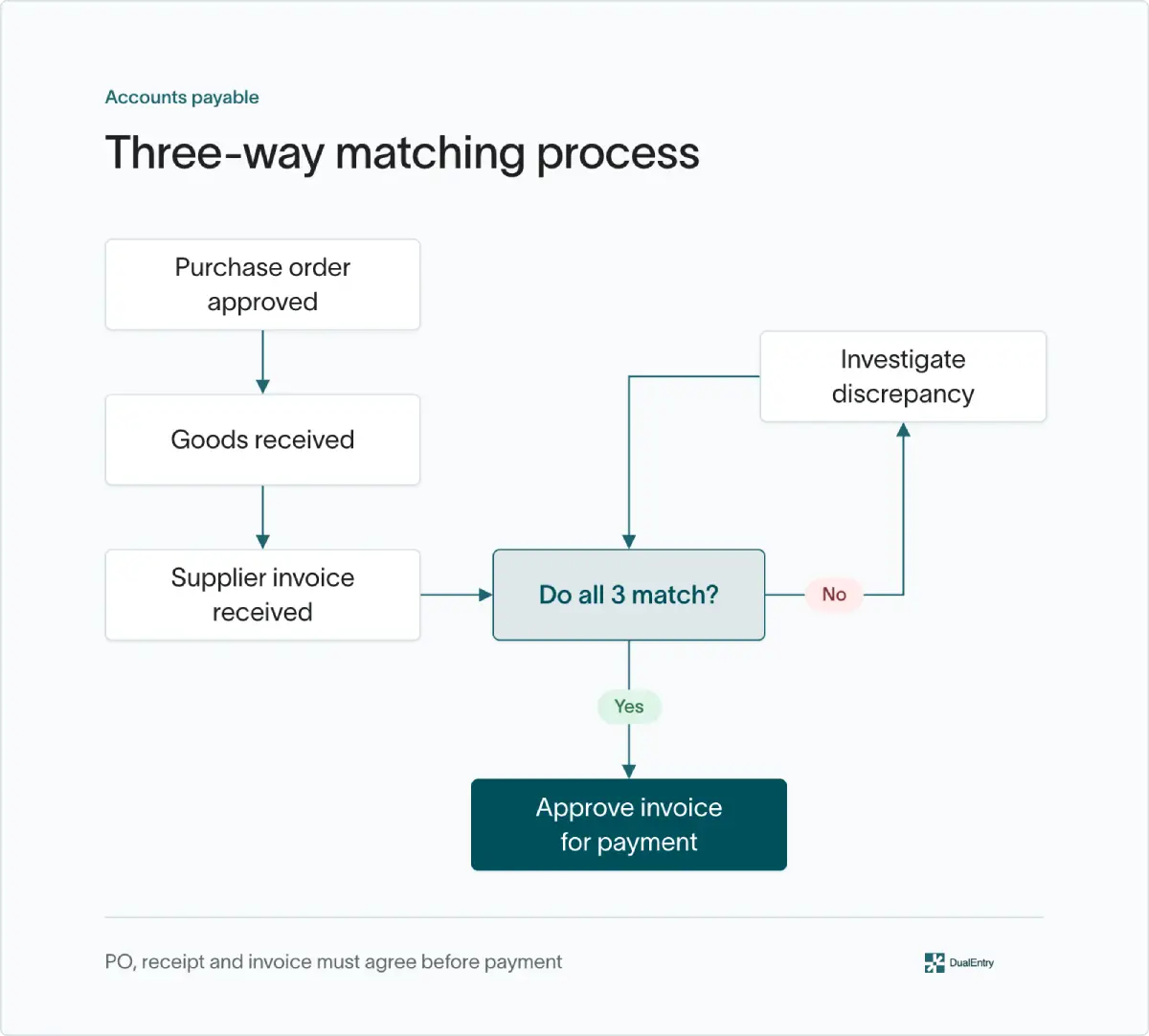
Three-way matching process flowchart
3-way matching example
Let's return to the company that ordered 1,000 inventory units at $10 each. The supplier delivered 600 units but invoiced the full order at $10.50 per unit.
*Goods receipt valued at the original PO price.
The records reveal two discrepancies. The first, the supplier billed for 400 units that haven't been received. The second, the invoice charges $0.50 more per unit than agreed, representing a 5% price increase.
Although the invoice exceeds the original PO by only $500, the company has received just $6,000 worth of goods against a $10,500 invoice. The $4,500 difference includes $4,000 for undelivered goods and $500 from the higher invoiced price.
How should AP resolve the discrepancy?
AP should confirm whether the remaining 400 units are still in transit and whether procurement approved the higher unit price. If the increase wasn't authorized, the supplier should issue a corrected invoice.
Assuming the business is billed only for the 600 units delivered at the agreed price, the payable amount becomes:
600 units × $10 = $6,000The remaining 400 units can be matched when delivery is confirmed. If procurement instead authorizes the $10.50 price, the received units would cost $6,300, subject to the company's accounting policy.
In either case, AP shouldn't approve the original $10,500 invoice without resolving the discrepancies.
What are tolerance levels in 3-way matching?
Small differences don't always justify stopping an invoice. Suppliers may round prices differently or apply minor authorized charges, so businesses establish matching tolerances to determine which variances can be accepted automatically and which require investigation.
Three common tolerance types are:
1. Percentage-based price tolerance
This allows a defined percentage difference between the invoice price and PO price. Under a 2% positive price tolerance, a $100 unit price may permit an invoice price up to $102, while a charge of $105 would require review.
2. Fixed-dollar tolerance
A fixed-dollar tolerance sets a maximum monetary difference, such as $100 per invoice. It prevents immaterial rounding differences from unnecessarily delaying payment while ensuring larger discrepancies receive attention.
3. Quantity tolerance
Quantity tolerances define acceptable differences between invoiced and received quantities. Some bulk materials may allow measurement variances, while individually counted items, such as laptops, may require an exact match.
How matching tolerances work together
Businesses may apply both percentage and dollar limits [2]. Suppose a company allows price variances of up to 2%, provided the total difference doesn't exceed $100.
Illustrative price tolerances, assuming quantities and other matching requirements are satisfied.
Both conditions must be met for the price variance to pass. Quantity differences, freight charges, and taxes may require separate rules.
A price variance within tolerance, for instance, shouldn't justify paying for goods that haven't been received.
3-way matching journal entries in accounting
Three-way matching verifies transaction details, but accountants must also record the resulting inventory and liabilities correctly.
When goods arrive before the invoice, companies may recognize a goods received not invoiced (GRNI) liability through a goods receipt/invoice receipt (GR/IR) clearing account. This allows finance teams to account for received goods before the supplier invoice is recorded in accounts payable.
The following 3-way match accounting entries use our earlier example and assume perpetual inventory, a standard cost of $10 per unit, and a GR/IR clearing process. Taxes and freight are excluded.
1. Record the goods receipt
The company receives 600 units valued at $6,000. Under the assumed accounting method, it records:
Inventory increases by $6,000, while the clearing account records the obligation for goods received but not yet invoiced.
2. Record the corrected supplier invoice
The supplier issues a corrected $6,000 invoice for the delivered units. AP records the invoice by clearing the GR/IR balance and recognizing the payable:
The liability now sits in accounts payable, where it remains until the supplier is paid.
3. Record an approved price variance
Suppose procurement approves the higher $10.50 unit price. The invoice for 600 units becomes $6,300, creating a $300 price variance [3]. Under standard-cost accounting, the entry may be:
The treatment depends on the inventory valuation method. Under actual-cost or moving-average accounting, the difference may instead increase inventory value, depending on whether the goods remain on hand.
These transactions affect both the general ledger and subledger, which accountants must keep reconciled. During the month-end close process, accountants review outstanding GR/IR balances to identify goods received without invoices, unmatched transactions, and unresolved differences.
2-way vs. 3-way vs. 4-way matching
Not every purchase requires the same level of verification. The appropriate method depends on what the company is buying, whether delivery confirmation is necessary, and the controls required before payment.
Two-way matching verifies that an invoice agrees with authorized purchasing terms. It may suit software subscriptions and certain professional services where no separate receiving event occurs [1].
Three-way invoice matching adds a receipt check, allowing AP to confirm that the quantities billed were actually received [4].
Four-way matching goes further by requiring inspection or acceptance evidence, such as quality testing for specialized manufacturing components [5].
Common 3-way matching discrepancies and how to resolve them
Most matching exceptions involve pricing differences, incomplete deliveries, missing documents, or incorrect supplier information.
The table below summarizes common problems and how AP teams can resolve them.
Accurate supporting records are essential. If goods have arrived but the warehouse hasn't recorded the receipt, AP should verify the delivery rather than change quantities simply to make the documents agree.
Similarly, PO prices should only be amended when changes have genuinely been authorized.
Every exception should have an owner, supporting evidence, and an audit trail. Regular balance sheet reconciliation also helps identify outstanding liabilities and discrepancies that remain unresolved at period-end.
Manage purchase orders and accounts payable with DualEntry
Manual matching requires accountants to retrieve invoices, locate purchase orders, verify receipts, compare line items, and investigate differences.
This becomes difficult as invoice volumes grow, particularly when the supporting records sit in different systems.
DualEntry’s accounts payable automation software reduces that work by automating several stages of invoice processing and matching.
With DualEntry, finance teams can:
- Create and approve purchase orders: Generate POs from approved purchase requests and route them through configurable approval workflows.
- Match invoices with purchasing records: Automatically compare purchase orders, supplier invoices, and goods receipts.
- Identify discrepancies: Flag differences in quantities and unit prices for review before payment.
- Capture supplier invoices: Use AI to extract invoice details and populate bill records.
- Manage exceptions and approvals: Review discrepancies, track supporting documents, and maintain an audit trail.
Because these records are connected to the general ledger, accountants can follow purchases from approval through invoice processing without switching between multiple systems.
Frequently asked questions about 3-way matching
What is the difference between 2-way and 3-way matching?
Two-way matching compares an invoice with an approved purchase order. Three-way matching also checks a goods receipt or service acceptance record to confirm that the billed goods or services were received.
Is 3-way matching required in accounts payable?
Three-way matching is a widely used internal control, but it isn't universally required. Its use depends on company purchasing policies, transaction risks, and applicable contractual or regulatory requirements.
Can 3-way matching be used for services?
Yes. An approved timesheet, completed milestone, or service acceptance record can replace a traditional goods receipt. For services without a distinct acceptance event, two-way matching may be more practical.
What happens when an invoice fails 3-way matching?
AP flags the invoice for investigation. The responsible team verifies the discrepancy, obtains missing documentation, or requests a corrected invoice. Unsupported amounts remain on hold until an authorized resolution is recorded.
What is a three-way match exception?
A three-way match exception occurs when an invoice fails the company's matching rules. Common causes include incorrect prices, quantities exceeding goods received, missing receipt records, and discrepancies beyond approved tolerances.
What is the difference between 3-way matching and invoice approval?
Three-way matching verifies that an invoice agrees with purchasing and receiving records. Invoice approval authorizes it to proceed under company policy. Depending on configured controls, successfully matched invoices may qualify for automatic approval.
See the full power of DualEntry in 30 minutes
Justin (Do San Myung) is Expert Accountant at DualEntry with 20+ years of hands-on experience managing general ledgers, financial close processes, and ERP implementations for mid-market and enterprise companies. As a former Consulting CFO and Controller, he has personally overseen month-end closes, SOX compliance programs, and multi-entity consolidations across technology, manufacturing, and services industries. Justin specializes in transforming manual accounting workflows into automated, AI-driven processes.