The 2026 Accounting AI Benchmark
We tested the top AI models on real accounting work for accuracy. Compare for yourself.








The 2026 Accounting AI Benchmark
Evaluating leading AI models on accounting work
The Accounting AI Benchmark tests leading AI models on 101 tasks across eight areas of accounting, from transaction classification and journal entries to reconciliation, financial reporting, and month-end close. Every model works from the same company books, receives the same instructions, and has access to the same accounting tools. Results are reported across accuracy, consistency, cost, duration, and accounting task area, showing both how models rank and where performance differs.
Current model performance
Compare the latest models across accounting accuracy, cost, consistency, and response time.
Leaderboard
All models in the current round are evaluated using the same benchmark release, accounting environment, tools, instructions, and test conditions.
Key takeaways
Accuracy vs. cost
Headline accuracy does not show how much a result costs to achieve. This view compares accounting performance with the estimated cost of running each model.
Accounting performance by category
Overall accuracy can hide substantial differences between accounting tasks. This view shows how each model performs across the eight areas included in the benchmark.
Gemini 4 Argon leads overall, but Muse Wonder performs better on Bank Reconciliation (91.7% vs. 75.0%) and Kimi K3 on Month-End Close (91.7% vs. 83.3%). Among the top five models, the largest gap appears in Accounts Receivable, where scores range from 50.0% (Kimi K3) to 91.7% (Gemini 4 Argon, Grok 4.7).
Performance by difficulty
The current benchmark contains 37 easy, 36 medium, and 28 hard cases. These labels are assigned as part of the benchmark and should not be read as a universal measure of accounting difficulty.
Gemini 4 Argon, Grok 4.7, and Gemini 3.8 Flash share the strongest performance on hard tasks at 82.1%, while Claude Opus 5.5 and Mistral Large 4 show the largest drop between easy and hard cases (94.6% to 64.3%, a 30.3-point drop).
What the benchmark tests
The Accounting AI Benchmark contains 101 synthetic cases across eight areas of accounting. Each case has a task, a reference answer, and fixed scoring requirements. No customer data is involved.
How answers are scored
Every case has a reference answer written before the model is evaluated. Grading is deterministic: the same response evaluated under the same scoring specification receives the same score. No AI model is used as a judge of another model’s answer.
For classification, structured-response, and numerical cases, a score of 0.8 or higher is a pass. Multiple-choice cases are binary. The benchmark retains both the underlying score and the pass indicator, so a pass should not be read as proof that every accounting detail in the response was perfect.
For numerical cases, expected values are checked using the benchmark’s fixed tolerance rules, including a 0.5% relative tolerance where applicable.
Where we report direct statistical comparisons between models, we compare matched cases using paired bootstrap analysis rather than treating every small percentage-point gap as meaningful.
Benchmark updates
Changes to the benchmark are versioned so readers can see when the case set, scoring rules, evaluation environment, or reporting changed.
October 2026 · Version 1.0
A new task, reference answer, scoring rule, or materially different evaluation condition creates a different benchmark condition. Results from incompatible versions should not be combined into a single ranking.
Methodology
DualBench100 is the evaluation framework behind the Accounting AI Benchmark. It defines the case composition, evaluation procedure, deterministic scoring methods, repeated-trial reporting, cost and latency measurement, matched statistical comparison, and reproducibility requirements.
Every model runs the complete benchmark three times under the same evaluation conditions. Each model receives the same 101 accounting cases, starts from an identical, freshly restored test company, has access to the same accounting tools and permitted actions, and receives the same instructions and evaluation settings. Each result is tied to the exact run, date, model configuration, and Accounting Intelligence release. A task counts as passed when the model passes it in at least two of the three runs.
The benchmark also records execution outcomes, elapsed response time, and available usage data separately from response quality. Cost estimates use provider-reported charges where available or an identified public pricing schedule.
The public benchmark summarizes the parts needed to interpret the results. The full methodology contains the formal scoring definitions, tolerances, eligibility rules, statistical procedure, and interpretation limits.
The DualBench100 methodology
The formal scoring definitions, tolerances, eligibility rules, statistical treatment and interpretation limits behind the Accounting AI Benchmark
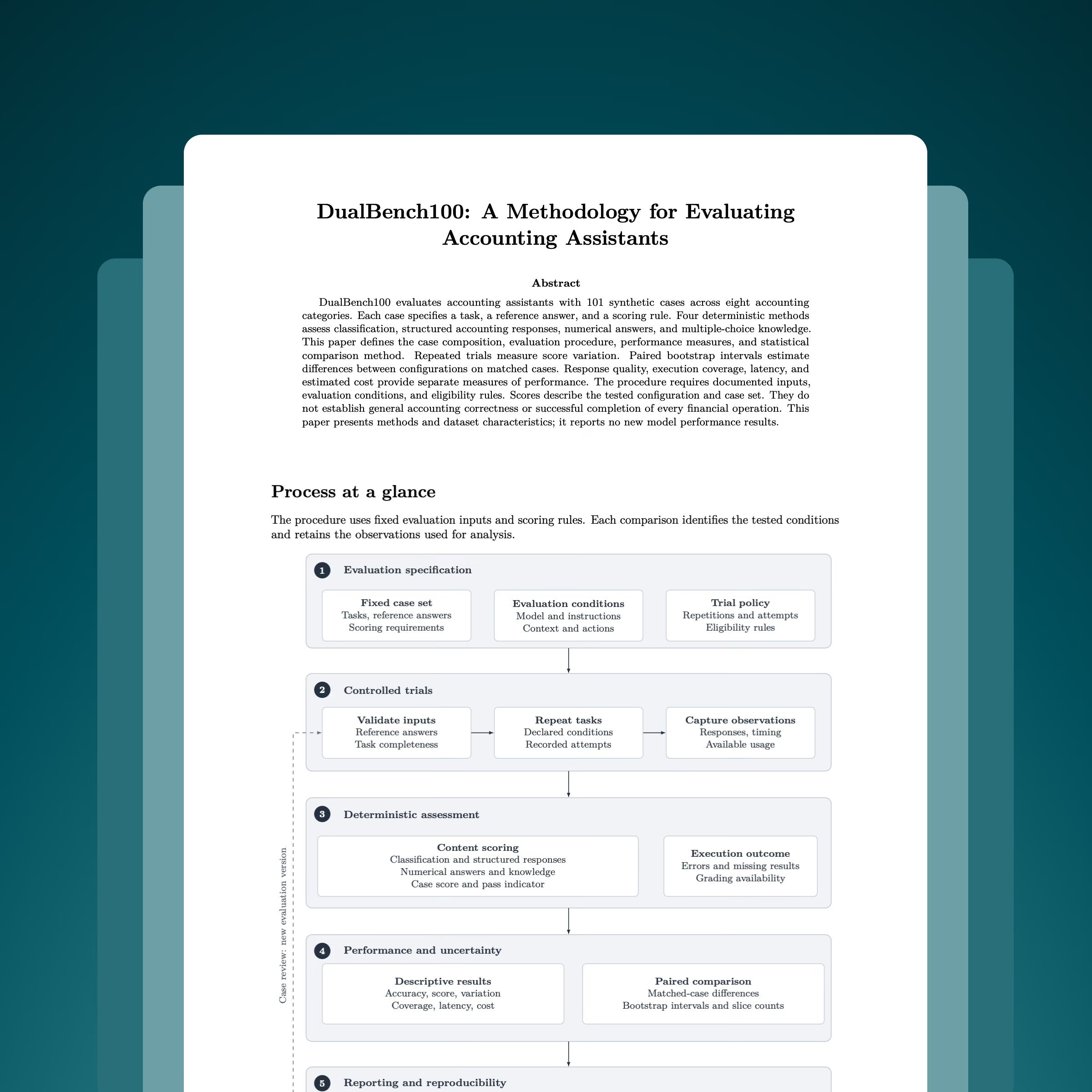
How to interpret the benchmark
DualBench100 uses synthetic accounting scenarios across a defined set of tasks. The mix does not represent every company, industry, accounting policy, or workflow, and the easy / medium / hard labels should not be read as universal measures of accounting difficulty.
Scores describe the tested model configuration under the reported conditions. Different instructions, context, tools, settings, or workloads may produce different results.
A benchmark pass means the response met the checks defined for that case. It does not guarantee complete financial validity or correctness beyond those checks. The benchmark evaluates the full tested configuration, not the model in isolation.
Frequently asked questions (FAQ)
Why don't you use an AI model to grade answers?
AI graders are inconsistent and can favor models similar to themselves. Every benchmark case has a fixed reference answer and deterministic checks, so the same response receives the same grade under the same scoring specification.
Why are these scores different from other AI benchmarks?
Most benchmarks test general knowledge or coding. DualBench tests real accounting work inside a real accounting system, where the model has to use tools and produce correct records. A model that's great at general tasks isn't automatically great at accounting.
Is customer data used?
No. All benchmark tasks use synthetic scenarios and run against a test company. No customer data is used.
How often is the benchmark updated?
New models can be evaluated as they are released. Full benchmark rounds rerun eligible models together so results can be compared under the same benchmark version and evaluation conditions.
Does the AI post anything to real books?
No. All benchmark tasks use synthetic scenarios and run against a test company. No customer data is used.
ERP Implementation Cost Calculator
Estimate license, implementation, and hidden costs of a legacy ERP rollout.
Open calculator →SaaS metricsNet Revenue Retention Calculator
Measure how much recurring revenue you retain and expand from existing customers.
Open calculator →SaaS metricsChurn Rate Calculator
See what share of customers or revenue you’re losing each period.
Open calculator →PlanningBreak-Even Calculator
Find the point where revenue covers your fixed and variable costs.
Open calculator →SaaS metricsWorking Capital Calculator
Calculate working capital, current and quick ratios, and non-cash working capital from your balance sheet.
Open calculator →PlanningBurn Rate Calculator
Track how fast you’re spending cash and how many months of runway remain.
Open calculator →The last ERP decision you'll ever make.
By clicking "Schedule Demo" you agree to the use of your data in accordance with DualEntry's Privacy Notice.