Don't worry! The contents here will appear on the published page.
Consolidated Financial Statements: Requirements & Example

Do San (Justin) Myung
Expert Accountant & Former Consulting CFO
Do San (Justin) Myung
Expert Accountant & Former Consulting CFO
Justin (Do San Myung) is Expert Accountant at DualEntry with 20+ years of hands-on experience managing general ledgers, financial close processes, and ERP implementations for mid-market and enterprise companies. As a former Consulting CFO and Controller, he has personally overseen month-end closes, SOX compliance programs, and multi-entity consolidations across technology, manufacturing, and services industries. Justin specializes in transforming manual accounting workflows into automated, AI-driven processes.
Learn about our editorial policies.
Last updated
October 8, 2026
Reviewed by
Woosung Chun

Woosung Chun
CFO
Woosung Chun is the CFO of DualEntry with experience in corporate finance, accounting, strategy, and acquisitions. He previously grew from scratch and led the M&A and Finance teams at Benitago, where he completed more than 12 acquisitions in 2 years. He graduated with a BS from NYU Stern. At DualEntry, Woosung writes about AI in accounting, revenue recognition, foreign currency accounting, hedge accounting, and ERP modernization for finance teams navigating complex, multi-entity environments.
Learn about our editorial policies.

Summarize this article
When one company controls another, it can't just report its own numbers and leave the other out. A parent and the companies it controls have to be presented as a single business, as if the whole group were one company instead of several.
That's harder than stacking two balance sheets on top of each other. Anything the companies owe each other, or sold to each other, has to come out first, so the final numbers show only what the group did with the outside world.
The tricky part is knowing what gets added, what gets eliminated, and what happens when the parent doesn't own 100% of the subsidiary.
What are consolidated financial statements?
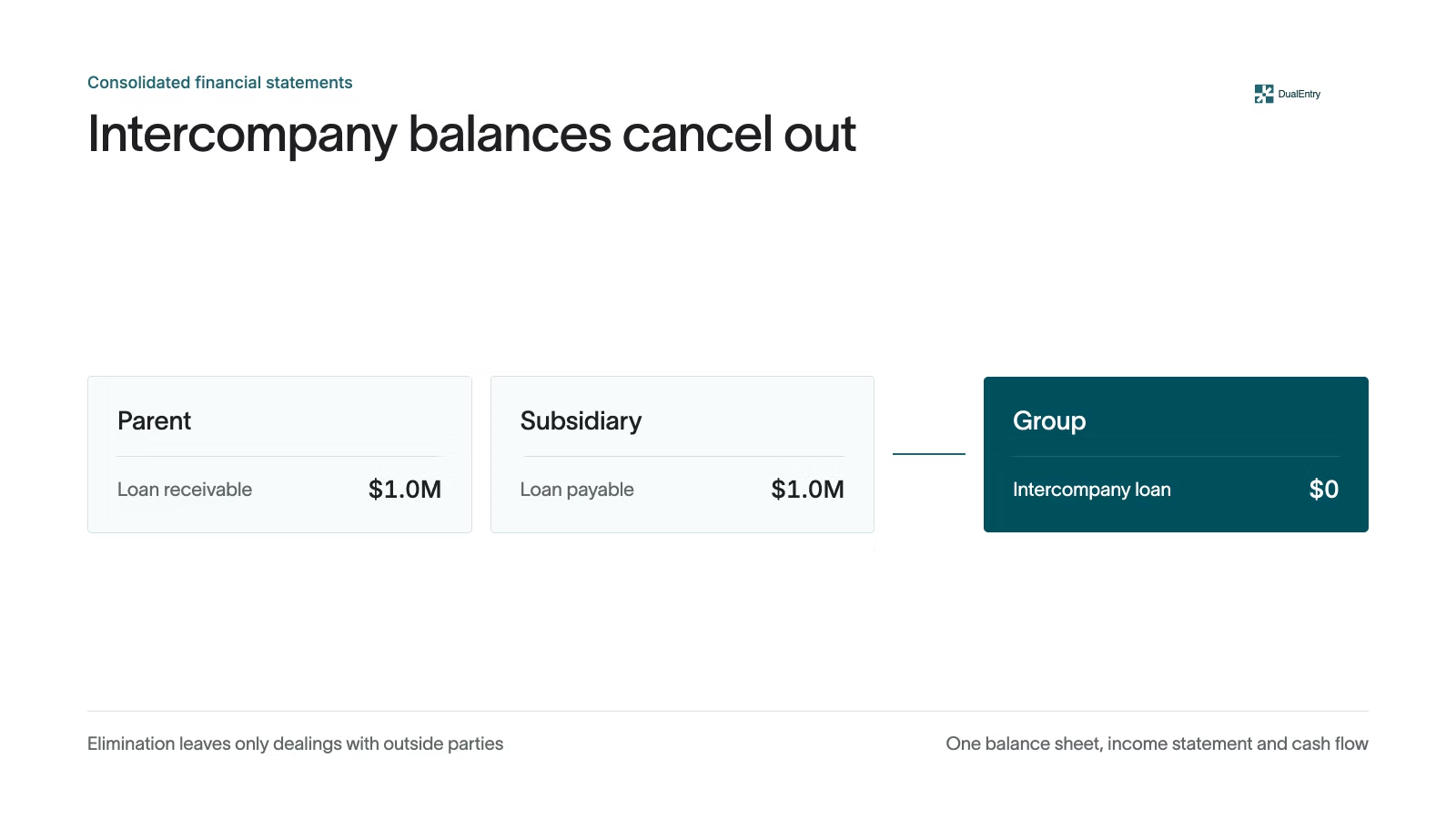
Consolidated financial statements report a parent company and the subsidiaries it controls as one economic entity. Instead of a separate set of books for each company, you get a single balance sheet, income statement, and cash flow statement covering the whole group.
The reason you can't simply add the companies together is intercompany activity. If a parent lends money to its subsidiary, the parent's books show a receivable and the subsidiary's show a payable, but the group as a whole owes nothing to anyone.
Those internal amounts get stripped out in consolidation, a step called elimination, so the group's statements reflect only its dealings with outside parties [1].
Public companies have to file consolidated results with the SEC [2]. Private companies don't file with the SEC, but a private company that issues US GAAP financial statements, usually because a lender or investor asks for them, still has to consolidate the subsidiaries it controls, since stand-alone parent-company statements don't comply with GAAP on their own [1].
When consolidation is required
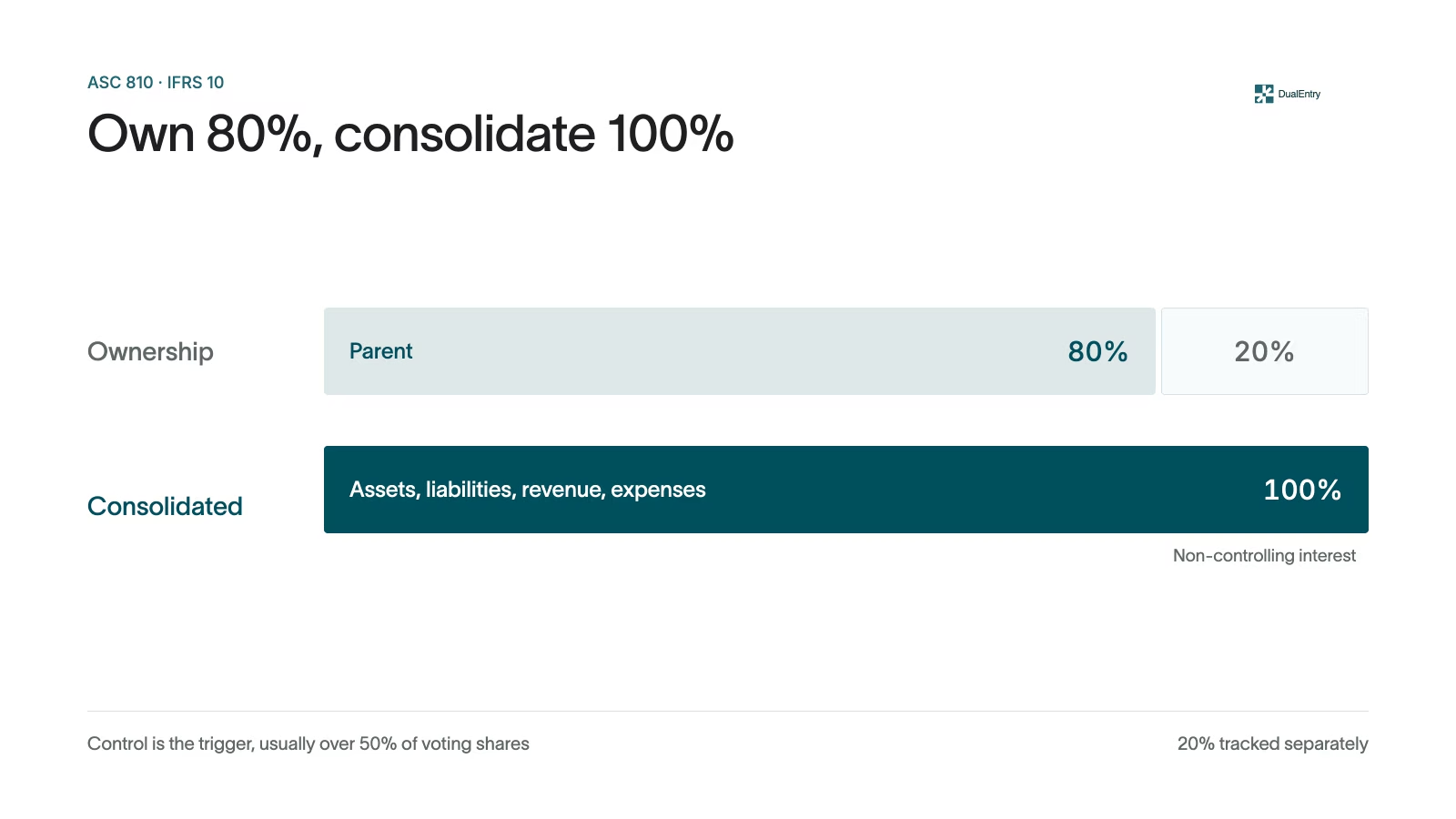
Consolidation is required when a parent controls another company. Control is the trigger, and it usually means owning more than half the voting shares, though it can exist with a smaller stake, for example through a contract, an agreement with other shareholders, or a court decree [3].
Under IFRS 10, control means having power over the company, exposure or rights to variable returns from it, and the ability to use that power to affect those returns [4]. US GAAP uses the majority-of-votes test for most companies and a similar power-plus-economics test for variable interest entities, companies controlled through contracts or other arrangements rather than votes [5].
Two standards govern how it's done. US companies follow ASC 810 under US GAAP, and companies reporting under international rules follow IFRS 10. [6] Both are built on control, though they define it a little differently.
One point that trips people up: control means you consolidate the whole subsidiary, not just your share of it. A parent that owns 80% of a subsidiary still pulls in 100% of that subsidiary's assets, liabilities, revenue, and expenses [4]. The 20% it doesn't own is tracked separately as the non-controlling interest [7], which the worked example below builds out in full.
Consolidated financial statements example: step by step
Take a parent company that acquires 80% of a subsidiary at the beginning of the year for $120,000. Assume the subsidiary's assets and liabilities are already carried at fair value and the price is exactly 80% of its book equity, so there is no goodwill and the 20% non-controlling interest is worth $30,000 at acquisition (US GAAP measures it at fair value) [8]. The subsidiary pays no dividends during the year.
The only thing the two companies owe each other is a $50,000 loan from the parent to the subsidiary. To keep the arithmetic clean, assume the loan carries no interest. Every figure below is in thousands of dollars, and the numbers are illustrative.
The two trial balances
Consolidation starts with each company's own trial balance, the list of account balances that comes off its general ledger at the end of the period.
Here are the two, side by side. Retained earnings is shown at its opening balance, with the year's revenue and expenses listed separately.
Both ‘balance’, which is the point of a trial balance. From here, the job is to combine them and take out everything internal.
The next step is to make the elimination entries that remove balances and transactions that exist only between companies in the group.
Eliminating the intercompany loan
The parent's books show a $50,000 loan receivable from the subsidiary, and the subsidiary's show a $50,000 loan payable to the parent. Between them, the group owes itself nothing, so both sides come out with a single entry:
- Debit intercompany loan payable $50,000
- Credit intercompany loan receivable $50,000
That removes the $50,000 from both the asset side and the liability side. Miss this step and the group looks like it has a loan on its books that doesn't really exist.
Eliminating the investment in the subsidiary
The parent's balance sheet carries a $120,000 investment in the subsidiary. That investment and the subsidiary's equity are two views of the same thing, so they cancel.
The parent paid $120,000 for 80% of the subsidiary's equity, which was $150,000 at the time it was bought (common stock of $100,000 plus retained earnings of $50,000). The other 20% of that equity, $30,000, becomes the opening non-controlling interest.
- Debit common stock (subsidiary) $100,000
- Debit retained earnings (subsidiary, opening) $50,000
- Credit investment in subsidiary $120,000
- Credit non-controlling interest $30,000
The subsidiary's opening equity is now gone, the parent's investment is gone, and a $30,000 non-controlling interest sits in its place. What's left of the subsidiary's numbers, its assets, liabilities, and this year's results, still flows into the group.
Calculating non-controlling interest
Non-controlling interest (NCI) is the slice of the subsidiary the parent doesn't own. It appears inside equity on the consolidated balance sheet, kept separate from the parent's own equity, so a reader can see how much of the group belongs to outside shareholders [7].
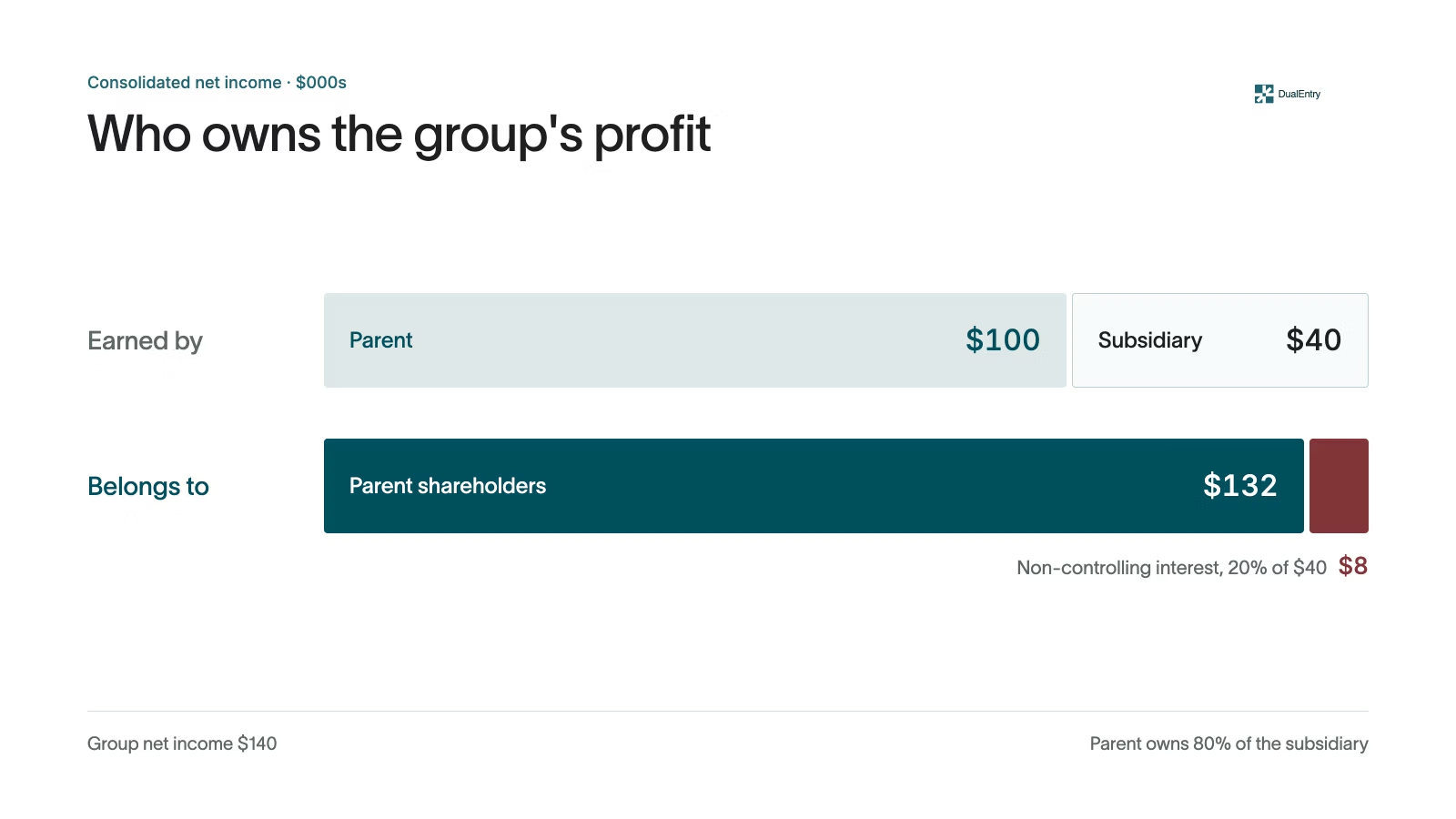
It has two parts. The opening piece is the 20% of the subsidiary's equity at acquisition, which is the $30,000 from the entry above. The second piece is the outside shareholders' share of this year's profit. The subsidiary earned $40,000 (revenue of $200,000 less expenses of $160,000), and 20% of that, $8,000, belongs to them.
Put together, the non-controlling interest at year end is $30,000 plus $8,000, or $38,000. That same $8,000 also shows up on the face of the income statement, as the share of profit attributed to outside owners [7].
The consolidated income statement
The income statement is the simpler of the two to combine, because there are no intercompany sales here to strip out. Revenue and expenses add straight across, and the only new step is splitting the result between the parent's shareholders and the non-controlling interest.
The group earned $140,000. Of that, $8,000 is the outside owners' share of the subsidiary's profit, and the remaining $132,000 belongs to the parent's shareholders. That $132,000 is the parent's own $100,000 profit plus its 80% share of the subsidiary's $40,000.
The consolidated balance sheet
Now everything comes together. The assets and liabilities add across, minus the intercompany loan that was eliminated. The investment in the subsidiary is gone. Equity is the parent's own, plus the group's retained earnings, plus the non-controlling interest.
Total assets of $1,090,000 equal total liabilities and equity of $1,090,000, so the statement balances. The retained earnings figure of $282,000 is the parent's year-end retained earnings of $250,000 plus its 80% share of the subsidiary's post-acquisition profit, and the non-controlling interest is the $38,000 worked out above.
The intercompany loan and the investment in the subsidiary have both disappeared, which is exactly right, because neither represents anything the group owns or owes outside itself.
Consolidated vs. combined financial statements
These two get mixed up because both bring several companies into one report, but the relationship between the companies is different.
Consolidated statements are for a parent and the subsidiaries it controls. Combined statements are for companies under common control where none of them owns the others, like two sister companies held by the same individual [1].
Because there's no parent-subsidiary link in combined statements, there's no parent investment to eliminate and no group-level non-controlling interest to calculate. Intercompany transactions between the companies still get removed, and any non-controlling interest inside one of the combined companies is handled the same way as in consolidation [1].
Consolidated vs. consolidating financial statements
Consolidated statements show only the final group totals. Consolidating statements show the work: each entity in its own column, the eliminations, and the consolidated total all on one page.
Lenders and auditors who want to see the parts
Lenders and auditors often ask for the consolidating version because it lets them trace how the final numbers were built and check the eliminations for themselves, rather than taking the combined total on trust.
Consolidated vs. unconsolidated financial statements
Unconsolidated statements, also called standalone or separate statements, show a single company on its own without pulling in the entities it controls. The parent's investment in its subsidiaries sits on the balance sheet as a single line rather than being replaced by the underlying assets and liabilities.
Both have their place. The consolidated view is what investors and lenders usually want, because it shows the economic reality of the group. The standalone view still matters for things like a specific entity's tax filing or a local statutory requirement.
How consolidation software handles this
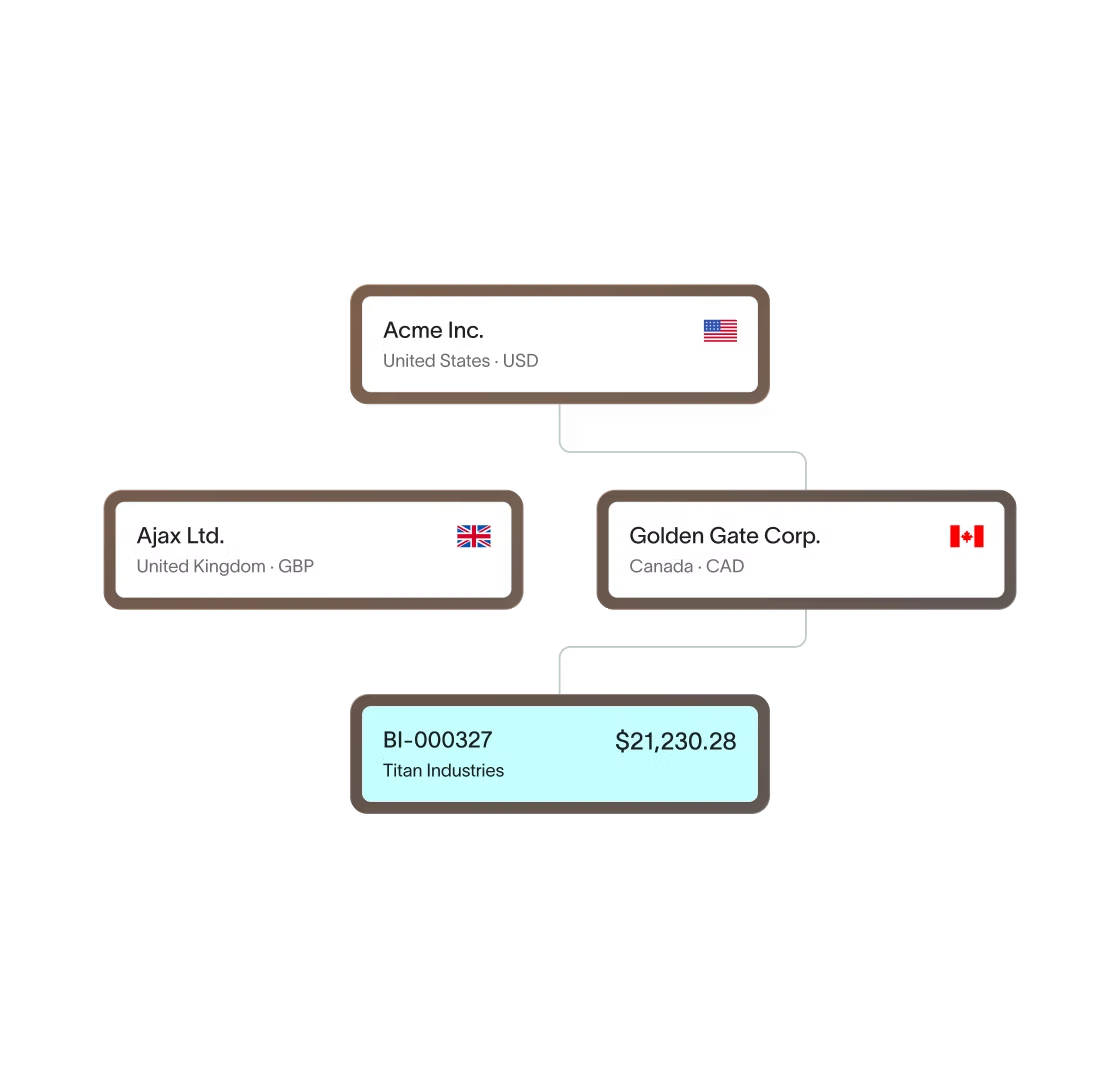
The example above had one subsidiary and one intercompany balance.
A real group can have dozens of entities across several currencies, with hundreds of intercompany transactions to match and eliminate every close. Done by hand in spreadsheets, that's slow and easy to get wrong, and it's a common reason multi-entity closes run long. APQC's open-standards benchmark puts the median cycle time from the initial trial balance to completed consolidated financial statements at 6.0 calendar days, across a sample of 11,223 companies [9].
Consolidation software takes that work over. The ownership structure is set up once, intercompany transactions are matched and eliminated automatically, standing elimination rules run every period, and currency translation is handled for foreign subsidiaries rather than worked out by hand.
The mechanics are the same as the worked example above; the software just runs them at scale, so consolidation becomes part of the close instead of a separate project at the end of it.
How DualEntry automates multi-entity consolidation
DualEntry runs the whole process on one ledger, so consolidation isn't a separate exercise at month-end. Elimination entries post when each intercompany transaction is recorded, so once every entity's period is closed, the consolidated view is already net of them [10].
- Entities are set up once. The multi-entity structure lives in the system, so you can move between entity-level and consolidated views without rebuilding the group rollup each period.
- Intercompany items are eliminated as they post. When an intercompany invoice or bill posts, DualEntry generates the counterparty entity's entries and the elimination entries with it, and intercompany journal entries, like the loan in the example, carry an elimination flag on each line. Nothing has to be chased down by hand at month-end[10].
- Foreign subsidiaries are translated in place. Currency translation runs automatically: income statement accounts translate at the period's average rate, equity at historical rates, and other balance sheet accounts at the period-end rate [10] [11], and the cumulative translation adjustment posts to its own equity account [12], so none of it lives in a side spreadsheet.
- The consolidated statements come straight off the ledger. Because the eliminations run against the same books the entities post to, the group balance sheet ties out without a manual reconciliation between systems.
The arithmetic is the same as the worked example above. Running it in one place is what keeps a multi-entity close from becoming a month-end project of its own.
Consolidated Financial Statements FAQs
See the full power of DualEntry in 30 minutes
Justin (Do San Myung) is Expert Accountant at DualEntry with 20+ years of hands-on experience managing general ledgers, financial close processes, and ERP implementations for mid-market and enterprise companies. As a former Consulting CFO and Controller, he has personally overseen month-end closes, SOX compliance programs, and multi-entity consolidations across technology, manufacturing, and services industries. Justin specializes in transforming manual accounting workflows into automated, AI-driven processes.