
The Agentic ERP

AI is a tool, a means to an end. Agents are how you get there: they do finance and accounting work for you from start to finish.
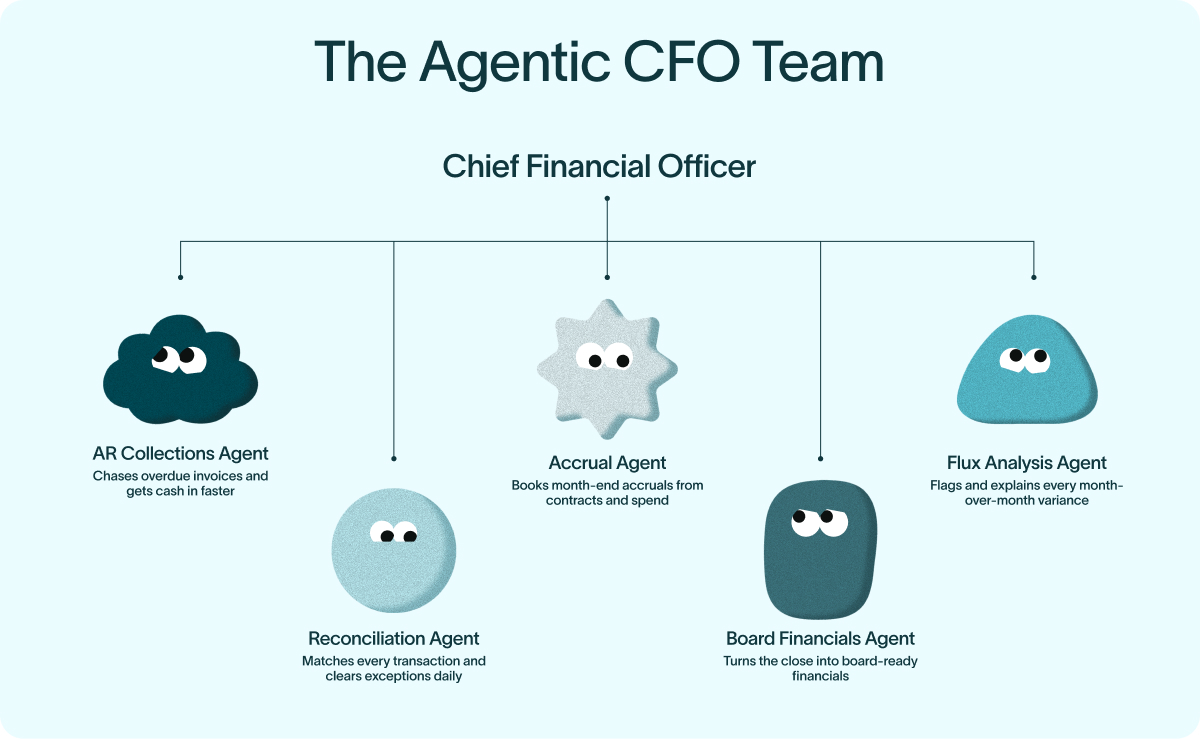
I get asked what ‘AI-native ERP’ means all the time. The more I’ve thought about it, the clearer it’s become that ‘Agentic ERP’ better captures what we mean: finance AI agents that deliver outcomes for your team within the ERP. An AR agent that chases your past-due invoices. A flux agent that explains variances at the line level. Agents that work for you 24/7.
The money is already moving. Gartner expects 62% of cloud ERP spending to go to AI-enabled products by 2027, up from 14% in 2024. But plenty of companies have lost the thread: an AI widget here, a copilot there, a slide for shareholders about ‘our AI strategy.’
Often that strategy amounts to a Claude seat per employee, and even that gets botched. One of our teammates came from a legacy ERP vendor where approval for a company-paid Claude account took 18 months.
The end we care about is a finance team that does ten times the work without hiring ten times the people. A chatbot does not get you there. An agent does.
What makes an agent an agent?
What you’re used to are chatbots like Claude or ChatGPT. They’re passive entities, usually active for a short time after you prompt them, and then they shut down until you prompt them again.
AI agents are very different. Agents use LLMs as their brains, but they have virtual hands that let them interact with the world and use external tools. They can reason, plan, and act on their own. And they can run independently and without human supervision for days, much more like the AIs we know from movies, although not on that level…yet.
Agents perform the task end to end. In customer support, an agent doesn’t send you a link to the refund page; it processes the refund. In personal AI, an agent doesn’t suggest a flight; it books one against live inventory from 500+ airlines, stopping only when it needs your approval.
In an ERP, agentic means the agent carries the work and a human carries the signature. That is the accounting team of two: a preparer and an approver, with a fleet of agents beneath both.
Take collections. A collections agent inside DualEntry has the whole customer in front of it: the open invoices, the short pays, the payment date someone promised in an email thread, and the tone your team uses with that account.
It scores who will pay late, gets invoices out on time, follows up in your voice, and escalates on your schedule. Today it emails; tomorrow it texts and calls. You can let it run unattended on the lowest-risk accounts and approve every message on the ones that matter. And it doesn’t stop working at 5 p.m.
The same shape holds across the close. The flux agent drafts variance commentary from the transactions that actually moved the account. The reconciliation agent matches dozens of deposit streams and surfaces the two that don’t tie. The AP agent reads the bill, codes it, and proposes the entry. Imagine the close as a queue of proposed entries, each tagged to the agent that drafted it, waiting for a human hand.
Why the ERP has to be built for agents
For agents to do real accounting work, they need more than access to the ERP. They need to operate inside the same controls, permissions, and accounting rules as the people using it.
The controls live in the data model, not the interface. A control that lives in the UI only governs people using the UI, and agents mostly don’t use the UI. So human approval is enforced below the UI, period locks and the immutability guard sit in the persistence layer, and integrations and agents face the same approval policies as manual entries. Every agent proposes transactions under its own identity in the audit trail, the approval is the posting event, and nothing reaches the ledger without a human approving it.
The agent works from the whole ledger. An agent bolted on through an API sees only what the API hands it. An agent inside DualEntry sees the transaction, its history, the contract behind it, the dimensional structure, and how the same thing was treated last period. That’s the difference between an agent that proposes the right entry and one that proposes a plausible entry.
Is it working? So far, the numbers say yes. Slash runs $600M of ARR on a finance team of two. Graphite took its close from 20 days to one. OnTrack runs 43 locations across six entities with a one-person accounting department. We processed $100B of journal entries on the platform in our first 12 months.
AI-native describes how we built DualEntry. Agentic describes what it does for you.
Want to build the future of ERP?
Join the team building a modern ERP for companies that have outgrown the old way of doing finance.