Don't worry! The contents here will appear on the published page.
Is Google Winning the AI Race for Accounting? Two Gemini Models Now Lead the Pack

John Iwuozor
Content Lead, Finance and Research
John Iwuozor
Content Lead, Finance and Research
John Iwuozor leads content, finance, and research at DualEntry. He writes for the people who actually close the books: controllers running month-end, CFOs weighing an ERP migration, accountants buried in reconciliations. Before DualEntry he spent five years covering B2B SaaS and fintech for Forbes Advisor, Ramp, and Infosecurity Magazine. He builds every piece on primary data, including benchmarks, practitioner interviews, and product testing, rather than recycled advice. He is also an avid chess player.
Learn about our editorial policies.
Last updated
November 10, 2026
Reviewed by
Summarize this article


TL;DR
Google is starting to pull ahead of OpenAI and Anthropic in our accounting AI tests.
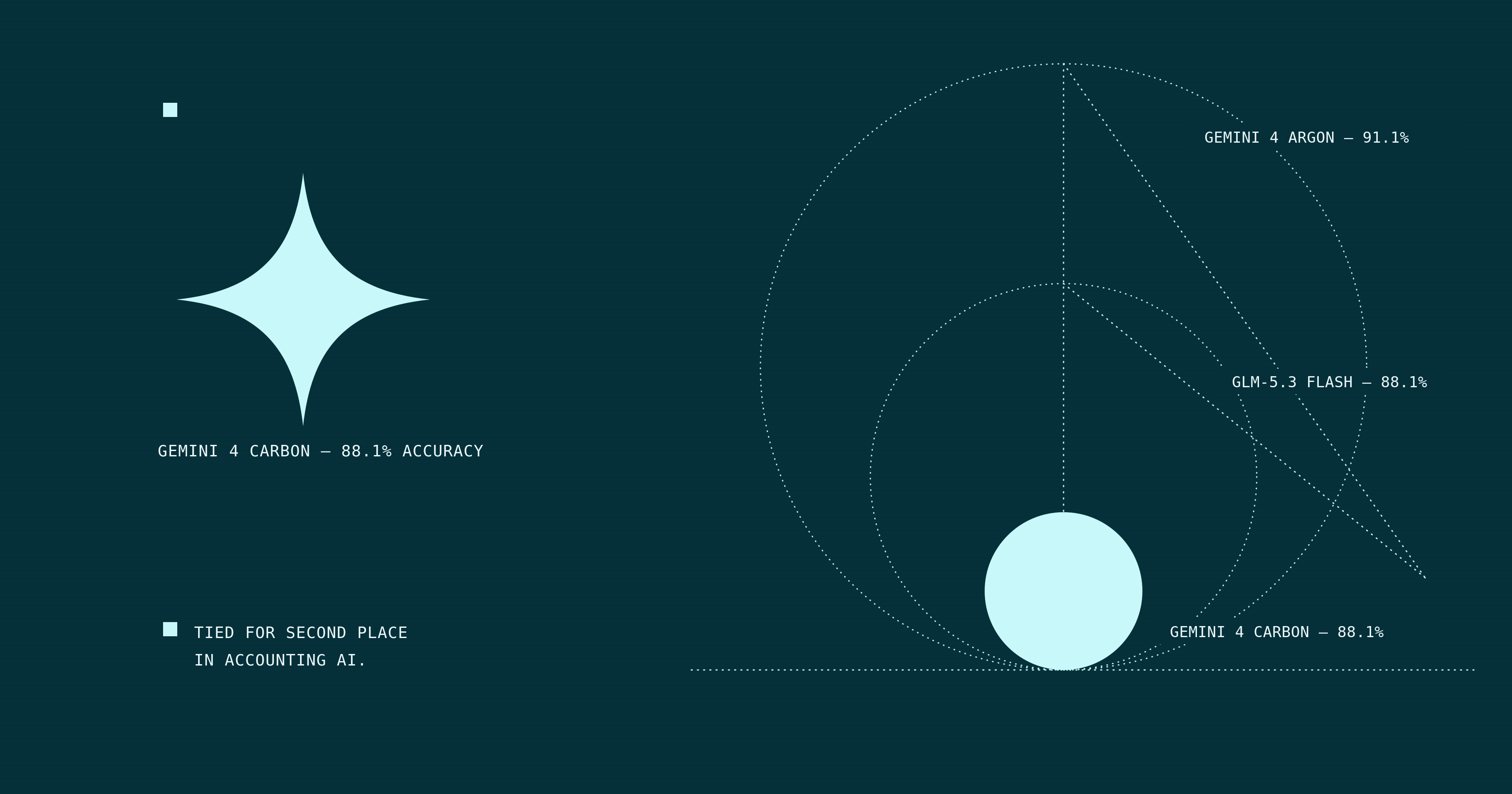
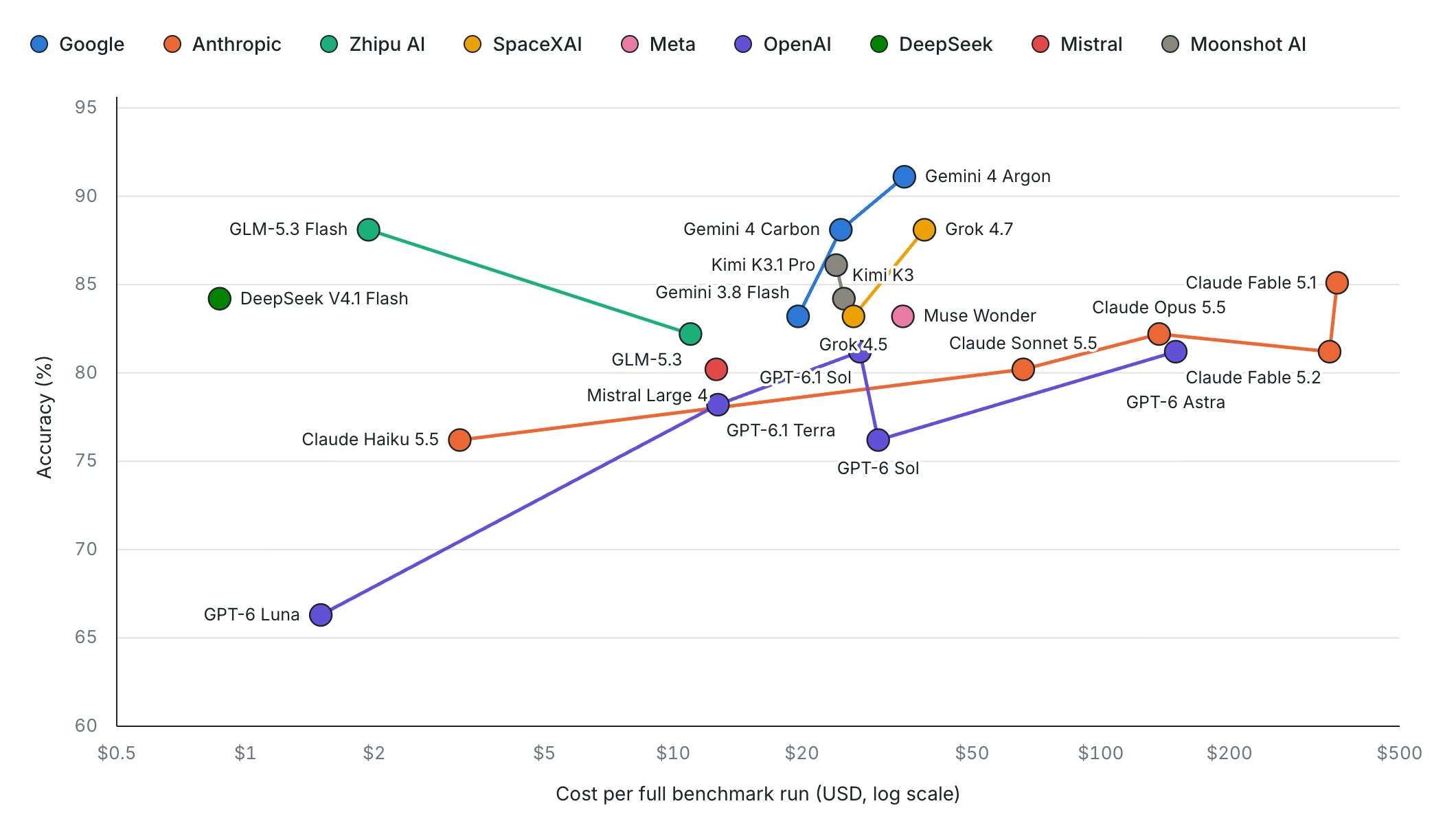
Gemini 4 Argon already holds the #1 spot on the DualEntry Accounting AI Benchmark with 91.1% accuracy. Now, Google's Gemini 4 Carbon has scored 88.1%, tying for second place with GLM-5.3 Flash and Grok 4.7.
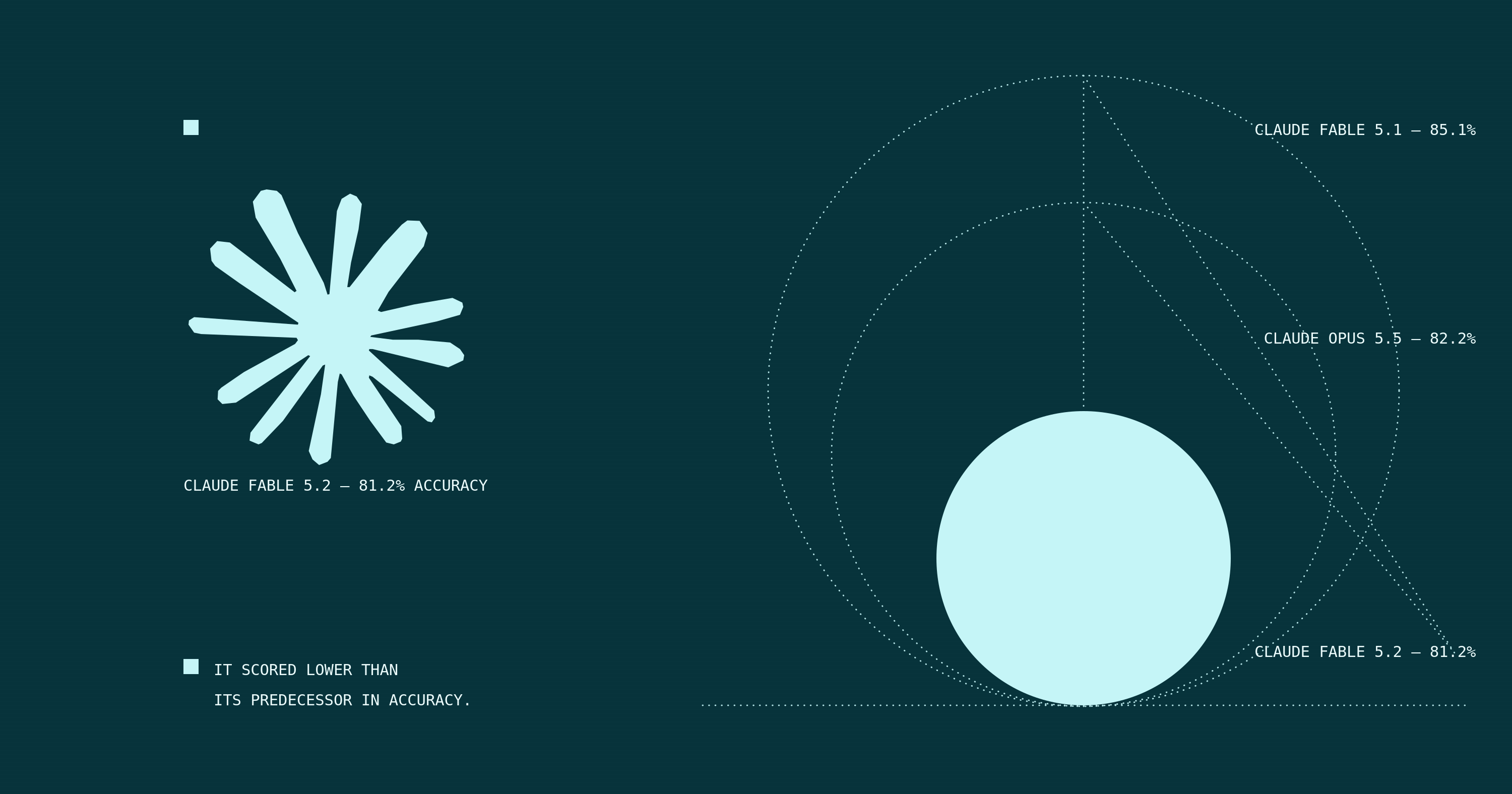
That puts two Google models ahead of Claude Fable 5.1 (85.1%), Claude Opus 5.5 (82.2%), and OpenAI's GPT-6 Astra (81.2%).
While the broader AI race remains competitive, Google's results in accounting are becoming harder to ignore.
Key findings
- Gemini 4 Carbon scored 88.1%, tying for second place behind Gemini 4 Argon at 91.1%.
- Google now has two models in the benchmark's top two ranking tiers.
- Carbon achieved 100% accuracy in transaction classification and accounting knowledge.
- Journal entries and financial reporting followed at 92.3% each.
- Carbon scored 80.2% on consistency, compared with 86.1% for Argon.
- Bank reconciliation was its weakest area at 66.7%, compared with Argon's 75%.
Google now has two models ahead of OpenAI and Anthropic
Carbon's result strengthens Google's position on the benchmark. Argon remains the overall leader, while Carbon joins GLM-5.3 Flash and Grok 4.7 at 88.1%.
Here's how the leading models compare:
Carbon scored 6.9 percentage points higher than GPT-6 Astra and 5.9 points higher than Claude Opus 5.5.
Where Gemini 4 Carbon performed best
The DualEntry Accounting AI Benchmark evaluates models on 101 synthetic accounting tasks across eight areas, including journal entries, accounts payable, accounts receivable, bank reconciliation, financial reporting, and month-end close.
Each model attempts the same tasks three times.
Across all eight accounting areas, it scored:
- 100% in transaction classification
- 100% in accounting knowledge
- 92.3% in journal entries
- 92.3% in financial reporting
- 83.3% in accounts receivable
- 83.3% in month-end close
- 76.9% in accounts payable
- 66.7% in bank reconciliation
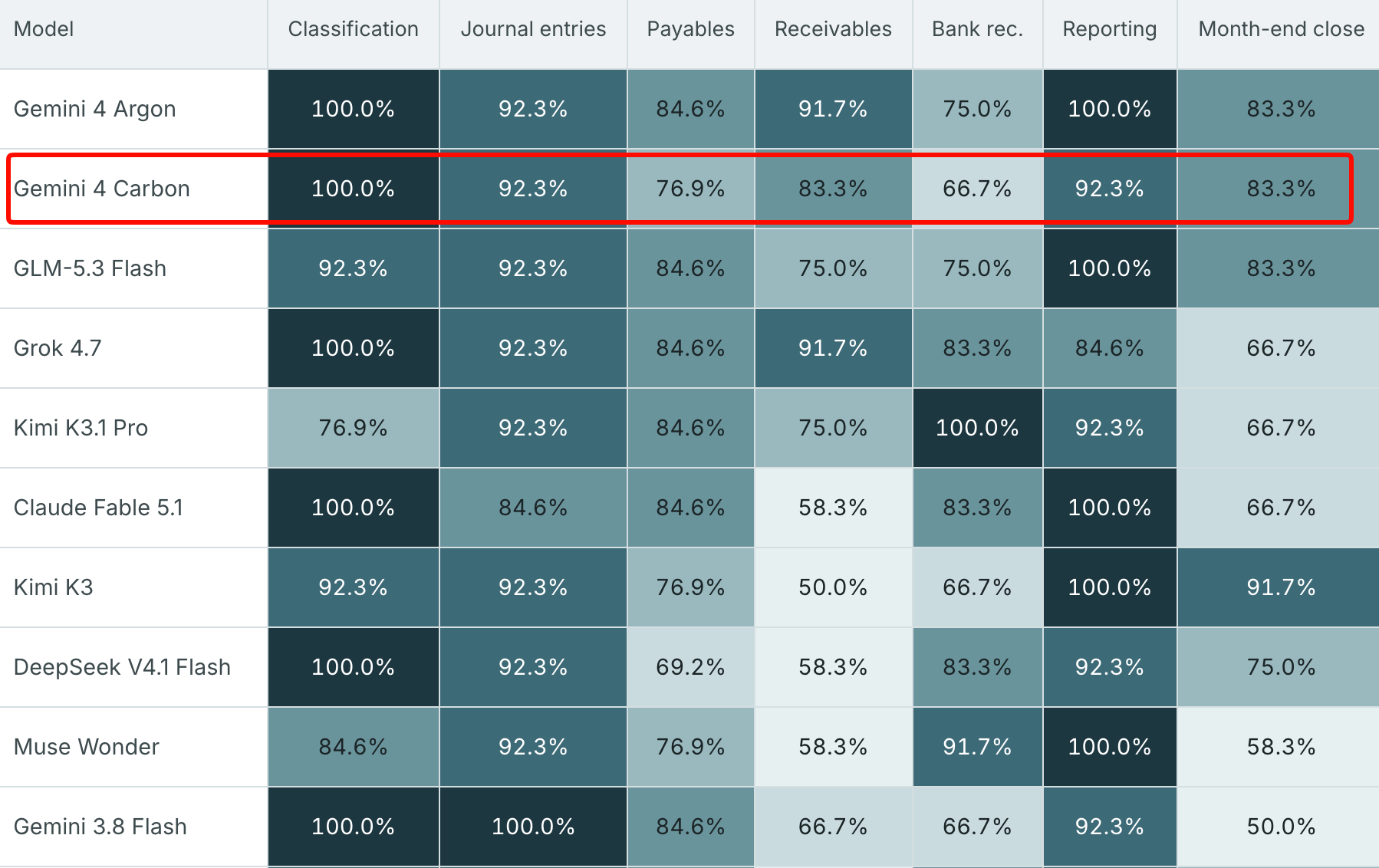
Carbon also performed similarly across difficulty levels, scoring 88% on easy tasks and 89% on both medium and hard tasks.
Its strongest results came in classification, accounting knowledge, journal entries, and reporting. However, its performance dropped considerably in payables and reconciliation.
How Carbon compares with Gemini 4 Argon
Argon remains Google's strongest accounting model, although Carbon comes within three percentage points of its overall accuracy.
The two models matched each other in transaction classification and journal entries, but Argon performed better in financial reporting and bank reconciliation.
Argon was also more consistent. The benchmark measures consistency by how often a model passes the same task in all three attempts. Carbon scored 80.2%, compared with Argon's 86.1%.
Google still has a reconciliation problem
Despite their strong overall rankings, neither Gemini model leads in bank reconciliation.
Carbon scored 66.7%, compared with Argon's 75%. Meanwhile, Kimi K3.1 Pro achieved 100% accuracy in the same category.
The difference shows why the highest-ranked model isn't necessarily the strongest performer in every accounting workflow.
Is Google pulling ahead?
For now, Google has the strongest overall model on the DualEntry Accounting AI Benchmark, plus another tied for second.
Argon leads at 91.1%, while Carbon's 88.1% puts it ahead of several major OpenAI and Anthropic models.
That gives Google an advantage in our current accounting tests, although competitors such as Kimi continue to lead in individual workflows. Whether Google can maintain that position as new models arrive remains to be seen.
Explore the full DualEntry Accounting AI Benchmark to compare accuracy, consistency, speed, and cost across leading AI models.
See the full power of DualEntry in 30 minutes
John Iwuozor leads content, finance, and research at DualEntry. He writes for the people who actually close the books: controllers running month-end, CFOs weighing an ERP migration, accountants buried in reconciliations. Before DualEntry he spent five years covering B2B SaaS and fintech for Forbes Advisor, Ramp, and Infosecurity Magazine. He builds every piece on primary data, including benchmarks, practitioner interviews, and product testing, rather than recycled advice. He is also an avid chess player.