Don't worry! The contents here will appear on the published page.
The AI Model Wars Are Creating a Market for Routers

John Iwuozor
Content Lead, Finance and Research
John Iwuozor
Content Lead, Finance and Research
John Iwuozor leads content, finance, and research at DualEntry. He writes for the people who actually close the books: controllers running month-end, CFOs weighing an ERP migration, accountants buried in reconciliations. Before DualEntry he spent five years covering B2B SaaS and fintech for Forbes Advisor, Ramp, and Infosecurity Magazine. He builds every piece on primary data, including benchmarks, practitioner interviews, and product testing, rather than recycled advice. He is also an avid chess player.
Learn about our editorial policies.
Last updated
September 14, 2026
Reviewed by
Summarize this article

TL;DR
For the first half of 2026, the AI industry was “tokenmaxxing” – pushing more work through frontier models and treating higher usage as a sign of adoption. Now, attention is coalescing around “modelmaxxing”, where teams match different models to different workloads based on cost, latency, and capability rather than defaulting to the most powerful option every time.
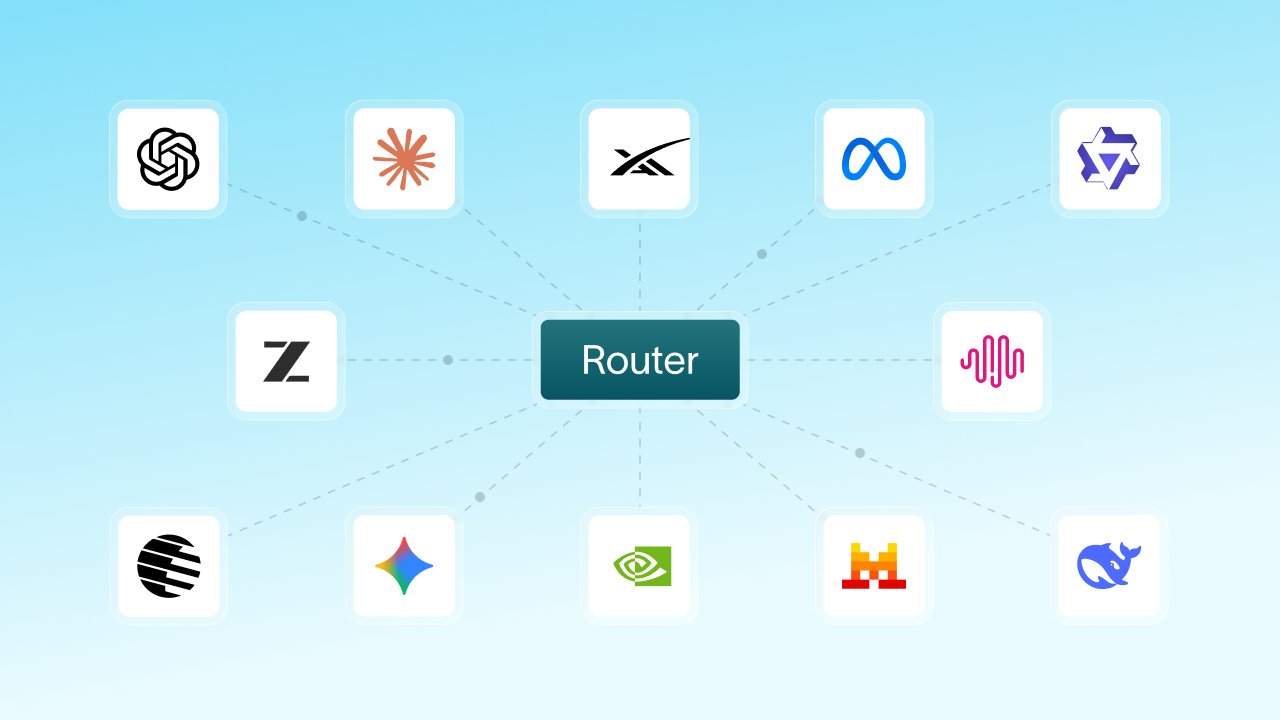
That shift is creating a market for the infrastructure between models. In August, Stripe agreed to acquire OpenRouter, which routes usage across 400+ models from more than 80 providers. Days later, Nvidia reportedly agreed to buy Hugging Face for $12.9 billion, adding another major bet on the layer that gives developers access to a broad model ecosystem.
The common thread here is model plurality. If no single model is optimal for every workload, the value of routing, abstraction, and optionality rises.
Our data shows the AI stack is widening
DualEntry data shows that model plurality is already visible in company budgets. By March 2026, Anthropic appeared in 83.3% of AI-buying company portfolios, OpenAI in 66.7%, GitHub Copilot in 62.5%, Cursor in 50%, Vercel in 33.3%, Perplexity in 29.2%, OpenRouter in 20.8%, and xAI/Grok in 12.5%.


Several layers of the AI stack are becoming economically relevant at the same time. Anthropic’s share in our sample has climbed past OpenAI’s, while newer infrastructure is gaining ground.
OpenRouter is emblematic of that shift, giving companies a routing layer for accessing and optimizing across multiple models. Frontier models now sit alongside coding tools, search products, development platforms, and routing infrastructure.
More than half of AI buyers now pay 6 or more vendors
If model plurality is changing procurement, the same companies should increasingly be paying several vendors at once. That is what we see.
In March 2024, 50% of AI-buying companies in our sample paid one AI vendor, while 7.1% paid 6 or more. By March 2026, 20.8% paid one vendor and 54.2% paid 6 or more. The median moved from 1.5 AI vendors to 6 over the same period.

That turns AI procurement into an allocation problem. As companies spread workloads across models and tools, finance teams have to track where each provider earns its place, how usage maps to cost, and when optionality turns into duplication.
See the full power of DualEntry in 30 minutes
John Iwuozor leads content, finance, and research at DualEntry. He writes for the people who actually close the books: controllers running month-end, CFOs weighing an ERP migration, accountants buried in reconciliations. Before DualEntry he spent five years covering B2B SaaS and fintech for Forbes Advisor, Ramp, and Infosecurity Magazine. He builds every piece on primary data, including benchmarks, practitioner interviews, and product testing, rather than recycled advice. He is also an avid chess player.