Don't worry! The contents here will appear on the published page.
Inside the Risky Bonus Structure of Finance Leadership

John Iwuozor
Content Lead, Finance and Research
John Iwuozor
Content Lead, Finance and Research
John Iwuozor leads content, finance, and research at DualEntry. He writes for the people who actually close the books: controllers running month-end, CFOs weighing an ERP migration, accountants buried in reconciliations. Before DualEntry he spent five years covering B2B SaaS and fintech for Forbes Advisor, Ramp, and Infosecurity Magazine. He builds every piece on primary data, including benchmarks, practitioner interviews, and product testing, rather than recycled advice. He is also an avid chess player.
Learn about our editorial policies.
Last updated
September 7, 2026
Reviewed by
Summarize this article

TL;DR
Annual bonuses are supposed to reward performance and give good people another reason to stay.
But new finance compensation data points to an uncomfortable possibility: the most common bonus structure in finance can become a retention risk precisely when company performance gets difficult.
Most CFOs, VPs, and Directors receive their bonuses once a year. That leaves a meaningful part of their compensation riding on a single performance cycle. And when that cycle goes badly, the difference between the target bonus and what actually gets paid can be substantial.
CFOs in the benchmark received a median 87% of their target bonus. For VPs, it was just 50%. More than a quarter of VP Finance respondents received no annual bonus at all.
If below-target payouts become a pattern, the same bonus designed to incentivize finance leaders can start giving them a reason to look elsewhere.
Most finance bonuses still ride on one annual payout
The first thing that stands out is how concentrated finance bonuses are around a single annual payment. 83% of CFOs receive their bonus once a year. The same is true for 74% of VPs and 75% of Directors, making annual payout the dominant structure at every level of finance leadership.
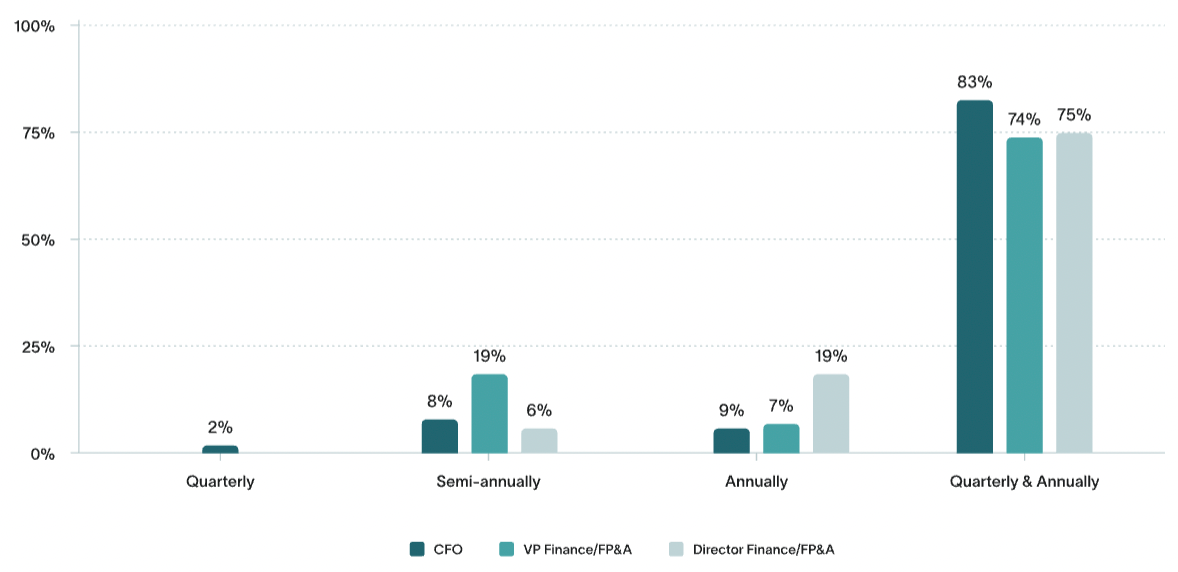
That puts a lot of weight on one payout. A sizable part of someone’s compensation can depend on how one full-year performance cycle ultimately turns out.
A bad year can wipe out the bonus entirely
The problem with concentrating variable pay into one annual cycle is that there is very little room for a difficult year.
The benchmark describes this as a “cliff-edge” effect. If full-year targets are missed, a finance leader can go from expecting a meaningful bonus to receiving no variable pay at all.
The payout data shows how steep that drop can be. CFOs received a median 87% of their target bonus. That falls to 50% for VPs and just 25% for Directors. More than a quarter of VPs received no bonus at all, while the bottom quarter of Directors also received 0%.
For executives on annual-only plans, there is no earlier payout to cushion a weak year. Everything comes down to where performance lands at year-end, which can leave a wide gap between the bonus on paper and what actually gets paid.
Finance leaders are often paid on results they can’t fully control
There is another problem with how these bonuses are designed: the payout is often tied to company-wide results, not just the performance of the finance function.
For CFOs, 73% of bonus plans include EBITDA or margin, 54% include revenue or ARR growth, and 52% include revenue targets.
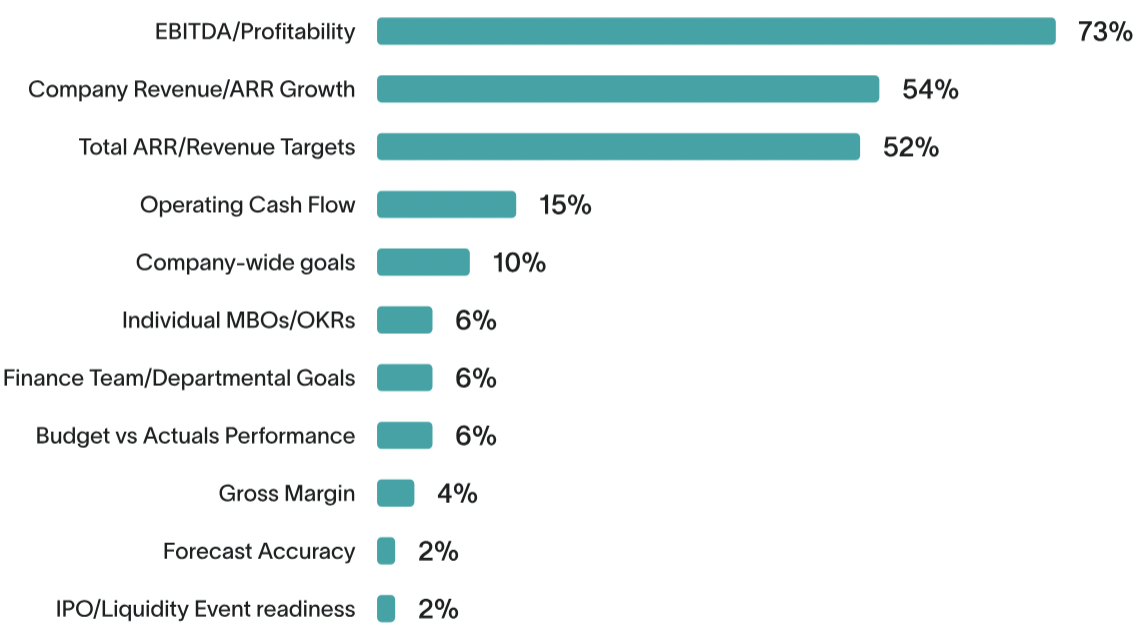
VP Finance plans follow a similar pattern, with bonuses predominantly linked to company-level metrics such as revenue, EBITDA, and ARR growth.
That is understandable at senior levels. Finance leaders are expected to have some responsibility for how the wider business performs.
But there is a limit to how much influence they have over every number. Revenue, for example, may depend heavily on sales and marketing performance. The benchmark notes that tying a finance leader’s pay to metrics largely controlled elsewhere can create misaligned incentives and unnecessary pay risk.
That makes the design of the bonus almost as important as the size of it. A target can look generous on paper, but if too much of the payout depends on outcomes outside someone’s control, it can quickly become a source of frustration.
Missed bonuses can quickly turn into a retention problem
A disappointing bonus does not automatically make someone leave. But repeated misses can change how they judge the value of the job.
The data makes that clearest at the CFO level. After two consecutive below-target years, CFOs are more likely to compare their actual earnings, rather than the compensation package they were originally offered, against what they could earn elsewhere.
The same pattern shows up in compensation satisfaction. Lower CFO satisfaction often correlates with below-target bonus attainment, while at the Director level, below-average satisfaction is a strong indicator of active job searching. Those Directors are often already comparing their package against external opportunities.
That creates an awkward gap between how the company and the employee may view the same compensation package.
The annual cycle may not match the job anymore
None of this means companies should stop paying performance bonuses. The question is whether a once-a-year payout still matches the way senior finance work actually happens.
For CFOs especially, many of the biggest priorities do not fit neatly inside a 12-month window. Finance transformations, systems changes, and other major initiatives can take several years to show results.
The benchmark suggests that for CFOs with multi-year mandates, a longer incentive cycle may better reflect the period over which they can realistically influence outcomes. It also points to semiannual and milestone-based structures as ways to reduce the cliff-edge effect without abandoning performance pay altogether.
Changing the cadence alone isn’t enough. Companies moving away from annual payouts would also need to rethink the targets and metrics used to determine those payouts.
The broader point is that the annual bonus has become so standard that companies may no longer question whether it’s still the best fit. But if one difficult year can wipe out a large part of expected pay, even when some of the underlying metrics sit outside finance’s control, then the structure itself deserves another look.
About the research
The 2026 Technology Finance Executive Compensation Benchmarks surveyed 288 CFOs, VPs of Finance, and Directors across Finance, Accounting, and FP&A. The research was conducted in March and April 2026 by Benchmarkit, in partnership with presenting sponsor DualEntry and strategic partners The SaaS CFO and FIF Collective.
See the full power of DualEntry in 30 minutes
John Iwuozor leads content, finance, and research at DualEntry. He writes for the people who actually close the books: controllers running month-end, CFOs weighing an ERP migration, accountants buried in reconciliations. Before DualEntry he spent five years covering B2B SaaS and fintech for Forbes Advisor, Ramp, and Infosecurity Magazine. He builds every piece on primary data, including benchmarks, practitioner interviews, and product testing, rather than recycled advice. He is also an avid chess player.