Don't worry! The contents here will appear on the published page.
Inside Anthropic’s IPO Filing: What’s Really Behind Its $42B Loss

John Iwuozor
Content Lead, Finance and Research
John Iwuozor
Content Lead, Finance and Research
John Iwuozor leads content, finance, and research at DualEntry. He writes for the people who actually close the books: controllers running month-end, CFOs weighing an ERP migration, accountants buried in reconciliations. Before DualEntry he spent five years covering B2B SaaS and fintech for Forbes Advisor, Ramp, and Infosecurity Magazine. He builds every piece on primary data, including benchmarks, practitioner interviews, and product testing, rather than recycled advice. He is also an avid chess player.
Learn about our editorial policies.
Last updated
September 29, 2026
Reviewed by
Summarize this article
The economics of frontier AI are beginning to look unlike anything the software industry has had to account for before. We’re seeing software-like growth paired with infrastructure spending more reminiscent of telecoms, data centers, or heavy industry.
Anthropic may be the clearest example yet. According to its confidential IPO prospectus reviewed by Reuters, the company behind Claude reported a net loss of nearly $42 billion in 2025, against just $4.59 billion in revenue. Revenue had grown roughly twelvefold in a year. Somehow, the loss was still about nine times larger. Or was it?
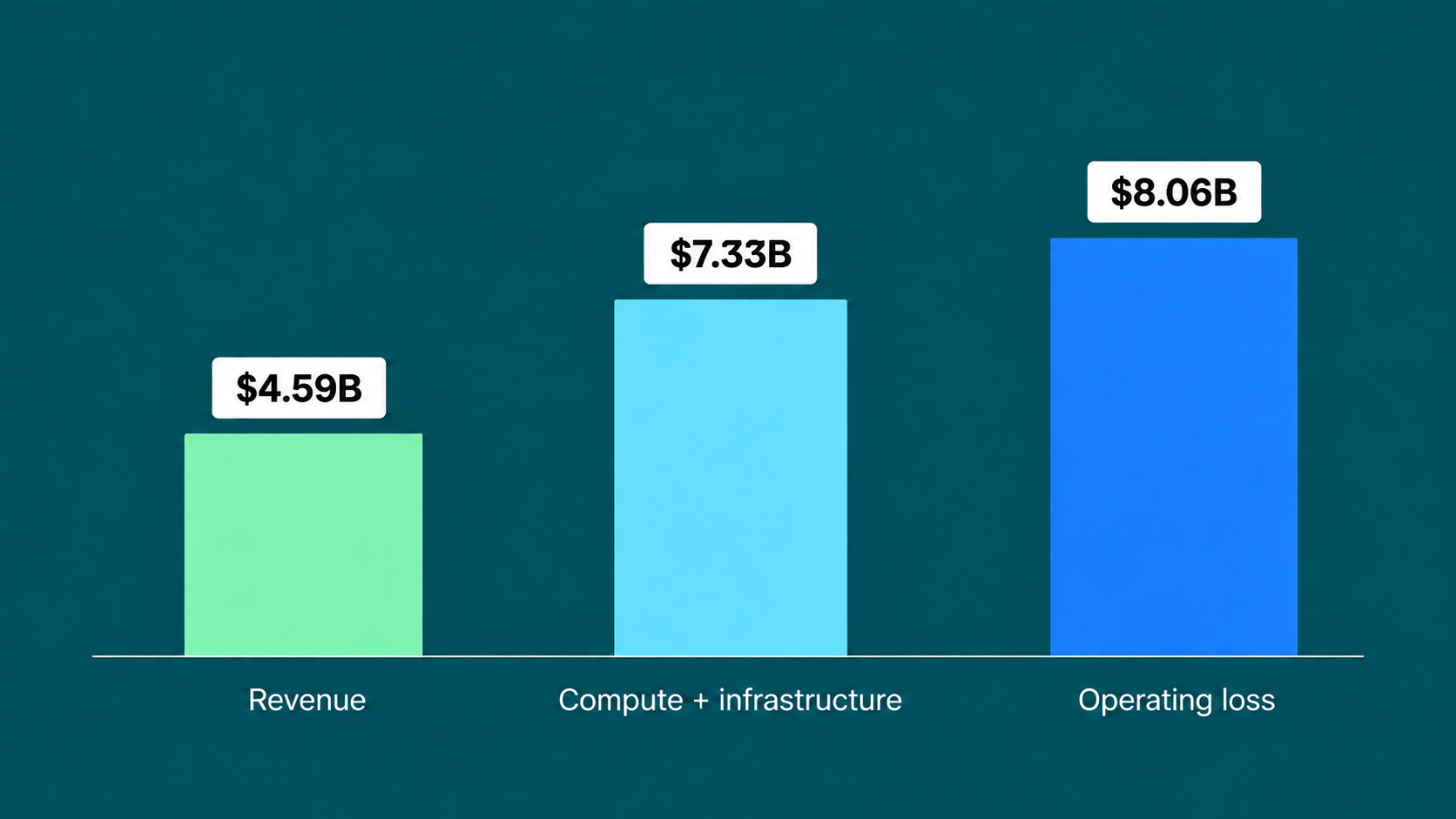
You see, the accounts tell a more complicated story when you dig in. Anthropic's operating loss was $8.06 billion. The other $34 billion came from an accounting charge tied mostly to financing from earlier fundraising rounds that could eventually turn into Anthropic shares.
As Anthropic’s valuation rose, so did the value of those financing instruments, creating a larger accounting charge.
Anthropic's numbers are enormous in almost every direction
Anthropic generated $4.59 billion in revenue in 2025, up from roughly $386 million in 2024. It then exited 2025 at around a $9 billion annualized run rate, before reaching roughly $65 billion by July 2026. However you slice it, the revenue curve is extraordinary.


But even with revenue rising that quickly, Anthropic's operating loss widened to $8.06 billion in 2025, from $2.98 billion a year earlier, while total operating expenses reached $12.65 billion.
The biggest line item was compute and infrastructure, which cost $7.33 billion, or about 58% of total operating expenses. Put another way, the company spent roughly $1.60 on compute and infrastructure for every $1 of revenue it made.

For all the attention on Anthropic's growth, this is the other half of the model. Claude can scale like software on the demand side, but supplying that demand still requires an extraordinary amount of physical infrastructure.
Where the other $34 billion went
Some of Anthropic’s earlier financing came through instruments that could later convert into equity. Because those instruments were recorded as liabilities, Anthropic had to remeasure them as the value of the company changed.
That becomes a problem when your valuation is rising this quickly. The more Anthropic was worth, the more valuable those future equity claims became, which increased the liability sitting on its books. The increase then passed through the income statement as an expense.
In practical terms, Anthropic’s own appreciation worked against it in the accounts. The company became more valuable, the financing attached to that value became more expensive, and the resulting revaluation pushed reported losses sharply higher.
It is an unusual feature of private-company financing, but also a useful reminder of how misleading the bottom line can be when you look at it without the balance-sheet mechanics sitting behind it.
What Anthropic's filing says about the economics of frontier AI
The bigger question is whether frontier AI can ever behave like the software businesses investors are used to valuing.
So far, Anthropic looks like a strange hybrid. Demand scales like software, but the supply side looks much closer to heavy infrastructure. The company can add customers at extraordinary speed, yet every step up in usage still pulls more compute behind it, while frontier model development requires increasingly expensive training. Research has found that the cost of training frontier models has historically risen around 2–3x per year (for the past eight years).
That is why the roughly $518 billion in future cloud, computing and infrastructure commitments matters. Those obligations stretch across roughly the next decade, and around 80% are non-cancelable or payable regardless of how much capacity Anthropic ultimately uses.
At the same time, two customers accounted for about 24% of 2025 revenue, while many of its largest customers were not locked into long-term contracts. That creates an interesting asymmetry: Anthropic is locking in enormous amounts of infrastructure years in advance while parts of the revenue supporting it remain considerably more flexible.
There is a reasonable bullish reading of that. Infrastructure is being built ahead of demand, utilization improves as usage rises, inference gets cheaper, and margins expand as the revenue base catches up.
There is also a reasonable skeptical one. A technology can be transformative without necessarily producing equally attractive economics for the companies building it. Airlines, telecoms and other capital-intensive industries have created enormous economic value without capturing all of it themselves, and frontier AI may yet face the same problem.
Anthropic's 2026 growth suggests the economics can improve remarkably quickly. But its infrastructure commitments run on a much longer timeline. The IPO will test whether those improvements can compound fast enough to support the capacity Anthropic is already locking in years ahead.
See the full power of DualEntry in 30 minutes
John Iwuozor
Content Lead, Finance and Research
John Iwuozor leads content, finance, and research at DualEntry. He writes for the people who actually close the books: controllers running month-end, CFOs weighing an ERP migration, accountants buried in reconciliations. Before DualEntry he spent five years covering B2B SaaS and fintech for Forbes Advisor, Ramp, and Infosecurity Magazine. He builds every piece on primary data, including benchmarks, practitioner interviews, and product testing, rather than recycled advice. He is also an avid chess player.