Don't worry! The contents here will appear on the published page.
Finance Executives Have a Serious Downside Protection Problem

John Iwuozor
Content Lead, Finance and Research
John Iwuozor
Content Lead, Finance and Research
John Iwuozor leads content, finance, and research at DualEntry. He writes for the people who actually close the books: controllers running month-end, CFOs weighing an ERP migration, accountants buried in reconciliations. Before DualEntry he spent five years covering B2B SaaS and fintech for Forbes Advisor, Ramp, and Infosecurity Magazine. He builds every piece on primary data, including benchmarks, practitioner interviews, and product testing, rather than recycled advice. He is also an avid chess player.
Learn about our editorial policies.
Last updated
August 31, 2026
Reviewed by
Woosung Chun

Woosung Chun
CFO
Woosung Chun is the CFO of DualEntry with experience in corporate finance, accounting, strategy, and acquisitions. He previously grew from scratch and led the M&A and Finance teams at Benitago, where he completed more than 12 acquisitions in 2 years. He graduated with a BS from NYU Stern. At DualEntry, Woosung writes about AI in accounting, revenue recognition, foreign currency accounting, hedge accounting, and ERP modernization for finance teams navigating complex, multi-entity environments.
Learn about our editorial policies.
Summarize this article

TL;DR
Finance compensation packages are usually built around the upside: salary, bonuses, equity, and how much all of it could eventually be worth as the company grows.
They often say much less about what happens if the role ends. That matters in finance, where acquisitions, leadership changes, or restructuring can quickly put a position at risk.
Our 2026 Finance Executive Compensation Benchmark shows just how little protection many finance leaders have in that situation. 52% of CFOs reported having no pre-negotiated severance. At VP Finance level, that rises to 86%, while 100% of the Directors surveyed reported having none.
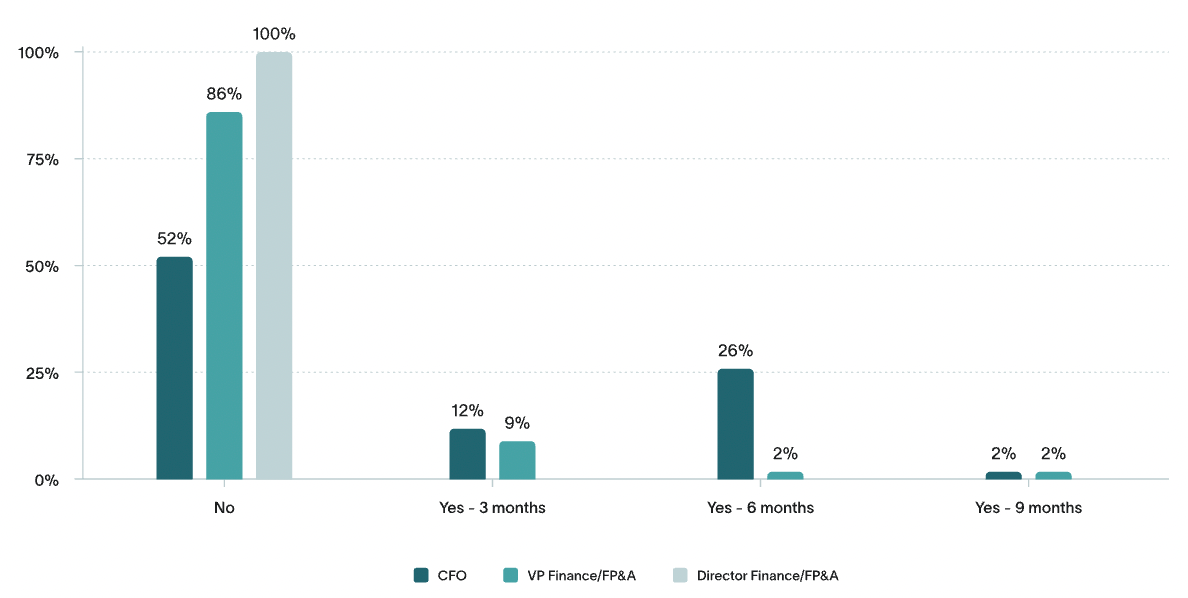
For people whose jobs revolve around managing risk, that is a remarkable amount of their own risk left uncovered.
When severance becomes important
One situation where that lack of protection can matter quickly is an acquisition. 60% of the CFOs surveyed had already experienced an acquisition or change of control. So for many, this is not a remote scenario.
After a deal, some finance roles may change or disappear as the companies are integrated. Finance leaders who have been through an acquisition before tend to pay closer attention to role continuity and redundancy risk for exactly that reason.
That risk is particularly relevant at PE-backed companies, where acquisitions can bring a compressed transition period for finance executives whose roles are affected. At VP Finance level, the report puts the search for another role at 90 to 120 days, which is why even three months of base continuation can provide meaningful protection.
In that situation, having severance agreed in advance can provide some financial protection while the next move is figured out.
Having severance doesn’t always mean full protection
But even among executives who have severance, another question matters: what does it actually cover?
Not every severance package is built the same way. Some protect only base salary, while others also cover parts of their wider compensation, such as bonus pay.
For instance, when executives were asked whether their severance included a bonus payout, 20% of CFOs said yes, compared with 9% of VPs and 6% of Directors.
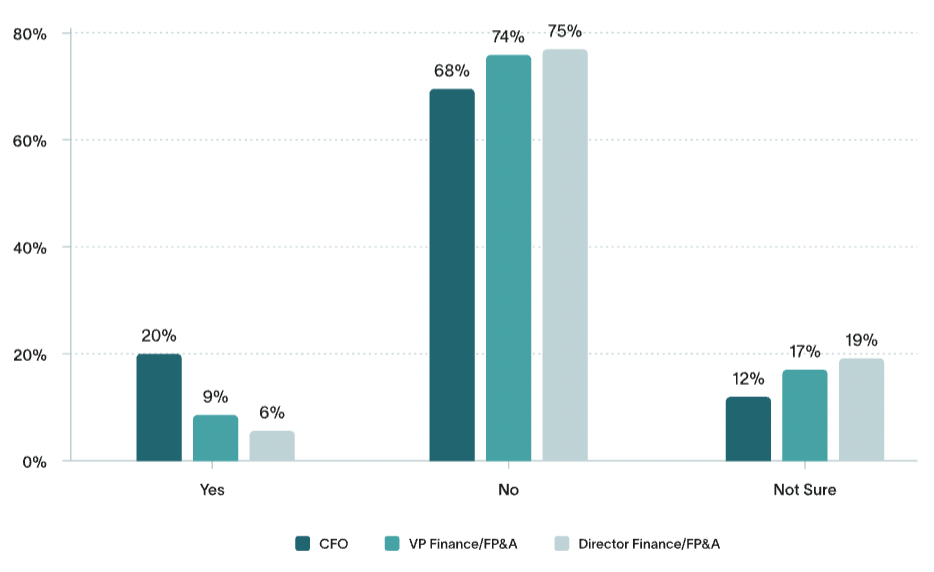
CFOs are more likely to have bonus protection written into their severance terms, helped by stronger negotiating leverage and the more formal employment agreements common at board level. Those provisions become less common at VP and Director level.
That can make two severance packages that look similar on paper worth very different amounts in practice.
Timing can make the gap even bigger
The timing of an exit matters too, especially when bonus pay is earned over the course of the year.
For most finance staff, that bonus is paid just once a year. 83% of CFOs receive their bonus annually, compared with 74% of VPs and 75% of Directors.
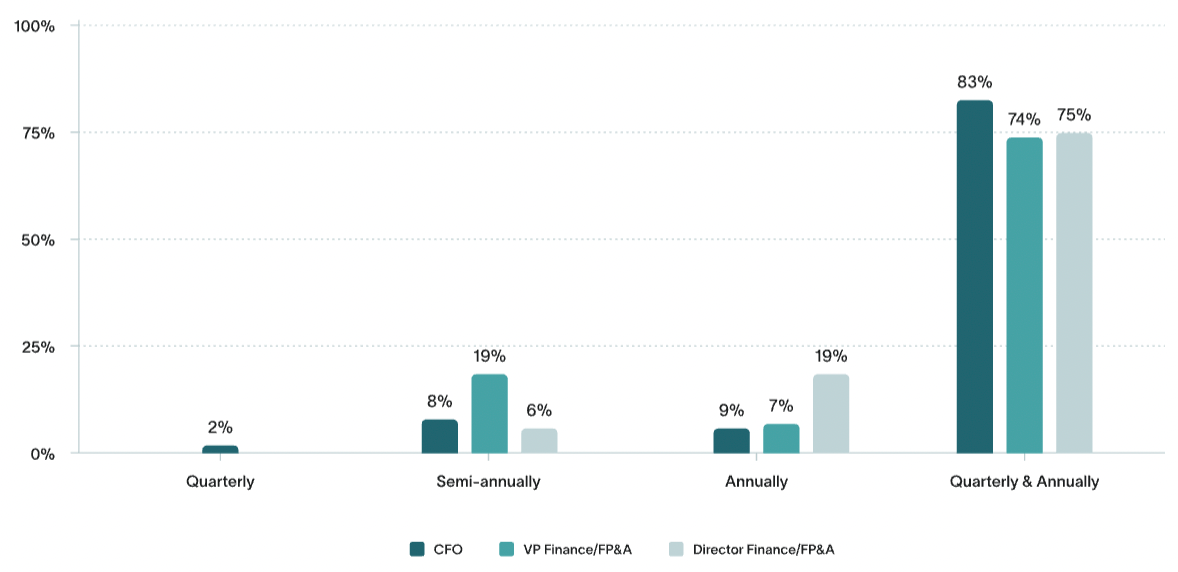
That can leave a lot riding on the date someone leaves. At VP Finance level, someone leaving mid-year can forfeit all of the variable pay accrued up to that point if their severance does not include a bonus provision.
The report also notes that a Director leaving in Q3 or Q4 may have already carried a full year of performance and still forfeit all accrued bonus value with no contractual recourse.
So an executive can have severance and still lose a meaningful part of that year’s compensation simply because the agreement did not extend to bonus pay.
Downside terms should be benchmarked too
Companies already put plenty of effort into benchmarking the upside. They compare base salaries, set bonus targets and debate how much equity is needed to make a package competitive.
The same exercise makes sense for the downside:
- How much severance is guaranteed?
- Does it include bonus compensation?
- What happens if someone leaves late in the performance year?
Those details can change how much financial protection the package actually provides.
That means looking at both the length of severance and whether bonus compensation is included, rather than treating severance as a simple yes-or-no benefit.
About the research
The 2026 Finance Executive Compensation Benchmark is based on responses from 288 finance leaders across CFO, VP Finance and Director of Finance roles spanning Finance, Accounting and FP&A. The survey was conducted in March and April 2026 by Benchmarkit in partnership with DualEntry, The SaaS CFO and FIF Collective.
See the full power of DualEntry in 30 minutes
John Iwuozor leads content, finance, and research at DualEntry. He writes for the people who actually close the books: controllers running month-end, CFOs weighing an ERP migration, accountants buried in reconciliations. Before DualEntry he spent five years covering B2B SaaS and fintech for Forbes Advisor, Ramp, and Infosecurity Magazine. He builds every piece on primary data, including benchmarks, practitioner interviews, and product testing, rather than recycled advice. He is also an avid chess player.