Don't worry! The contents here will appear on the published page.
The 7 Best Campfire (ERP) Alternatives in 2026 + How to Pick

Woosung Chun
CFO
Woosung Chun
CFO
Woosung Chun is the CFO of DualEntry with experience in corporate finance, accounting, strategy, and acquisitions. He previously grew from scratch and led the M&A and Finance teams at Benitago, where he completed more than 12 acquisitions in 2 years. He graduated with a BS from NYU Stern. At DualEntry, Woosung writes about AI in accounting, revenue recognition, foreign currency accounting, hedge accounting, and ERP modernization for finance teams navigating complex, multi-entity environments.
Learn about our editorial policies.
Last updated
August 27, 2026
Reviewed by
Do San (Justin) Myung

Do San (Justin) Myung
Expert Accountant & Former Consulting CFO
Justin (Do San Myung) is Expert Accountant at DualEntry with 20+ years of hands-on experience managing general ledgers, financial close processes, and ERP implementations for mid-market and enterprise companies. As a former Consulting CFO and Controller, he has personally overseen month-end closes, SOX compliance programs, and multi-entity consolidations across technology, manufacturing, and services industries. Justin specializes in transforming manual accounting workflows into automated, AI-driven processes.
Learn about our editorial policies.

Summarize this article
Campfire raised $103.5M in under three years [1], [3] , [4], and its customer list includes companies that ripped out NetSuite to switch1. If it’s on your shortlist, it earned the spot.
But a shortlist of one isn’t an evaluation. The AI-native ERP category is young, pricing is mostly custom-quoted, and the real differences between platforms only show up under an actual close. Comparing them takes work.
This guide covers the seven Campfire alternatives worth that work in 2026, along with a framework for deciding: by stage, by total cost, and by audit-readiness. One disclosure upfront: we’re DualEntry, and we’re on the list.
What is Campfire?
Campfire (campfire.ai) is an AI-native ERP founded in 2023 that gives startups a modern general ledger with embedded AI automation. It’s accounting software positioned between QuickBooks and NetSuite for seed-to-Series-B companies.
Campfire was founded by John Glasgow, previously of Invoice2go, Adobe, and Fidelity [1], went through Y Combinator’s Summer 2023 batch [1] , [2], and is headquartered in San Francisco. Accel led a $35M Series A in June 2025 [1]. Accel and Ribbit Capital co-led a $65M Series B in October 2025 [3], [4]. That’s roughly $103.5M in total funding [4], raised about four months apart.
What it does: a modern general ledger with AI in the workflow rather than bolted on top. Ember AI, Campfire’s natural-language agent, lets anyone in the company query financials in plain English. Its proprietary Large Accounting Model (L.A.M.) automates reconciliations and variance detection, with company-reported 95%+ accuracy on those workflows3. Revenue automation and close management round out the suite.
Who it’s for, per Campfire’s own positioning and the press coverage around it: companies outgrowing QuickBooks that aren’t ready for NetSuite. The customer list backs that up, with NetSuite rip-outs like Advisor360, Rhumbix, and Fooji, and startup names like Replit and Replo [1].
If that’s your profile, Campfire deserves a spot on your shortlist. The rest of this article is about what else does.
Why finance teams look for Campfire alternatives
Finance teams evaluating Campfire alternatives usually cite five criteria: multi-entity and consolidation depth, pricing opacity, vendor maturity, configurability limits, and stage misfit in either direction. None of these is an indictment of Campfire. They’re the pressure tests any three-year-old system of record should face before it holds your general ledger.
Multi-entity and consolidation depth. Campfire supports multi-entity accounting, but “supports” and “goes deep” are different questions. If you’re running four or more entities with intercompany eliminations, multi-currency reporting, and contract revenue under ASC 606 [11], [12], you need to see how the consolidation behaves during an actual close, not in a demo environment with three clean entities.
Pricing opacity. Campfire quotes custom pricing only. That makes it hard to budget and nearly impossible to benchmark against alternatives, most of which also quote custom pricing. We’ll give you a framework for making those quotes comparable later in this article.
Vendor maturity. Campfire was founded in 2023. Your auditors, your board, and your future acquirer will all expect the system of record to carry a clean, continuous audit trail for years. That’s not a red flag. It’s a diligence item, and we’ll show you exactly how to run it.
Configurability ceilings. Conversational AI is a UX choice, not a substitute for dimensional reporting, granular role-based controls, and configurable approval workflows. As headcount and entity count grow, the ceiling matters more than the chat interface.
Stage misfit, in both directions. A single-entity startup with 15 employees may not need an ERP at all; Puzzle makes that argument well, and it’s often right. Meanwhile, a 200-person multi-entity company may need more than Campfire ships today. Either way, the fix is the same: match the system to the stage, which is what the rest of this article does.
Campfire alternatives at a glance
The table below organizes the seven alternatives by stage fit, not by feature count, because stage fit is how this decision actually gets made. Find your situation in the “best for” column first, then read the full reviews that follow.
The 7 best Campfire alternatives, reviewed
1. DualEntry

G2 rating: 4.9/5 (122)
DualEntry is an AI-native ERP designed for mid-market firms with complex financial operations. It automates 90% of traditional workflows through intelligent general ledger management and multi-entity consolidation, without relying on legacy architecture [16].
DualEntry cuts down on the delays of batch processing by handling transactions in real time. OCR technology scans invoices and receipts, pulling data accurately to create journal entries automatically. Every action leaves a detailed audit trail. With connections to 13,000+ banks worldwide [16], transactions import directly into the system without any manual work needed.
The platform excels at multi-entity management. Intercompany transactions eliminate automatically during consolidation, and currency conversions update in real time. The close that drags across multiple weeks on legacy systems tends to run in a few days here.
Setup is lighter than the feature depth suggests, and categorization improves over time as the system learns from your data patterns and transaction history.
Key features:
- Workflow automation with AI-native architecture
- OCR invoice scanning with automatic journal entry posting
- Integration with global 13,000+ banking institutions
- Multi-entity consolidation with automatic eliminations
- Real-time transaction categorization and matching
- SOC 2 Type II certified with bank-level encryption
- Continuous reconciliation instead of batch processing
- Custom general-ledger configurations without coding
Pros:
- Reduces manual journal entries by up to 90% (according to user reports)
- Handles complex multi-entity consolidations automatically
- Real-time processing eliminates month-end bottlenecks
- G2 rating of 4.9 indicates exceptional user satisfaction
- No legacy system limitations or patch-based compliance
Cons:
- No published pricing, so budgeting requires a quote
- Advanced features may not be needed by smaller businesses
- Learning curve for users switching from traditional systems
Pricing: Custom pricing, you can book a demo to learn more
2. Everest Systems
G2 rating: 4.8/5 (4)
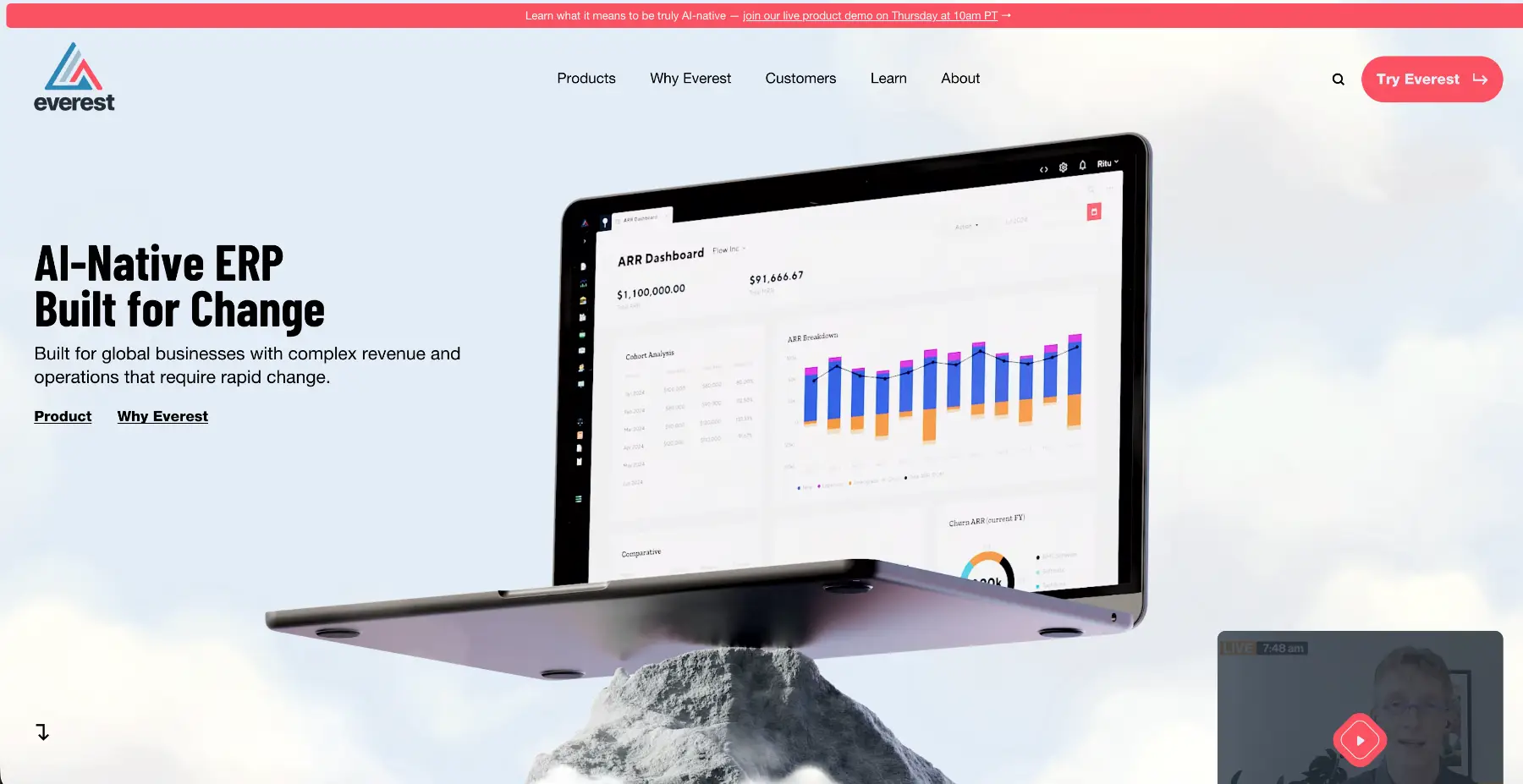
Everest Systems is an end-to-end AI-native ERP built by people who have built ERPs before. Founded in 2020 by Sandeep Chopra with Franz Faerber, the original SAP HANA architect, and Joachim Fitzer, it emerged from four years of stealth with $140M from Sutter Hill, Altimeter, Redpoint, and D1 [5], [6].
Version one is built for software businesses and sold mid-market, direct to CFOs. The scope is wider than most AI-native platforms: order management, subscription billing, revenue recognition, spend and cloud cost management, asset tracking, people costs, and multi-entity support in a single system. Where Campfire leads with conversational AI, Everest leads with architectural breadth.
The distinctive feature is the Live Sandbox, which lets finance teams simulate configuration changes against real data before publishing them. For controllers who have been burned by config changes going live in production, that’s a design choice, not a gimmick.
Early customer feedback centers on the revenue recognition module, which reviewers describe as automating what used to be a painful manual process, and on AI that’s integrated where it saves time rather than bolted on for show. The counterweight: the platform is newer to market than its founding team’s résumés suggest, and documentation is still catching up to the product.
Key features:
- End-to-end scope: order management, subscription billing, revenue recognition, spend management
- Subscription and usage-based revenue recognition built for software business models
- Cloud cost management and people-cost tracking alongside core financials
- Multi-entity support in a single platform
- Live Sandbox for simulating configuration changes before publishing
- AI-assisted bank reconciliation suggestions
- Customizable platform sold direct to mid-market CFOs
Pros:
- Founding team has built ERP at SAP scale before
- Replaces multiple systems with one unified platform
- Revenue recognition automation is a consistent highlight in early reviews
- Live Sandbox de-risks configuration changes in production
- $140M in funding provides a long runway
Cons:
- Recently out of stealth, so referenceable customers at your scale are the diligence question
- Documentation and edge-case workflows still maturing, per early reviews
- Small review base to date
Pricing: Custom
3. NetSuite
G2 rating: 4.1/5 (4,849)
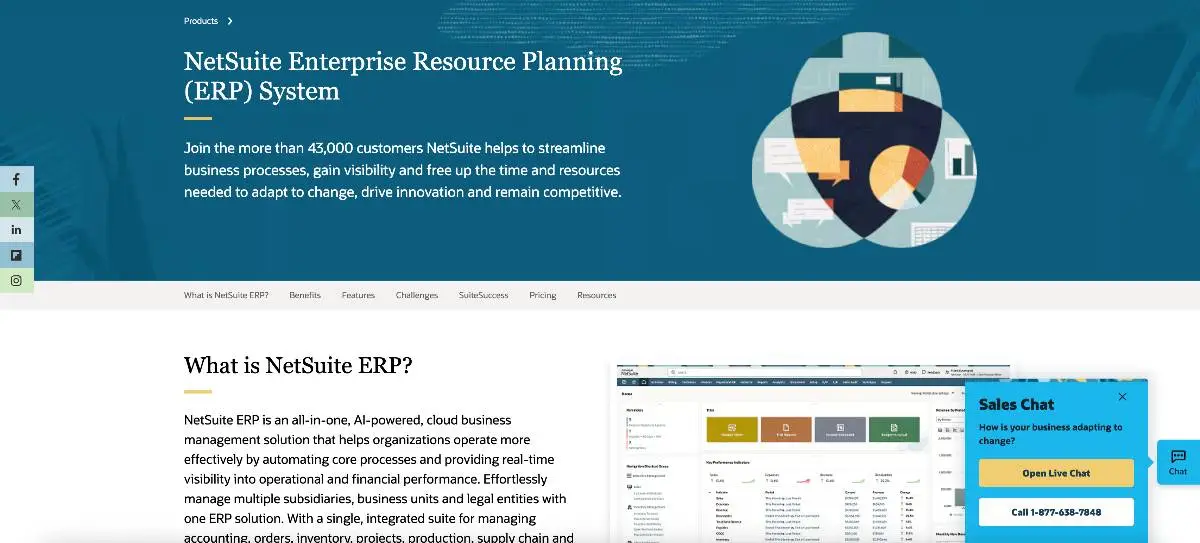
NetSuite is the incumbent Campfire is displacing, and for operationally complex businesses it still earns the position. It’s the right Campfire alternative when you need inventory, supply chain, or enterprise-wide modules, because no AI-native ERP ships those today.
The honest case for NetSuite starts with maturity. Twenty-plus years in market means your auditors have tested it hundreds of times, every consultant ecosystem supports it, and its module breadth covers functions the AI-native category hasn’t touched. If your business carries physical inventory, this isn’t a close call.
The trade-offs are equally well documented: implementations measured in months rather than weeks, per-module pricing that compounds as you add capability, and a user experience designed in a different era. Oracle acquired NetSuite in 2016 for approximately $9.3 billion [7], which bought enterprise stability but also enterprise sales motions and enterprise pricing.
The right way to think about NetSuite in a Campfire evaluation: it’s not competing on speed or AI, and it doesn’t need to. It’s competing on the things a three-year-old platform can’t have yet, which are breadth, ecosystem, and decades of audit history. Whether those are worth the implementation cost is a stage question, and the decision tree below handles it.
Key features:
- Full module suite: financials, inventory, supply chain, procurement, CRM
- OneWorld multi-entity and multi-currency consolidation
- Advanced Revenue Management module for complex rev rec
- SuiteScript and SuiteFlow for deep customization
- Planning and budgeting via connected modules
- Mature ecosystem of implementation partners and consultants
- 20+ years of auditor familiarity
Pros:
- Unmatched module breadth for operationally complex businesses
- Auditors and consultants know it inside out
- Scales from mid-market to enterprise without replatforming
- Deep customization for unusual business models
- The safe choice when inventory or supply chain is in scope
Cons:
- Implementations typically cost $50,000 to $250,000+ and run 3 to 6 months [18]
- Per-module pricing compounds quickly
- Batch-era UX; AI features are add-ons, not architecture
Pricing: Subscription plus modules, custom quote
4. Sage Intacct
.webp)
G2 rating: 4.3/5 (4,260)
Sage Intacct is the finance-first Campfire alternative for CFOs who want mid-market depth without NetSuite’s operational breadth. It answers the configurability question better than any AI-native platform: granular dimensions, deep consolidation, and controls proven through thousands of audits.
Intacct’s strength is exactly the ceiling that concerns Campfire evaluators. Dimensional reporting and multi-entity consolidation are among the strongest in the mid-market, and Intacct is the AICPA-preferred provider of financial applications [8]. For a finance team that doesn’t need inventory but does need serious reporting structure, it’s a credible landing spot.
The trade-off is architectural. Intacct predates the AI-native category, so automation arrives as added features rather than as the foundation. Trading AI-era speed for accumulated depth is a legitimate call; just make it consciously.
In practice, Intacct shows up strongest in finance-heavy verticals: SaaS companies tracking ARR and contract revenue, professional services firms, and nonprofits with fund accounting needs. Its SaaS metrics and contract billing modules are mature, and the partner channel means you’ll never struggle to find an accountant or consultant who knows the system.
Key features:
- Dimensional general ledger with granular reporting structure
- Deep multi-entity, multi-currency consolidation
- Contract and subscription billing modules with SaaS metrics
- Role-based permissions with detailed audit trails
- Open API with a large marketplace of integrations
- AICPA-preferred provider of financial applications
- Established control frameworks proven through thousands of audits
Pros:
- Best-in-class dimensions and consolidation for finance-first teams
- Long audit track record reduces diligence friction
- Strong mid-market partner and accountant ecosystem
- Mature contract billing and SaaS metrics modules
- Modular growth without NetSuite-scale complexity
Cons:
- AI is bolt-on, not native to the architecture
- Implementation and per-module costs add up
- UX feels dated next to AI-native platforms
Pricing: Subscription, custom quote
5. Puzzle

G2 rating: 3.8/5 (3)
Puzzle is the honest downmarket answer: if you’re a single-entity startup with founder-run books and 1–25 employees, you may not need any ERP yet, Campfire included. Puzzle makes this argument in its own comparison content, and it’s often right.
Puzzle is AI-powered accounting software for early-stage startups, with published pricing tiers [9] and Stripe-based revenue handling. For a pre-seed or seed company, that combination covers the actual job: clean books, burn visibility, investor-ready financials, minimal overhead.
What Puzzle doesn’t do is the structural work: multi-entity consolidation, contract-based ASC 606, granular controls. That’s not a criticism; it’s a stage boundary. Cross it, and you’re back to this list.
Worth knowing before you commit: Puzzle plays well with the rest of the early-stage stack, pulling from banks, payroll providers, and spend cards automatically, and founders praise how little of their week it demands. Professional accountants are more mixed, noting that AI categorization still wants review and manual controls are limited. For founder-run books, that trade is usually fine.
Key features:
- AI-powered bookkeeping with real-time financial statements
- Native Stripe integration for revenue tracking
- Automated categorization that flags entries needing review
- Integrations with startup banks, payroll, and spend cards
- Burn, runway, and startup-metric dashboards
- Monthly close checklist built into the workflow
- Published pricing tiers with unlimited users and transactions
Pros:
- Transparent, published pricing in a category that hides it
- Purpose-built for founder-run, single-entity books
- Real-time metrics investors actually ask about
- Minimal weekly time commitment for non-accountants
- Honest positioning about who it’s for
Cons:
- No multi-entity consolidation or intercompany eliminations
- Revenue recognition is Stripe-based, not contract-based ASC 606
- You will outgrow it, and should plan for that
Pricing: Published tiers from $0 (first $20K in transactions) to about $150/month [9]
6. QuickBooks Online

G2 rating: 4/5 (3,850)
QuickBooks Online is the “stay put” option, and for some Campfire evaluators it’s the right one. If your pain is bookkeeping volume rather than structural complexity, QBO plus a disciplined close checklist is cheaper than any migration.
The test is the nature of the pain. Transaction volume, categorization backlog, and slow reconciliations are process problems, and process problems travel with you to a new system. Multiple entities, intercompany eliminations, and contract revenue recognition are structural problems, and structural problems are what ERPs exist to solve.
If your problems are on the first list, save the migration budget. If they’re on the second, QBO isn’t a candidate, and you already know it.
There’s also a middle path worth naming: QBO plus discipline. A documented close checklist, a reconciliation cadence, and one good accountant extend QBO’s ceiling further than most teams expect. The app marketplace fills gaps in payroll, spend management, and reporting. None of that fixes multi-entity, but it buys time, and time is sometimes the right purchase.
Key features:
- Core bookkeeping, invoicing, and bank feeds
- Receipt capture and basic automation on higher tiers
- Multi-currency support on Plus and Advanced plans
- Large accountant and bookkeeper ecosystem
- App marketplace covering most SMB needs
- Payroll available as an add-on
- Published, predictable pricing
Pros:
- Lowest total cost of any option on this list
- Every accountant knows it
- No migration risk, no implementation project
- App marketplace covers most functional gaps
- Fine for single-entity books at moderate volume
Cons:
- No real multi-entity support; workarounds mean separate files
- Basic revenue recognition only
- Structural pain won’t improve, whatever add-ons you buy
Pricing: Published tiers, $38 to $275 per month [10]
7. Rillet
G2 rating: 5/5 (78)
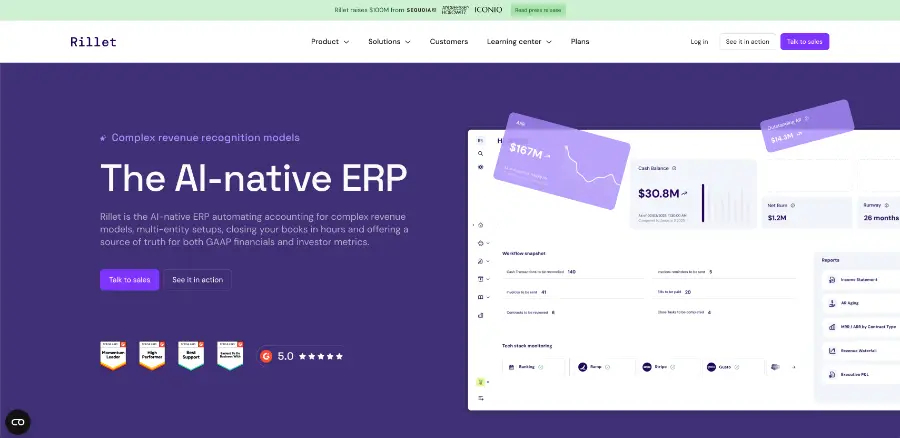
Rillet is an AI-native ERP most often evaluated head-to-head with Campfire, and it’s on this list because that comparison is the most-searched one in the category. For most buyers it duplicates rather than differentiates the AI-native shortlist: the watch-outs mirror Campfire’s own.
Third-party comparisons flag custom-only pricing, a roughly six-week implementation that runs slower than the category norm, a thin ecosystem of accountants trained on the platform, and no operational modules. None of that is disqualifying. It means Rillet carries the same trade-offs a Campfire evaluation already surfaces, rather than resolving them.
The practical use case: a second AI-native quote to benchmark pricing in a category where nobody publishes it.
On the product itself, the facts: Rillet is an AI-native general ledger with automated journal entries, native ASC 606 revenue recognition with deferred revenue schedules, and integrations with Stripe, Salesforce, and HubSpot. It supports multi-entity consolidation and positions itself, like Campfire, as a NetSuite alternative for software companies.
Key features:
- AI-native general ledger with automated journal entries
- Native ASC 606 revenue recognition with deferred revenue schedules
- Multi-entity consolidation support
- Stripe, Salesforce, and HubSpot integrations
- ARR and SaaS-metric reporting
- AI agents for GL updates and report generation
Pros:
- Native revenue recognition for subscription businesses
- Direct CRM and billing integrations reduce manual entry
- Second AI-native data point for pricing benchmarks
Cons:
- Custom-only pricing, same opacity as Campfire
- Roughly six-week implementation, slower than the category norm
- Thin ecosystem of accountants trained on the platform
- No operational modules
Pricing: Custom
* Not an alternative: close-management layers (Numeric, FloQast). These are automation layers that sit on top of whatever general ledger you keep, not ERP replacements. If the close process is the bottleneck rather than the ledger itself, you don’t need to replatform at all.
The stage-based decision tree
ERP selection is a stage-and-complexity decision, not a feature bake-off. Choose by matching four variables: entity count, ARR band, revenue-model complexity, and finance headcount. Single entity under $5M ARR rarely needs an ERP; 2+ entities or $10M+ ARR with contract revenue justifies an AI-native ERP; inventory or 10+ entities points to NetSuite or Intacct.
The table below maps observable triggers to a shortlist. Find the row that describes your situation today, not the one you hope describes it in two years; you can replatform once you’ve earned the complexity.
Decision Logic: Which System at Which Stage
Two things worth saying plainly about this table. First, it contains branches that route away from us: if you’re single-entity under $5M ARR, stay on QuickBooks or Puzzle, and if Campfire’s sweet spot describes you, we’ve said so in the row. Second, the inventory row has no AI-native option because none exists yet. Full stop.
If your close is the only bottleneck and the ledger itself is fine, revisit the close-management callout above before replatforming anything.
What switching actually costs: the TCO framework
Here’s the uncomfortable truth about pricing in this category: every vendor on this list except QuickBooks Online and Puzzle quotes custom pricing. Campfire, DualEntry, Rillet, Everest, NetSuite, and Intacct will all tell you “it depends.” So the only honest comparison is a total-cost framework you fill in yourself, quote by quote.
License price is the line vendors want you to compare. It’s also the least useful one, because the real cost of an ERP move lives in the lines nobody quotes: migration labor, parallel-run months, auditor onboarding, and your controller’s hours. Put every vendor’s numbers into the same six rows and the comparison becomes real.
ERP Evaluation TCO Line Items
Two of those rows deserve emphasis. Internal hours are the invisible 30 to 50% of true cost, so price your controller’s and accounting manager’s time explicitly rather than treating it as free. And ask about exit cost before signing, not after; a full GL export test during the trial tells you what leaving would actually take.
One more thing worth flagging, because it changes the budget math: implementation costs of a hosted cloud ERP are often capitalizable under ASC 350-40 rather than expensed as incurred [13]. That won’t change the cash you spend, but it changes how the project hits your P&L, and your auditors will expect you to have made the assessment either way. If you’re building the full business case, our implementation cutover plan walks through the mechanics.
To put real numbers against these line items for your own setup, run our ERP implementation cost calculator.
The audit and IPO-readiness scorecard
Your ERP is your system of record. Before trusting it to a young vendor, score five things: current SOC 1 and SOC 2 Type II reports, ICFR-supporting controls, your audit firm’s familiarity with the platform, GL history portability, and vendor viability. This applies to Campfire, DualEntry, and Rillet alike.
The specific requests: a current SOC 1 Type II and SOC 2 Type II report under NDA, evidence of ICFR-supporting controls per SEC Release 33-8810 and PCAOB AS 2201 [14[ ,[15], a list of audit firms that have audited clients on the platform, a full GL export test run during your trial, and vendor-viability data covering funding, headcount, and reference customers at your scale.
Vendor Due-Diligence Scorecard (apply to Campfire, DualEntry alike)
Why this matters more in this category than most: the AI-native ERPs on this list are three to six years old. That’s not disqualifying, but it means the audit-trail history, control maturity, and auditor familiarity that legacy platforms earned over decades have to be verified rather than assumed. A vendor that hesitates on any of these five requests has answered the question.
The auditor-familiarity line has a direct cost attached. If your audit firm has never tested a platform, expect more substantive testing in year one, which shows up in your audit fee. Ask your engagement partner about their experience with each shortlisted system before you sign, not at planning.
And to be consistent with our own framework: run this scorecard on DualEntry too. Any vendor worth your general ledger should welcome it.
When Campfire is the right choice
Campfire is the right choice when: you’re a seed-to-Series-B software company outgrowing QuickBooks, you want conversational AI access to financials for non-finance teammates, and you value days-not-months implementation over deep configurability. If all three describe you, Campfire wins this evaluation, and you should take the demo.
The evidence backs each scenario. TechCrunch reported a Campfire customer cutting its close from 15 days to 3 after switching [1]. Ember AI means a sales lead or department head can ask the system a financial question directly instead of filing a ticket with the controller. And “days to weeks” implementation is a real advantage for a lean team that can’t spare a quarter for a systems project.
The momentum is real too, on the company’s own numbers: 10x year-to-date revenue growth, $103.5M raised, migrations off SAP, and NYSE-listed customers, per the Series B release [3]. Those are Campfire’s claims, not ours, but they’re the kind investors verified twice in twelve weeks.
If your evaluation is trending multi-entity and audit-horizon, that’s the DualEntry conversation.
How to run the evaluation in 30 days
A disciplined ERP evaluation fits in four weeks: week one for requirements and shortlist, week two for demos run against your own chart of accounts, week three for a sandbox test with your real trial balance plus a full export test, and week four for references, SOC reports, the TCO worksheet, and the decision.
Week 1: Requirements and shortlist.
- Document entity count, revenue model, close timeline, and the three problems that triggered this evaluation
- Pick two or three vendors from the decision tree above; more than three and the demos blur together
- Book demos for week two, and send each vendor your chart of accounts in advance
Week 2: Demos on your data, not theirs.
- Insist every demo runs against your CoA and one messy month of your transactions; a vendor demo on their sample company proves nothing
- Ask the two questions that expose weak demos: “show me an intercompany elimination” and “show me how I’d explain this AI-posted entry to my auditor”
- Score each demo against the week-one problem list, not against features you didn’t know you wanted
Week 3: Sandbox with your trial balance.
- Load your real trial balance and run one close cycle end to end
- Run the full GL export test; your exit cost is set the day you sign
- Have the accounting manager, not just the controller, spend hours in the system
Week 4: Verify and decide.
- Call two references at your entity count and ARR band
- Collect SOC 1 and SOC 2 Type II reports and fill in the TCO worksheet from Table C
- Make the call, then move to our ERP migration guide, for cutover planning
If you want the longer version of this process, the ERP selection framework covers requirements-gathering in depth.
The bottom line
The AI-native ERP category is real; the $100M+ Campfire alone has raised [3], [4] validates it, and DualEntry’s $90M [16] and Everest’s $140M [5] say the same thing. The decision isn’t brand, it’s stage fit: entity count, ARR band, revenue-model complexity, and finance headcount. The framework above is the whole answer; run the decision tree, fill in the TCO worksheet, and score the diligence checklist, and the shortlist picks itself.
If the process points you multi-entity with an audit horizon, that’s our lane. You can see a multi-entity close in DualEntry in 30 minutes.
Campfire Alternatives FAQ
See the full power of DualEntry in 30 minutes
Woosung Chun is the CFO of DualEntry with experience in corporate finance, accounting, strategy, and acquisitions. He previously grew from scratch and led the M&A and Finance teams at Benitago, where he completed more than 12 acquisitions in 2 years. He graduated with a BS from NYU Stern. At DualEntry, Woosung writes about AI in accounting, revenue recognition, foreign currency accounting, hedge accounting, and ERP modernization for finance teams navigating complex, multi-entity environments.