Don't worry! The contents here will appear on the published page.
Built So a Finance Team of Two Can Win

Andy Wagner
Lead Technical Writer
Andy Wagner
Lead Technical Writer
Andy Wagner is the Lead Technical Writer at DualEntry with experience in technical documentation, information architecture, and developer education. He previously spent two years as a technical writer and information architect at a machine learning startup in Princeton, NJ, where he built documentation systems from the ground up. He earned his PhD in English from UCLA. At DualEntry, Andy writes about product documentation, API references, integration guides, and implementation workflows for finance and engineering teams.
Learn about our editorial policies.
Last updated
September 2, 2026
Reviewed by
Andy Woods

Andy Woods
Head of Product
Andy Woods is the Head of Product at DualEntry with experience in AI, database infrastructure, and developer platforms. He previously spent eight years at Cockroach Labs, rising from product manager to Director of Product Management, where he helped scale CockroachDB from pre-revenue to more than $100M ARR and led its first AI product initiatives. He earned his MBA from Northwestern's Kellogg School of Management. At DualEntry, Andy writes about AI agents in finance systems, integration architecture, and data infrastructure for multi-entity accounting.
Learn about our editorial policies.
.jpg)
Summarize this article
The old playbook involved hiring accountants to match revenue growth. More bookings meant more manual work, so CFOs raced to grow the function to keep finance from becoming a bottleneck.
But growing the team only solved part of the problem. When something went wrong, teams were still dependent on vendors and their support teams to resolve it. The path from “I have a question” to “I have an answer I can act on” could take far longer than it should.
Now finance teams are smaller, but the job isn’t. The board’s forecast, the auditor’s schedules, and the CEO’s urgent questions still land on the same shrinking team, all while the close deadline stays fixed.
We built DualEntry for a world where a two-person team owns the entire close. Yes, even revenue recognition. The job of the product is to take work off the person, not move it around.
That same principle shaped how we built our documentation. The docs, MCP server, and in-product Accounting Intelligence are designed to give finance teams accurate, up-to-date answers in minutes, not days.
One source of truth, three ways in
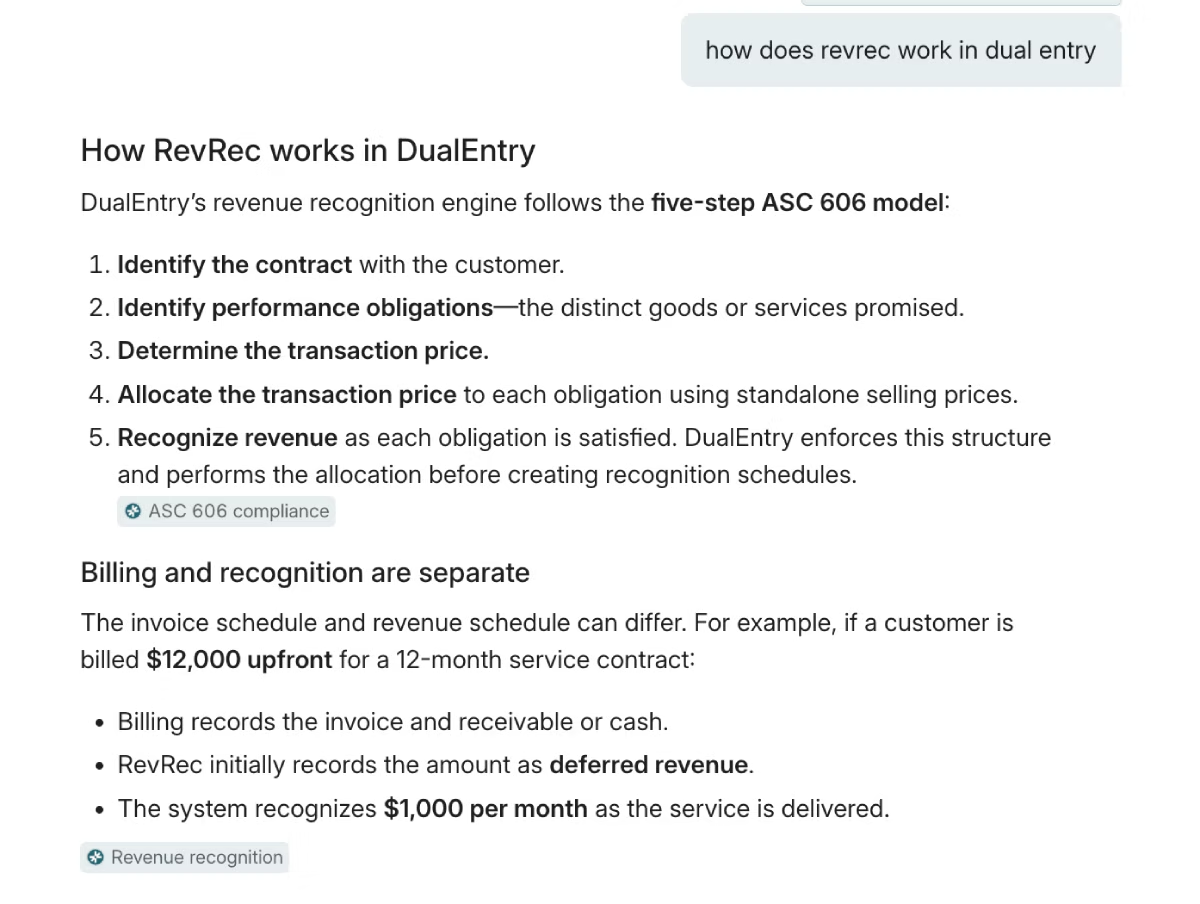
The docs, MCP server, and Accounting Intelligence are three ways to access the same body of content.
Readers can go directly to docs.dualentry.com, organized around the tasks finance teams need to complete. Outside the product, the MCP server gives editors and AI assistants access to the same information. Inside the product, the Accounting Intelligence answers questions in the context of your data and cites its sources.
Same content, accessed three different ways. Pick the one that fits your operating style.
Most vendors ship a docs site, a chatbot, and a help center from three different backlogs, so over time, the information starts to drift. Every feature we ship comes with a changelog you can rely on and a guidance doc that walks you through how to use it.
The Accounting Intelligence and MCP use that same updated content from the day the feature ships. If we change something on Tuesday, the answer is correct on Tuesday.
What this looks like at your desk
"How does this feature work?"
It’s a simple question, but one that can take far too long to answer. The old pattern was to search a vendor knowledge base, hope the page was current, and eventually open a support ticket if you still couldn’t find what you needed. Now you can ask the Accounting Intelligence inside the product, or your assistant outside it, and get the current answer from the latest documentation.
"How does tax work, and can I set it up in DualEntry?"
This is the kind of question that used to mean a call with sales engineering before you committed to anything, or a follow-up with customer success midway through implementation. Now you can work through it yourself. The docs explain the model, while the Accounting Intelligence can walk you through the configuration in your actual tenant, against your real chart of accounts. If the answer is "yes, here is how," you can move ahead. If the answer is "not cleanly for your specific case," you know that too, without spending days trying to find out.
"How do I connect DualEntry to the rest of my stack, like Ramp and Brex?"
Finance has run on a stack of systems for years. Spend, billing, and payroll all have to flow into the books. The integration docs include how-to guides that explain exactly how to connect them. A controller can enable a Ramp connection through the Accounting Intelligence without paging a developer, while an engineer can work with the same integration through the MCP server from their own editor.
What that gives you back
A controller who can answer a setup question without waiting on support can keep the close moving. A revenue recognition question that once required digging through documentation or waiting for help can now be answered on demand. And troubleshooting a posted journal no longer has to stall the close behind someone else’s queue.
The time you get back goes to the forecast, the board narrative, and the strategic questions the CEO is asking today. You spend less time hunting down answers and more time understanding what the numbers are telling you.
A smaller team can do different work because the system handles what doesn’t need a human and makes it easier to move through the work that still does.
Quality top to bottom
None of this works if the quality is inconsistent across the surfaces a customer touches. Every layer has to be right, from the general ledger up through the Accounting Intelligence that explains it. Otherwise, users don’t know which answer to trust and fall back to escalations and workarounds, which is exactly what we are trying to remove.
Docs ship with the feature, not three months later. That means the Accounting Intelligence can cite current sources, and external agents reading through the MCP get the same information. Auditors can rely on the changelog to understand what changed and when.
Try it
If you are an accountant who is going to live in the product, start here. Developers wiring DualEntry into the rest of your stack are one role-switch away in the nav.
When you are ready to see it running on your data, talk to our team and we will migrate your data live so that you can see a modern ERP in action.
Every surface ships to the same standard: the ledger, the revenue engine, the docs, the MCP server, and the Accounting Intelligence.
See the full power of DualEntry in 30 minutes
Andy Wagner is the Lead Technical Writer at DualEntry with experience in technical documentation, information architecture, and developer education. He previously spent two years as a technical writer and information architect at a machine learning startup in Princeton, NJ, where he built documentation systems from the ground up. He earned his PhD in English from UCLA. At DualEntry, Andy writes about product documentation, API references, integration guides, and implementation workflows for finance and engineering teams.