Don't worry! The contents here will appear on the published page.
DualEntry Software Vendor Scoreboard: Q3 2026

John Iwuozor
Content Lead, Finance and Research
John Iwuozor
Content Lead, Finance and Research
John Iwuozor leads content, finance, and research at DualEntry. He writes for the people who actually close the books: controllers running month-end, CFOs weighing an ERP migration, accountants buried in reconciliations. Before DualEntry he spent five years covering B2B SaaS and fintech for Forbes Advisor, Ramp, and Infosecurity Magazine. He builds every piece on primary data, including benchmarks, practitioner interviews, and product testing, rather than recycled advice. He is also an avid chess player.
Learn about our editorial policies.
Last updated
October 19, 2026
Reviewed by
Summarize this article

TL;DR
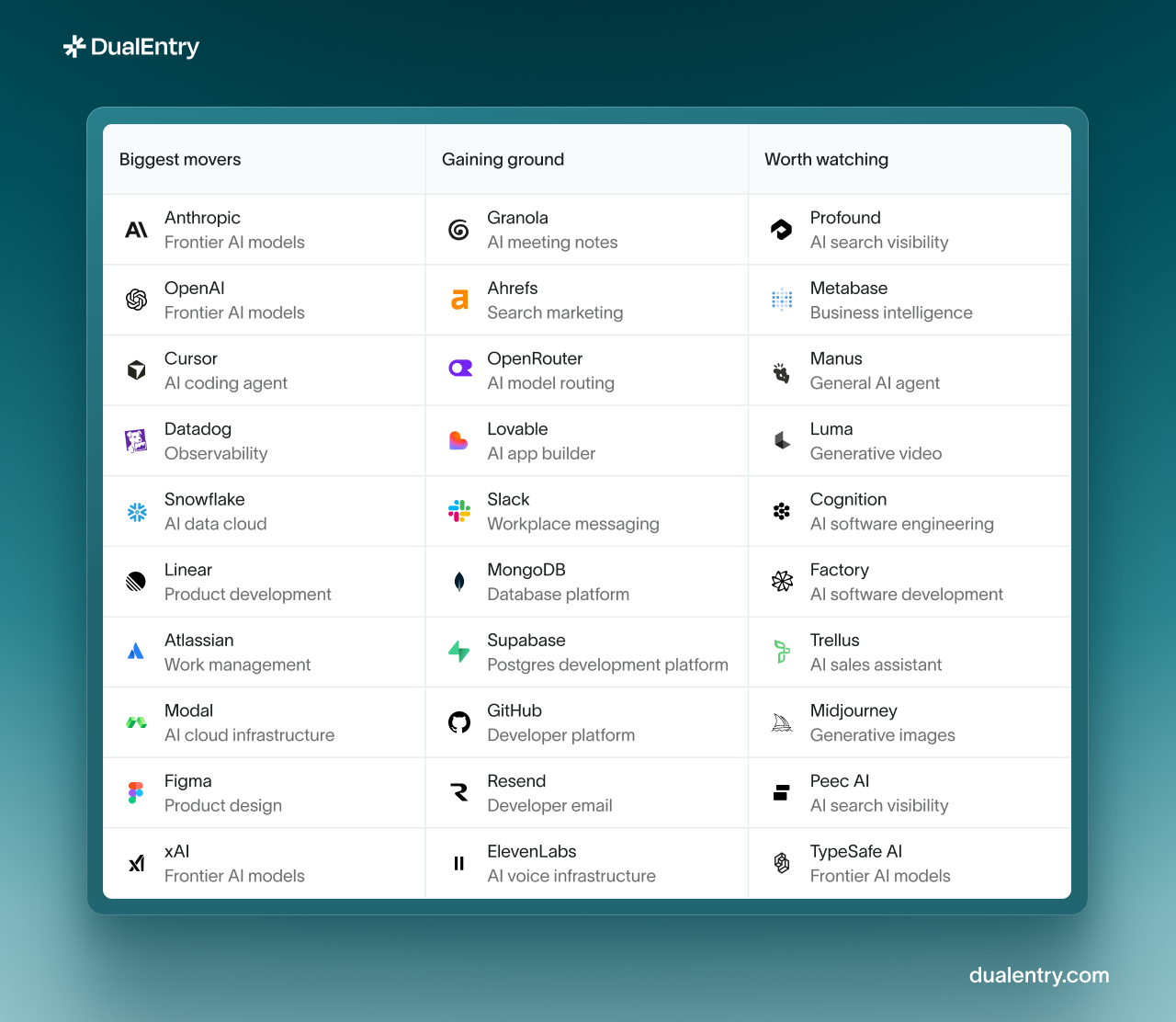
- Frontier models still led the biggest spend gains: Anthropic and OpenAI were the two biggest movers in our data, with xAI also making the top 10.
- AI coding is becoming a software category of its own: Cursor was one of the biggest movers, while Lovable, Cognition and Factory also showed up strongly.
- More spend is moving into AI infrastructure: OpenRouter more than doubled spend, while Modal, Snowflake and Datadog also stood out.
- Search has a new crop of challengers: Ahrefs gained ground, while Profound and Peec AI point to a growing market around AI visibility.
- AI applications are getting much more specialized: Granola, ElevenLabs, Luma, Manus and Trellus span everything from meetings and voice to video, agents and sales.
- Established software is still growing too: Linear, Atlassian, Figma, Slack, MongoDB and GitHub all gained alongside the newer AI-native tools.
AI has continued to take a bigger share of software spend in Q3, led by Anthropic and OpenAI. But the quarter also showed growth across coding tools, infrastructure, search software and more established SaaS platforms.
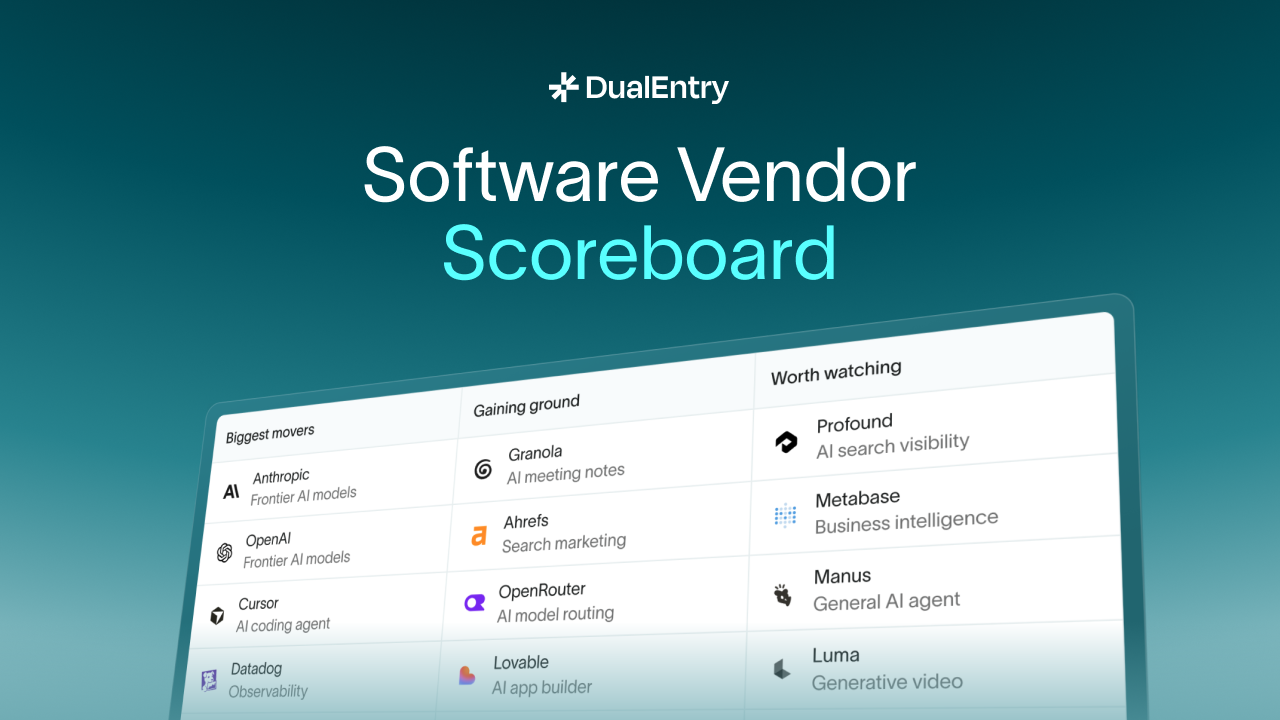
Biggest movers ranks vendors by absolute spend growth, Gaining ground by percentage growth from a meaningful Q2 base, and Worth watching highlights smaller vendors showing early traction, based on anonymized, aggregated transaction data from businesses using DualEntry.
What stood out in Q3 software spend?
The quarter showed AI spending spreading across more parts of the software stack, while established platforms continued to grow alongside it.
[tldr]
What's driving these shifts
1. Frontier model demand is still compounding
The biggest model providers are still scaling at an extraordinary rate. OpenAI’s annualized revenue reached nearly $50 billion in September, while Anthropic crossed $65 billion in July. That kind of growth suggests businesses are moving well beyond experimentation and putting sustained budget behind model usage, even as pricing gets more competitive.
2. AI coding spend is accelerating
The category is expanding beyond autocomplete into agents, app builders and more autonomous development workflows. Lovable raised $400 million at a $13.3 billion valuation in August 2026. Cognition followed in September 2026 with a $2 billion raise at a $48 billion valuation, while Factory also raised $200 million at a $5 billion valuation the same month, after saying its tools were already used by hundreds of thousands of developers.
3. More AI usage creates another layer of infrastructure spend
As companies use more models, they need more routing, compute, storage and observability around them. OpenRouter says weekly volume grew from 5 trillion to 25 trillion tokens in six months, across more than 400 models, and by August 2026, it was processing 10+ trillion tokens per day. There are more examples but this alone gives a sense of how quickly the infrastructure sitting between applications and model providers is becoming important in its own right.
4. Search has a new crop of challengers
Compared to other enterprise software, Profound and Peec AI represent a newer class of search software built around AI visibility. Profound says more than 2,500 brands, including a third of the Fortune 100, use its platform, and it raised $180 million at a $1.8 billion valuation in September 2026. That is a pretty strong signal that companies are starting to treat visibility inside AI-generated answers as a problem worth buying dedicated software for.
5. AI software is becoming much more specialized
The next wave of spending is spreading into narrower workflows. For example, Granola is built around meetings, ElevenLabs around voice, Luma around video, Manus around agents, and Trellus around sales. And most of these companies are scaling quickly too: Granola raised $125 million at a $1.5 billion valuation, ElevenLabs passed $500 million ARR, and Manus crossed $100 million ARR.
6. The existing software stack is adapting
Established vendors are increasingly absorbing AI into products businesses already use. Atlassian reported 28% year-over-year revenue growth and 31% cloud growth in its latest fiscal quarter, while Figma reported 48% year-over-year revenue growth and explicitly tied some of that momentum to expanded AI capabilities. So the shift is not simply “AI replacing SaaS”; incumbents are also growing by adding AI into existing workflows.
Why does this matter for finance teams?
Software spend is getting harder to manage as more vendors, narrower AI tools and usage-based pricing models enter the market.
For finance teams, that means watching where spend is accelerating, which tools are becoming material enough to show up in the P&L, and whether AI spend is being added on top of existing software costs rather than replacing them. If that pattern continues, it is a pretty bullish signal for software spend overall.
Methodology: This analysis draws on anonymized, aggregated transaction data from businesses using DualEntry across Q2 and Q3 2026. The findings reflect spending patterns within our dataset and should not be interpreted as estimates of overall market share.
See the full power of DualEntry in 30 minutes
John Iwuozor leads content, finance, and research at DualEntry. He writes for the people who actually close the books: controllers running month-end, CFOs weighing an ERP migration, accountants buried in reconciliations. Before DualEntry he spent five years covering B2B SaaS and fintech for Forbes Advisor, Ramp, and Infosecurity Magazine. He builds every piece on primary data, including benchmarks, practitioner interviews, and product testing, rather than recycled advice. He is also an avid chess player.